

The Israel-Gaza conflict has shocked the world in its brutality, but stock markets have remained largely unmoved by the scale of the tragedy unfolding before us.
There’s been no meltdown, no panic and no race to safe-haven assets, and right now that doesn’t look like changing either.
So, what does this say about investors? Are they really a hard-hearted bunch who only care about the bottom line?
Individual investors are, no doubt, just as concerned about the human and political nightmare as everybody else.
Taken as a whole, markets are not. It’s harsh, but that’s the reality. To them, it’s no big deal. Yet.
But it’s wrong to say that no markets were affected. While western stock markets in the US, UK and Europe quickly recovered their exposure, local markets were deeply affected, says Kathleen Brooks, founder of Minerva Analysis, a market analysis company.
“There were significant declines in Israel, Palestine, Turkey, Qatar, the UAE, and Saudi Arabia in the immediate aftermath of the attacks,” she adds.
The oil price rose, too, with Brent crude jumping by 3.5 per cent to just more than $88 per barrel.
“The Middle East accounts for just under a third of global oil production. A war in the region can increase the risk of a major interruption to the oil supply,” Ms Brooks says.
Yet, it’s still well below this year’s intraday peak of $97.04 a barrel, which it hit on September 27 as low US crude inventories increased supply fears.
However, traditional safe-haven asset classes such as US Treasuries, the US dollar, Japanese yen and Swiss franc have only moved slightly. Defence stocks did pick up, though.
The gold price jumped by 3 per cent, to around $1,889 an ounce from $1,833, but that was driven more by a dip in the US dollar and falling yields on Treasuries, than the war. It is down 2 per cent over the last month.
The startling truth is that investors are far more worried about the direction of inflation and interest rates than what Israel will do next.
As Jeremy Batstone-Carr, European strategist at Raymond James, puts it: “Trading does not feel like becoming disorderly even as the threat of escalated tensions prevails. Financial markets are, sadly, all-too used to crises in the Middle East.”
Geopolitical events can have a major impact on markets, says Jason Hollands, managing director of wealth advisers Evelyn Partners.
“Most notably, the Arab-Israeli conflict in the mid-70s triggered an inflationary surge as the Arab states embargoed oil exports to the US in retaliation for their support of Israel,” he adds.
Yet, war never happens in a vacuum and that was true then, too, as the 1973 oil crisis took place at a time when inflation was already a problem, according to Mr Hollands.
The S&P 500 plunged almost 15 per cent in the week after the September 11 terror attacks in 2001, while oil and gold rallied.
Yet within a week, the oil price had retreated to pre-attack levels as no further attacks followed and crude oil shipments to the US were uninterrupted.
By the middle of October, markets had recovered nearly all their losses.
Global stock markets fell 10 per cent when Russia invaded Ukraine last year, triggering an energy price shock and a cost-of-living crisis, and the S&P 500 index ended the year crashing almost 20 per cent.
Once again, other factors had a bigger impact on markets, Mr Hollands says.
“The origins of the inflationary surge ultimately lay with an excessive increase in money supply by central banks and supply chain bottlenecks caused by pandemic lockdowns,” he adds.
Despite hundreds of thousands of deaths and no conclusion in sight, the war in Ukraine seems contained and markets have moved on.
The Israel-Hamas conflict has had little impact on oil production, but one thing could shake markets out of their complacency, Mr Hollands says.
“If other regional actors became directly embroiled, this would trigger a much sharper reaction because of the threat to energy supplies if, say, Iran attempted to close the Straits of Hormuz,” he explains.
Samy Chaar, chief economist at Swiss private bank Lombard Odier, says the Gulf Co-operation Council region has suffered less than investors might expect.
“While it is fuelling some concerns over the region’s outlook, we see the GCC countries ultimately striving to avoid regional escalation and maintaining current oil output behaviour,” he adds.
Mr Chaar says the GCC’s long-term development plans rest on avoiding “geopolitical conflagration”.
It is unwilling to allow the oil price to spike higher as this would accelerate global electrification trends.
“The unpredictable nature and scale of the conflict will, however, require close monitoring,” he adds.
Israel-Gaza war – in pictures
-
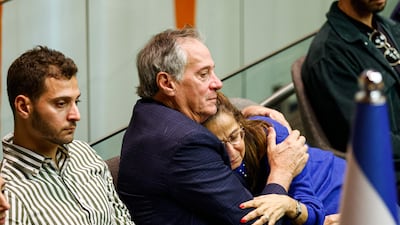
At UN headquarters in New York City, Rachel Zeitchik, right, and Jay Zeitchik attend an event for families of Israelis kidnapped by Hamas. AFP -
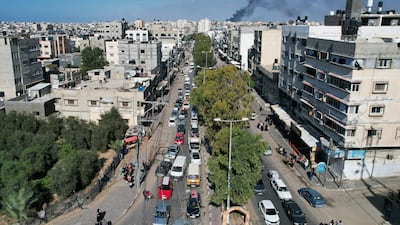
Palestinians flee from northern Gaza towards the south after the Israeli army demanded the population of more than a million people leave before a ground invasion. AP -

Demonstrators at a rally in support of Palestine face a counter-demonstration in support of Israel near Times Square in New York. EPA -
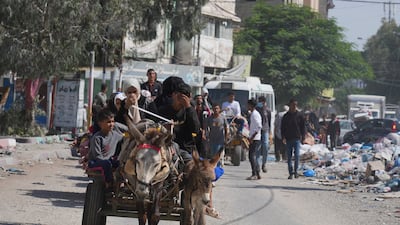
Palestinians flee from northern Gaza to the south after the Israeli army issued an evacuation warning. AP -

An injured man is rescued from the rubble of a building following an Israeli airstrike in Rafah, Gaza Strip. AP -

Mourners take cover as sirens sound during the funeral of Tom Godo, killed during the attack by Hamas militants on the Kibbutz Kisuffim last week, in Kibbutz Naan near Tel Aviv. AFP -
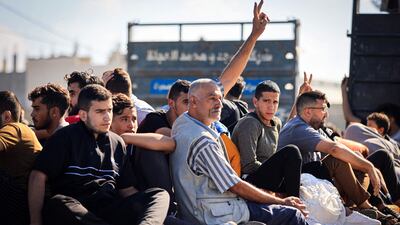
A Palestinian man flashes the victory sign as he and others leave northern Gaza before an expected Israeli ground offensive. AFP -
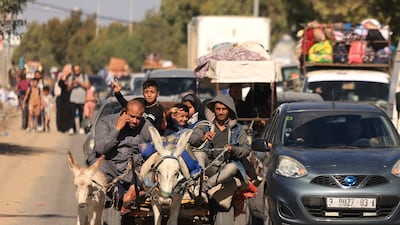
Palestinians head south with their belongings after being ordered by Israel to leave northern Gaza on Friday. AFP -

Israel ordered more than a million Palestinians to head south within 24 hours. Reuters -

The UN criticised the directive, saying forcing such a large number of people to flee en masse would be catastrophic. Reuters -

Gazans have to travel about 15km if they live in the northernmost part of the strip to reach the area south of the Wadi Gaza. Reuters -

The UN said that more than 423,000 people have already fled their homes in the territory, with a sizeable number making the more than 10km journey on foot. Reuters -
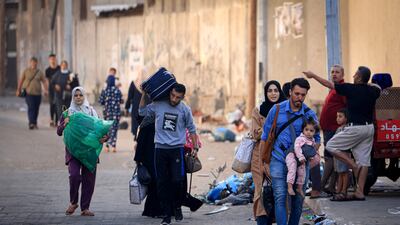
Palestinians with their belongings flee to safer areas in Gaza City. AFP -

An Armoured Personnel Carrier drives near Israel's border with the Gaza Strip. Reuters -
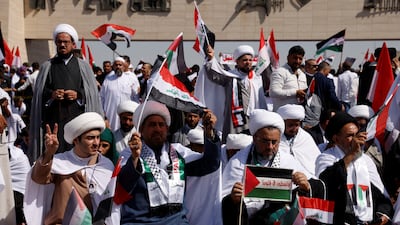
Supporters of Iraqi Shi'ite cleric Moqtada al-Sadr gather for mass Friday prayer during a protest in solidarity with Palestinians in Gaza, in Baghdad, Iraq. Reuters -
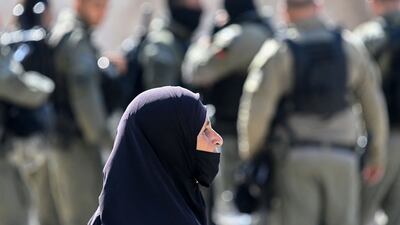
A Palestinian woman waits to cross into Jerusalem's Old City through Damascus Gate next to Israeli soldiers. AFP -
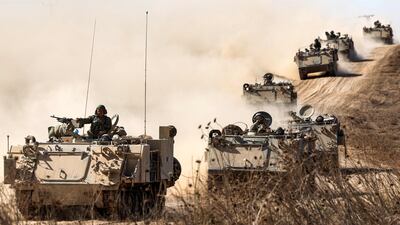
Israeli army infantry fighting vehicles deploy along the border with the Gaza Strip in southern Israel. AFP -
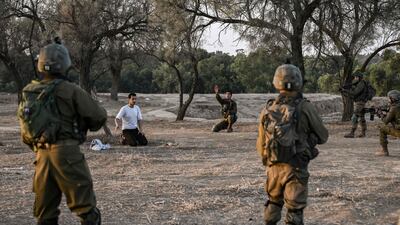
Israeli soldiers detain a man while on patrol near Kibbutz Beeri, near the Gaza Strip. AFP -

Students hold in a rally in support of Palestine at Columbia University in New York. Getty Images -

Family and friends mourn Valentin Ghnassia, 23, who was killed in a battle with Palestinian militants at Kibbutz Beeri near the Israeli border with the Gaza Strip. Getty Images -
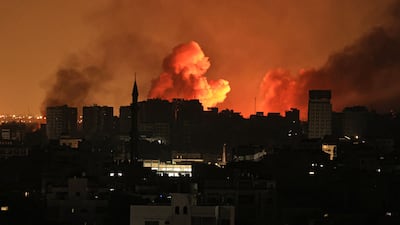
A ball of fire erupts in Gaza city after an Israeli air strike. AFP -
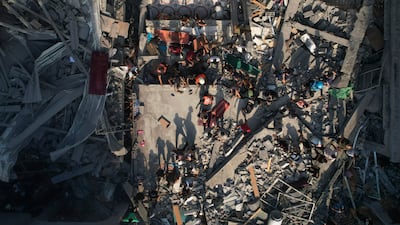
Palestinians inspect the rubble of buildings hit by an Israeli air strike at Al Shati refugee camp. AP -
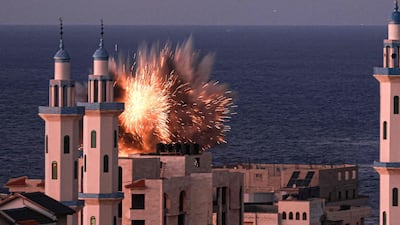
A fireball erupts from an Israeli air strike in Gaza city. AFP -

People waiting for news of victims outside the morgue at Al-Shifa hospital in Gaza City. AFP -
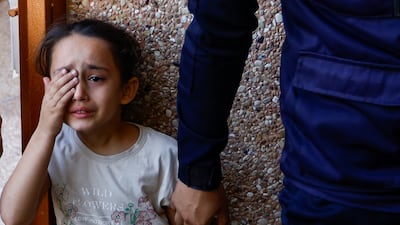
A girl mourns the death of members of the Samour family, who were killed in Israeli strikes on their house in Khan Younis in the southern Gaza Strip. Reuters -
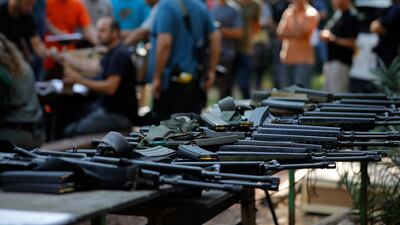
Israelis arrive to sign up at a weapons distribution point for people allowed to carry arms, at the Ayyelet HaShahar Kibbutz in northern Israel, near the Lebanese border. AFP -
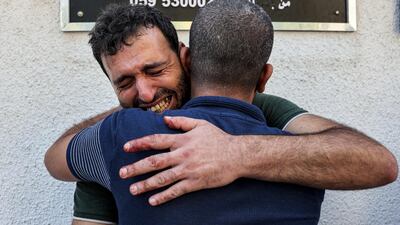
Mourners outside the morgue at Al-Shifa hospital in Gaza City as battles between Israel and the Hamas movement continue for a sixth consecutive day. AFP -

Men dig graves to bury members of the Samour family, who were killed in Israeli strikes on their house in Khan Younis. Reuters -

Palestinian children who fled their homes during Israeli strikes, play at a United Nations-run school in Gaza City. Reuters -
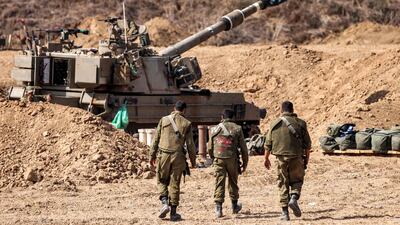
Israeli soldiers near a self-propelled howitzer near the border with Gaza in southern Israel. AFP -

Israel's Foreign Minister Eli Cohen, left, welcomes US Secretary of State Antony Blinken upon arrival at Israel's Ben Gurion Airport. AFP -

Palestinian children in a makeshift shelter at Al-Shifa hospital in Gaza City. Reuters -
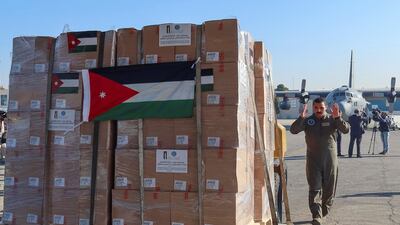
Boxes of humanitarian aid and supplies from Jordan Hashemite Charity Organisation destined for Gaza, in Amman, Jordan. Reuters -
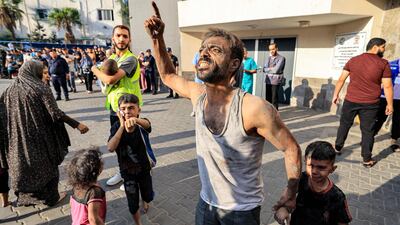
Palestinians outside Al-Shifa hospital in Gaza City on the sixth day of fighting between Israel and Hamas. AFP -
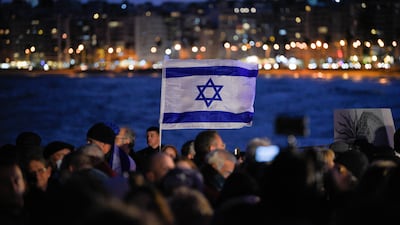
A pro-Israel vigil in Montevideo, Uruguay. EPA


Graphic images of the Israel-Hamas conflict may be dominating the headlines in the most horrific way imaginable, but what markets remain focused on are the same grey men in suits. Namely, central bankers led by the US Federal Reserve and yes, they are still mostly men.
What markets really want to know is whether they have finished hiking interest rates, and how soon they will start cutting them instead.
For them, this is a far more vital issue than how Israel exacts revenge in Gaza.
If the Fed pushes too hard, it could trigger bank collapses and a global recession, while a successful outcome would be to engineer an economic soft landing.
The Israel-Hamas conflict scarcely comes into that calculation, except in how it affects the oil price.
For now, investors are refusing to worry, says Sabin Hathorn, senior market analyst at Capital.com.
“Markets are assigning little chance that this conflict will become entrenched and the effects will be limited geographically,” he adds.
A 1970s-style oil price surge would change all that, but seems unlikely at this stage. Even that may not have the same impact, as the world is a lot less dependent on oil than it was 50 years ago.
What’s happening in Gaza is a human tragedy, rather than a financial one. Perhaps in that respect, markets have struck the right response after all.

