
Predicting where inflation goes next is not easy, but the International Monetary Fund has stuck its neck out and forecast that it is soon going to fall sharply, plunging investors into a very different world from today.
The world’s ageing population and low productivity will tame consumer price growth, and return interest rates to pre-coronavirus levels, according to IMF economists Jean-Marc Natal and Philip Barrett.
Almost immediately afterwards, the latest US inflation figures landed, suggesting the downwards shift has already begun.
The US consumer price index rose by only 0.1 per cent in March and 5 per cent over the year. That is a two-year low and down from 6 per cent in February.
US stock markets quickly rallied, as investors anticipated this could allow the US Federal Reserve to slow interest rates increases and even start cutting them by the end of the year.
Watch: US Federal Reserve raises interest rates a quarter point amid banking turmoil
However, there was a sting in the tail as core inflation, which excludes food and energy, rose slightly to 5.6 per cent in March.
Markets have become addicted to analysing every piece of data as they await signs of the Fed interest rate “pivot”, and seized on weak US manufacturing figures and a rise in jobless claims to climb again, says Chris Beauchamp, chief market analyst at trading platform IG.
“The market hopes more bad news will tilt the Fed further towards a pause on rate increases.”
Markets might even welcome a poor US company earnings season, as long as there isn’t too much bad news, Mr Beauchamp says.
Inflation will inevitably fall due to the baseline effect, which will result in last year's significant monthly increases falling out of the annual figures, says Fawad Razaqzada, market analyst at City Index and Forex.com.
“Unless there's a major setback, we will get a lot closer to the Fed’s 2 per cent target, especially if the economic output falls more significantly than expected.”
Inflation and interest rates could fall further than people realise and investors need to be ready for it, says Laith Khalaf, head of investment analysis at AJ Bell.
“US interest rates could have started falling by the end of this year, possibly by 0.5 per cent. The latest Bank of England report suggests inflation will fall to 1 per cent in 2025, and just 0.4 per cent in 2026.”
This will be good for share prices and make debt more manageable, Mr Khalaf says.
“It would be especially good for growth stocks with more distant earnings streams. This sector has sold off most heavily as rising interest rates reduced the value of future cash flows in real terms.”
This might even trigger a recovery in the embattled US technology sector, although that could take time, given the widespread job cuts in the sector.
Many investors may already have plenty of exposure to technology and growth stocks after the long bull run of the past decade or so, Mr Khalaf says.
“Don’t go all in on growth but retain a balance with value strategies, in case inflation proves sticky and interest rates stay high.”
Those who want exposure to growth stocks might consider an exchange-traded fund such as the iShares Core S&P US Growth ETF, balanced with the iShares MSCI EAFE Growth ETF, which focuses on growth stocks in developed markets beyond the US and Canada.
Those happy to take on added risk could try Cathie Wood’s Ark Innovation ETF that invests in “disruptive innovation” across the biotechnology, automotive, energy, technology and finance sectors.
The fund was a darling of investors during the boom but has crashed 39.17 per cent in the 12 months to March 31.
Top holdings include Tesla, Zoom, digital media player Roku and cryptocurrency platform Coinbase, underlining its high-risk profile. Alternatively, tech investors could try the Invesco Nasdaq 100 ETF.
Lower interest rates will ease the cost-of-living crisis and allow consumers to spend more freely.
Bullish investors could take advantage of that trend with the Vanguard Consumer Discretionary ETF, Invesco Dynamic Leisure and Entertainment ETF or US Global Jets ETF, which provides exposure to the global airline industry.
Inflation around the world — in pictures
-

People queue to buy wheat flour at government-controlled prices in Islamabad. Pakistan's economy has been hit hard by a political crisis, as well as devastating floods and the global energy crisis, with the rupee plummeting and inflation at decades-high levels. AFP -

A market in Rio de Janeiro. Brazil's inflation ended 2022 with a sharp slowdown from double-digit peaks seen throughout the year. Reuters -

A market in Istanbul. Turkey's inflation at the end of 2022 stood at 64. 27 per cent, the country's Statistical Institute said, while the independent group of inflation researchers ENAG calculated it at 137. 55 per cent. EPA -

A Walmart in New Jersey. According to a poll, US Republicans and Democrats have distinct views of what’s most important for the government to address amid high inflation. More Republicans name gas and food prices, energy and immigration, while Democrats focus on health care, climate change and poverty. AP -

A used car sales lot in California. US Federal Reserve officials have indicated it’s possibly too early to declare victory over inflation. AFP -

A person walks by a sign showing interest rates at a bank in New York. EPA -
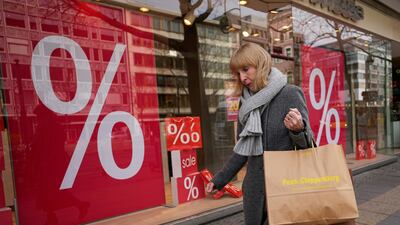
A woman walks with purchases past a store in Berlin. In December, consumer price growth across the Euro zone slowed to 9.2 per cent from 10.1 per cent a month earlier, Eurostat data showed last week. AP -
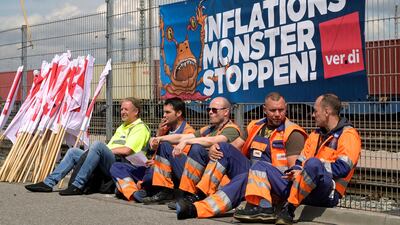
Workers sit in front of a banner reading "Stop the Inflation Monster" at the Burchardkai Container Terminal as they go on strike for higher wages at the harbour in Hamburg, Germany. Reuters -

Price tags at a market in Nice, France. Reuters -

Commuters cross Waterloo Bridge in London. The British Retail Consortium said spending in store chains rose by 6.9 per cent in annual terms in December, but this was a long way off consumer price inflation, which hit 10.7 per cent in November. Reuters -

Jobseekers in Johannesburg. South Africa’s governing party wants the central bank’s mandate broadened to shore up the economy and promote employment in addition to its existing task of tackling inflation. Reuters -

Social grant recipients stand in a queue outside a post office, as joblessness takes its toll in Meadowlands, South Africa. Reuters


Bonds also stand to prosper when interest rates fall, in a reversal of their recent poor fortunes, Mr Khalaf says.
Bonds pay a fixed rate of interest, which should prove more attractive when inflation and interest rates are on the way down again, while prices should rise and give investors a capital boost.
The iShares US Treasury Bond ETF, iShares iBoxx $ Investment Grade Corporate Bond ETF and SPDR Bloomberg High Yield Bond ETF could be a way to play this trend.
Lower bond yields would also increase demand for gold, a rival safe haven that does not pay any interest, which looks more attractive when yields are falling elsewhere. The SPDR Gold Shares is a popular ETF.
Commercial property and infrastructure could also pick up when conditions ease, Mr Khalaf said.
Options here include the Vanguard Real Estate ETF and the Xtrackers International Real Estate ETF. The SPDR S&P Global Infrastructure ETF or iShares Global Infrastructure ETF would also benefit.
Lower interest rates could also ease the pressure on the property market, boosting house-building stocks, and the SPDR S&P Homebuilders ETF or iShares US Home Construction ETF could work well here.
managing director at fund platform Bestinvest.com
Tech stocks have the greatest sensitivity to interest rates and are starting to recover as the Fed pivot nears, says Jason Hollands, managing director at fund platform Bestinvest.com.
The Nasdaq composite crashed by a third last year, but is up by about 17 per cent so far in 2023, against 8 per cent on the wider S&P 500, and that is mostly down to technology stocks, Mr Hollands notes.
“Another sign of exuberance in mega-cap tech is that the NYSE Fang+ Index is up 32 per cent since the start of the year.”
Yet he also urges caution.
“While an end to the hiking cycle is in sight, we also face a mild recession towards the end of the year and I would urge investors to remain cautious about tech, where valuations are still quite demanding.”
While markets are quick to celebrate an end to rate increases, they are too relaxed about a possible deterioration in company earnings.
“The tech sector would be especially vulnerable if things do not play out as expected and interest rates stay elevated for longer in the face of sticky core inflation,” Mr Hollands says.
A combination of falling interest rates and a recession would also hit the banking sector, as it would squeeze net interest margins, the difference between what they pay savers and charge borrowers.
The outlook may be a little brighter but there is still plenty of risk out there, Mr Hollands says. “I wouldn’t abandon more defensive sectors such as consumer staples, health care and utilities just yet.”

