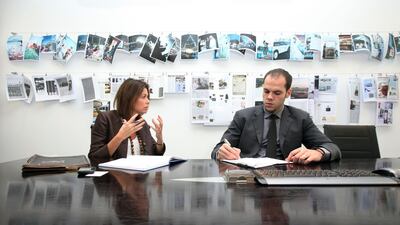
About 89 per cent of professionals across the Middle East and North Africa region plan to do more freelance work in 2023, as demand surges for their services and employers seek cost-effective ways to deliver projects within tight deadlines, according to a survey by jobs portal Bayt.com.
The biggest motivations for taking up freelance work include earning extra income, exploring more career opportunities and learning new skills, Bayt.com said.
The survey, conducted from December 4 to January 6, polled 2,375 professionals and employers from 18 Mena countries, including the UAE, Saudi Arabia, Kuwait, Oman, Lebanon, Jordan and Egypt.
Freelance jobs - in pictures
“Freelancers are one of the fastest-growing segments in the Middle East market and this has been boosted by the pandemic,” said Ola Haddad, director of human resources at Bayt.com.
Since the Covid-19 outbreak, employees around the world have been leaving their jobs at much higher rates than normal, in what has been called The Great Resignation.
This comes as they seek a better work-life balance and more flexibility with their jobs, with many turning hobbies into viable career options as freelancers or small business owners.
Demand for freelance workers has also surged as technology continues to advance and employers become more adaptable to remote working.
The fastest-growing industries for Mena freelancers in 2023 include digital marketing, information technology, customer service and graphic design, the Bayt.com survey found.
Employers in the region believe there are multiple benefits to hiring freelancers, with 44 per cent of respondents to the survey saying they are better at delivering within tight deadlines.
Twenty per cent of those polled said freelancers are a good option for contingency planning between hires, 18 per cent said they are a cost-effective option and 17 per cent believe they provide extra help for small teams and departments, the survey found.
Meanwhile, 36 per cent of respondents said time management was a top skill required by freelancers, 24 per cent said good communication was needed and 12 per cent cited leadership experience.
Watch: The stats behind the UAE's hiring boom
“Eighty-six per cent revealed that their company is planning to hire freelancers in 2023 and 78 per cent say that their company offered a full-time job to the freelancer after completing a project,” Bayt.com said.
“Respondents usually search for freelance jobs on online job sites and professional platforms, social media, companies’ websites and personal networks.”
However, there are a number of challenges associated with freelancing, including a lack of job security, less pay than full-time jobs, lack of extra benefits and fewer chances of receiving a promotion, it added.

From Zero
Artist: Linkin Park
Label: Warner Records
Number of tracks: 11
Rating: 4/5
Results
2pm: Maiden (PA) Dh 40,000 (Dirt) 1,200m, Winner: AF Thayer, Tadhg O’Shea (jockey), Ernst Oertel (trainer).
2.30pm: Maiden (PA) Dh 40,000 (D) 1,200m, Winner: AF Sahwa, Nathan Crosse, Mohamed Ramadan.
3pm: Handicap (PA) Dh 40,000 (D) 1,000m, Winner: AF Thobor, Szczepan Mazur, Ernst Oertel.
3.30pm: Handicap (PA) Dh 40,000 (D) 2,000m, Winner: AF Mezmar, Szczepan Mazur, Ernst Oertel.
4pm: Sheikh Hamdan bin Rashid Al Maktoum Cup presented by Longines (TB) Dh 200,000 (D) 1,700m, Winner: Galvanize, Nathan Cross, Doug Watson.
4.30pm: Handicap (PA) Dh 40,000 (D) 1,700m, Winner: Ajaj, Bernardo Pinheiro, Mohamed Daggash.
Brahmastra%3A%20Part%20One%20-%20Shiva
%3Cp%3E%3Cstrong%3EDirector%3A%20%3C%2Fstrong%3EAyan%20Mukerji%3C%2Fp%3E%0A%3Cp%3E%3Cstrong%3EStars%3A%20%3C%2Fstrong%3ERanbir%20Kapoor%2C%20Alia%20Bhatt%20and%20Amitabh%20Bachchan%3C%2Fp%3E%0A%3Cp%3E%3Cstrong%3ERating%3A%3C%2Fstrong%3E%202%2F5%3C%2Fp%3E%0A
THE BIO
Born: Mukalla, Yemen, 1979
Education: UAE University, Al Ain
Family: Married with two daughters: Asayel, 7, and Sara, 6
Favourite piece of music: Horse Dance by Naseer Shamma
Favourite book: Science and geology
Favourite place to travel to: Washington DC
Best advice you’ve ever been given: If you have a dream, you have to believe it, then you will see it.
Stamp duty timeline
December 2014: Former UK finance minister George Osbourne reforms stamp duty, replacing the slab system with a blended rate scheme, with the top rate increasing to 12 per cent from 10 per cent:
Up to £125,000 - 0%; £125,000 to £250,000 – 2%; £250,000 to £925,000 – 5%; £925,000 to £1.5m: 10%; Over £1.5m – 12%
April 2016: New 3% surcharge applied to any buy-to-let properties or additional homes purchased.
July 2020: Rishi Sunak unveils SDLT holiday, with no tax to pay on the first £500,000, with buyers saving up to £15,000.
March 2021: Mr Sunak decides the fate of SDLT holiday at his March 3 budget, with expectations he will extend the perk unti June.
April 2021: 2% SDLT surcharge added to property transactions made by overseas buyers.
Jetour T1 specs
Engine: 2-litre turbocharged
Power: 254hp
Torque: 390Nm
Price: From Dh126,000
Available: Now
Killing of Qassem Suleimani
More from Neighbourhood Watch:
Ten tax points to be aware of in 2026
1. Domestic VAT refund amendments: request your refund within five years
If a business does not apply for the refund on time, they lose their credit.
2. E-invoicing in the UAE
Businesses should continue preparing for the implementation of e-invoicing in the UAE, with 2026 a preparation and transition period ahead of phased mandatory adoption.
3. More tax audits
Tax authorities are increasingly using data already available across multiple filings to identify audit risks.
4. More beneficial VAT and excise tax penalty regime
Tax disputes are expected to become more frequent and more structured, with clearer administrative objection and appeal processes. The UAE has adopted a new penalty regime for VAT and excise disputes, which now mirrors the penalty regime for corporate tax.
5. Greater emphasis on statutory audit
There is a greater need for the accuracy of financial statements. The International Financial Reporting Standards standards need to be strictly adhered to and, as a result, the quality of the audits will need to increase.
6. Further transfer pricing enforcement
Transfer pricing enforcement, which refers to the practice of establishing prices for internal transactions between related entities, is expected to broaden in scope. The UAE will shortly open the possibility to negotiate advance pricing agreements, or essentially rulings for transfer pricing purposes.
7. Limited time periods for audits
Recent amendments also introduce a default five-year limitation period for tax audits and assessments, subject to specific statutory exceptions. While the standard audit and assessment period is five years, this may be extended to up to 15 years in cases involving fraud or tax evasion.
8. Pillar 2 implementation
Many multinational groups will begin to feel the practical effect of the Domestic Minimum Top-Up Tax (DMTT), the UAE's implementation of the OECD’s global minimum tax under Pillar 2. While the rules apply for financial years starting on or after January 1, 2025, it is 2026 that marks the transition to an operational phase.
9. Reduced compliance obligations for imported goods and services
Businesses that apply the reverse-charge mechanism for VAT purposes in the UAE may benefit from reduced compliance obligations.
10. Substance and CbC reporting focus
Tax authorities are expected to continue strengthening the enforcement of economic substance and Country-by-Country (CbC) reporting frameworks. In the UAE, these regimes are increasingly being used as risk-assessment tools, providing tax authorities with a comprehensive view of multinational groups’ global footprints and enabling them to assess whether profits are aligned with real economic activity.
Contributed by Thomas Vanhee and Hend Rashwan, Aurifer
Six large-scale objects on show
- Concrete wall and windows from the now demolished Robin Hood Gardens housing estate in Poplar
- The 17th Century Agra Colonnade, from the bathhouse of the fort of Agra in India
- A stagecloth for The Ballet Russes that is 10m high – the largest Picasso in the world
- Frank Lloyd Wright’s 1930s Kaufmann Office
- A full-scale Frankfurt Kitchen designed by Margarete Schütte-Lihotzky, which transformed kitchen design in the 20th century
- Torrijos Palace dome
Farage on Muslim Brotherhood
Nigel Farage told Reform's annual conference that the party will proscribe the Muslim Brotherhood if he becomes Prime Minister.
"We will stop dangerous organisations with links to terrorism operating in our country," he said. "Quite why we've been so gutless about this – both Labour and Conservative – I don't know.
“All across the Middle East, countries have banned and proscribed the Muslim Brotherhood as a dangerous organisation. We will do the very same.”
It is 10 years since a ground-breaking report into the Muslim Brotherhood by Sir John Jenkins.
Among the former diplomat's findings was an assessment that “the use of extreme violence in the pursuit of the perfect Islamic society” has “never been institutionally disowned” by the movement.
The prime minister at the time, David Cameron, who commissioned the report, said membership or association with the Muslim Brotherhood was a "possible indicator of extremism" but it would not be banned.
MATCH INFO
Champions League quarter-final, first leg
Ajax v Juventus, Wednesday, 11pm (UAE)
Match on BeIN Sports
The%20specs
%3Cp%3E%3Cstrong%3EEngine%3A%20%3C%2Fstrong%3ESingle%20front-axle%20electric%20motor%3Cbr%3E%3Cstrong%3EPower%3A%20%3C%2Fstrong%3E218hp%3Cbr%3E%3Cstrong%3ETorque%3A%20%3C%2Fstrong%3E330Nm%3Cbr%3E%3Cstrong%3ETransmission%3A%20%3C%2Fstrong%3ESingle-speed%20automatic%3Cbr%3E%3Cstrong%3EMax%20touring%20range%3A%20%3C%2Fstrong%3E402km%20(claimed)%3Cbr%3E%3Cstrong%3EPrice%3A%20%3C%2Fstrong%3EFrom%20Dh215%2C000%20(estimate)%3Cbr%3E%3Cstrong%3EOn%20sale%3A%20%3C%2Fstrong%3ESeptember%3C%2Fp%3E%0A
Poacher
%3Cp%3E%3Cstrong%3EDirector%3A%20%3C%2Fstrong%3ERichie%20Mehta%26nbsp%3B%3C%2Fp%3E%0A%3Cp%3E%3Cstrong%3EStarring%3A%3C%2Fstrong%3E%20Nimisha%20Sajayan%2C%20Roshan%20Mathew%2C%20Dibyendu%20Bhattacharya%3C%2Fp%3E%0A%3Cp%3E%3Cstrong%3ERating%3A%20%3C%2Fstrong%3E3%2F5%3C%2Fp%3E%0A
Moral education needed in a 'rapidly changing world'
Moral education lessons for young people is needed in a rapidly changing world, the head of the programme said.
Alanood Al Kaabi, head of programmes at the Education Affairs Office of the Crown Price Court - Abu Dhabi, said: "The Crown Price Court is fully behind this initiative and have already seen the curriculum succeed in empowering young people and providing them with the necessary tools to succeed in building the future of the nation at all levels.
"Moral education touches on every aspect and subject that children engage in.
"It is not just limited to science or maths but it is involved in all subjects and it is helping children to adapt to integral moral practises.
"The moral education programme has been designed to develop children holistically in a world being rapidly transformed by technology and globalisation."
Mercer, the investment consulting arm of US services company Marsh & McLennan, expects its wealth division to at least double its assets under management (AUM) in the Middle East as wealth in the region continues to grow despite economic headwinds, a company official said.
Mercer Wealth, which globally has $160 billion in AUM, plans to boost its AUM in the region to $2-$3bn in the next 2-3 years from the present $1bn, said Yasir AbuShaban, a Dubai-based principal with Mercer Wealth.
“Within the next two to three years, we are looking at reaching $2 to $3 billion as a conservative estimate and we do see an opportunity to do so,” said Mr AbuShaban.
Mercer does not directly make investments, but allocates clients’ money they have discretion to, to professional asset managers. They also provide advice to clients.
“We have buying power. We can negotiate on their (client’s) behalf with asset managers to provide them lower fees than they otherwise would have to get on their own,” he added.
Mercer Wealth’s clients include sovereign wealth funds, family offices, and insurance companies among others.
From its office in Dubai, Mercer also looks after Africa, India and Turkey, where they also see opportunity for growth.
Wealth creation in Middle East and Africa (MEA) grew 8.5 per cent to $8.1 trillion last year from $7.5tn in 2015, higher than last year’s global average of 6 per cent and the second-highest growth in a region after Asia-Pacific which grew 9.9 per cent, according to consultancy Boston Consulting Group (BCG). In the region, where wealth grew just 1.9 per cent in 2015 compared with 2014, a pickup in oil prices has helped in wealth generation.
BCG is forecasting MEA wealth will rise to $12tn by 2021, growing at an annual average of 8 per cent.
Drivers of wealth generation in the region will be split evenly between new wealth creation and growth of performance of existing assets, according to BCG.
Another general trend in the region is clients’ looking for a comprehensive approach to investing, according to Mr AbuShaban.
“Institutional investors or some of the families are seeing a slowdown in the available capital they have to invest and in that sense they are looking at optimizing the way they manage their portfolios and making sure they are not investing haphazardly and different parts of their investment are working together,” said Mr AbuShaban.
Some clients also have a higher appetite for risk, given the low interest-rate environment that does not provide enough yield for some institutional investors. These clients are keen to invest in illiquid assets, such as private equity and infrastructure.
“What we have seen is a desire for higher returns in what has been a low-return environment specifically in various fixed income or bonds,” he said.
“In this environment, we have seen a de facto increase in the risk that clients are taking in things like illiquid investments, private equity investments, infrastructure and private debt, those kind of investments were higher illiquidity results in incrementally higher returns.”
The Abu Dhabi Investment Authority, one of the largest sovereign wealth funds, said in its 2016 report that has gradually increased its exposure in direct private equity and private credit transactions, mainly in Asian markets and especially in China and India. The authority’s private equity department focused on structured equities owing to “their defensive characteristics.”