



The search for affordable housing in the US is becoming critical as rents soar and home ownership becomes more of a distant dream than a reality for millions of people.
With inflation continuing to pinch and a shortage of available houses, younger Americans are looking for alternatives to traditional accommodation, from sleeping in bunks, to “tiny homes”, to ad hoc dwellings erected on a larger property.
Perhaps the most vivid illustration of America’s housing crisis is the growing popularity of “pods” — small rooms often furnished with only a bed — in expensive areas such as Palo Alto, one of the main cities of California's Silicon Valley.
Pods owned by Brownstone Shared Housing are 2.4 metres tall and include a bed, foldaway desk and a charger for electric gadgets, with access to a communal area that has other facilities including a bathroom and kitchen.
The cost? About $500 a month.
Christina Lennox, one of the company’s founders, says the idea came from her own experience of trying to find somewhere to live.
“I moved out to California from Arizona to attend a church leadership college,” Ms Lennox says. “We received housing. After college ended, I was on my own and was going to go homeless.
“Palo Alto is one of the most expensive places to live in the world. The rents are more than double we are charging, even for a studio.”

Ms Lennox points to the difficulties faced by people moving to the area to work for local businesses. Pod tenants are chosen in part for their compatibility rather than the size of their wallets, she says.
“The category they fall into is young professionals, 20s to mid-30s. We have culinary interns, a Tesla employee, we had a poet, Stanford researchers and teachers.”
As Ms Lennox stretches out on one of the pods, she says it is far more comfortable than a bunk bed.
She hopes the company will go national and even international, looking at cities such as London experiencing a similar housing crunch.
Similar projects are popping up in New York, San Francisco and Los Angeles.
The rise of pods and other alternatives is taking place as a generation already struggling with student debt now faces a housing shortage and soaring costs.
Emaar Properties: real estate across the UAE — in pictures
-

An Emaar Properties sign is seen against the backdrop of the Burj Khalifa, which the company developed. Satish Kumar / The National -

A view from the Burj Khalifa at sunrise. Emaar is the masterdeveloper behind the world's tallest building. Courtesy Emaar Properties -

Mohamed Alabbar, Chairman of Emaar Properties and founder of Noon, speaks at the TIE Global Summit at Expo 2020 Dubai. Leslie Pableo for The National -

An Emaar sign seen at night in Dubai. Reuters -

Emaar is the developer of Dubai Marina, pictured here. -

The shadow of the Cayan Tower is seen along the Dubai Marina view from the tower's 72nd floor penthouse apartment. Razan Alzayani / The National -

A banner for Emaar Properties. Pawan Singh / The National -

Houses on the Palm Jumeirah. -
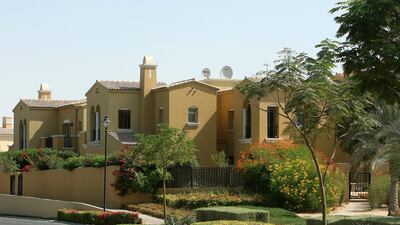
Villas at the Arabian Ranches on Emirates Road in Dubai. Pawan Singh / The National -
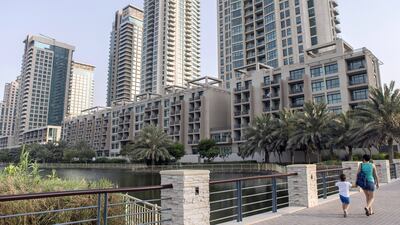
The Fairways apartment buildings at Emaar's development "The Views" in Dubai. Reem Mohammed / The National -
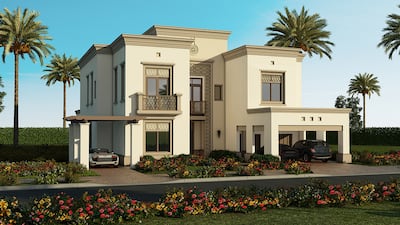
Arabesque style Yasmin villas in Arabian Ranches. Rendering courtesy Emaar -

A mock up of the Dubai Creek Harbour development by Emaar. Satish Kumar / The National


“Millennials are competing for mid-priced housing and what use to be called 'starter homes' with institutional investors who are turning traditional homeowner properties into rental property,” says Robert Silverman, professor in the department of urban and regional planning at the University of Buffalo.
“All of this activity puts additional upwards pressure on housing prices and rents.”
Residential rents in the US increased by an average of 15 per cent last year, double the rate of inflation in many parts of the country, In increasingly popular spots such as Austin, Texas, the figure was 40 per cent.
“The affordability crisis is worsening and it’s increasing up the income spectrum,” says Caitlin Sugrue Walter, vice president of research at National Multifamily Housing, the trade association representing the apartment industry.
“People who are well off now can’t afford to buy but they have considerable renting power, which is driving the market up,” she tells The National.
Then there is the shortage of supply, as house building has yet to recover from the 2008 crash.
“We estimate we need to build 328,000 [homes] a year to keep up with annual demands Ms Sugrue Walter says. "We have had a decade of underbuilding ... we are running at full capacity and it is still not enough.”

The pods are only one way in which the US is trying to square the circle of soaring demand and affordability: “tiny homes” are also gaining in popularity.
The idea is hardly new. The movement dates back to the mid-19th century and the publication of On Walden Pond by David Thoreau, the first great experimenter in small-space living.
It came into vogue in the 1970s as part of the counterculture movement, with pioneers such as Lester Walker citing Thoreau as an inspiration. By the end of the century, it was boosted further by Jay Shafer, who wrote The Small House Book in 1999.
But it was the 2008 financial crash that provided the impetus for living smaller, as families struggling to pay their mortgages downsized.
Tiny homes are rarely bigger than 500 square feet — about a fifth of the size of a normal family house.
They come with a much lower price tag, costing up to $75,000 — a fraction of what a buyer would pay for a conventionally sized dwelling.
They even come with a chic cachet, with Elon Musk renting one in Texas while working on SpaceX.

The other option is what Americans call an ADU, or Accessory Dwelling Unit, which is built on the land of an existing home.
These come in an array of shapes and sizes, from converted garden sheds to granny flats. And like tiny homes, they cost far less than a normal house, Even on the expensive Pacific coast, the price tag can be as low as $116,000.
But planning laws in some areas can thwart the construction of ADUs. In the last election, former president Donald Trump campaigned to protect the suburbs against cheaper housing developments, indicating that the ADU movement is likely to have to battle political headwinds.
Prof Silverman is sceptical about the viability of large-scale development of pods and tiny homes, believing they are attracting interest because of media hype.
“Auxiliary units may have a little more promise,” he says.
“They are basically studio-style units built on the lot of an existing home. They are more cost-efficient since they have smaller square footage, but that also limits them as an option to only small households.”
However, smaller households are becoming more of the norm, In 1960, the average US household averaged 3.33 people. Last year it had shrunk to 2.51.
And so, as prices rise and households shrink, these alternative housing forms might be the way of the future.

