
The UAE is expected to see a rebound in initial public offerings once the US-Iran conflict ends, and the country’s credit market is also set to boom, according to a senior Morgan Stanley executive.
While there have been no listings in the UAE so far this year, the investment bank is bullish about the capital market prospects despite the uncertainty caused by the war. UAE companies raised a total of $1.1 billion through three IPOs in 2025, Dealogic data shows.
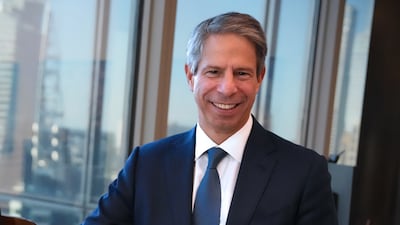
“I think long term, as the conflicts get resolved or hits some level of stabilisation, you will definitely see a rebound in the IPO marketplace in the UAE,” Dan Simkowitz, co-president of Morgan Stanley told The National.

“So, we are investing in and have high confidence in that. And we've been so impressed with the leadership on the sort of financial infrastructure in the country all the way around,” he said.
The Iran war, which began on February 28, has led to increased uncertainty across the Middle East. After the US-Israeli bombing of Iran and Tehran’s retaliatory strikes on its Arab neighbours halted in early April, peace in the region has teetered on a fragile ceasefire.
A report from the World Bank released last week said Gulf economies will contract by an average of 4.3 per cent this year, a downward revision of 5.7 percentage points from its April forecast. While the International Monetary Fund also anticipates that the Gulf economy will contract this year, the region is expected to face a strong recovery next year, conditional on the normalisation of shipping, the fund’s managing director, Kristalina Georgieva, said.
"I think it [the war] clearly creates a slightly higher and hopefully temporary risk premium in the region, but not so much that it changes long-term investment perspectives and investor interest," Mr Simkowitz said.
The investment bank's commitment to the region is "as strong as it's ever been".
"We continue to be thinking about how to invest in growth. Our corporate clients, FDI clients, are still very focused on the demographics in the region, the potential for GDP growth, the diversification that is coming in the marketplace,” he added.
There is extreme resilience that has been built in the region, the Morgan Stanley executive said.
“There is also real capital strength in the region, and so as they need to either rebuild or redirect energy infrastructure, for example, there is the capability to do so. And … there is international capital ready to help do that,” he explained.
Morgan Stanley, which is headquartered in the US and has more than $10 trillion in assets, has been present in the region for the past 20 years. It also opened a new office in Abu Dhabi in 2024.
co-president of Morgan Stanley
The bank currently has well over 100 employees in the region and it plans to expand its operations further.
"We're going to stay very committed to growing that. I think wealth and asset management will be a part of that,” Mr Simkowitz said.
The company's current pipeline of deals in the region is still active, he said. "Some element is on pause, and I think it would change a little bit in that people will have to re-underwrite maybe some of their resiliency supply chain and diversification. But I would argue most of it that was on is underway."
Credit market boom
The Morgan Stanley executive is also bullish about growth in credit markets in the UAE and across the region, with global trends also positive. Credit markets cover bonds, government debt, private credit and bank loans.
Globally, asset managers and owners, including sovereign wealth funds and pension funds, are playing a key role in the credit market, he said.
“The credit market has become more important because we're entering into a period where high capex manufacturing is back ... and in that context, you need to spend money, and you need to bridge this ‘build to revenue, build to profitability’ gap … and it is not just banks or governments.”
Economic tailwinds from the AI buildout and "surprisingly enduring demand" have bolstered credit conditions in many major economies this year, S&P Global Ratings said in a report this month.
But the positive momentum of overall credit stability seen over the past few years will become more difficult to sustain, it said.
Heading into the fourth quarter, "risks are building amid the sharp rise in benchmark borrowing costs, including yields on government debt, as investors bet that major central banks have a complex challenge in their fight against inflation", the ratings agency said.
In the UAE and the Gulf, the credit market “is coming, and I think that's encouraging”, Mr Simkowitz said.
Gulf debt capital markets reached $1.2 trillion outstanding at the end of the first half of this year, according to Fitch Ratings.
Even in mature markets like the US, the credit market is evolving and building, Mr Simkowitz said, adding that the growth of a fixed income market or a bond market is "incredibly important”.
“Over the last several years, the conversations we've had throughout the Gulf with finance ministries, stock exchanges, and other leadership … has been skewing more and more towards bond markets and credit markets, as we've had some great success with ADX [Abu Dhabi Securities Exchange] and with other exchanges in the Gulf around equities, it's a natural progression,” he said.
More than $100 billion has been raised in debt markets in the region this year, he said. "That is really important to continue to satisfy the growth, diversification and resiliency ambitions, it can't all be done with equity, and so you need some element of credit and bond markets.”
AI, midterms and outlook
The big economic theme is AI, which is "incredibly transformational", Mr Simkowitz said. "It's going to require a lot of capital today to drive an immense amount of productivity in the future.
"Certainly, the UAE has been at the centre of that. As relative to GDP or even wealth or market cap, the UAE is one of the most important AI players in the world."
A recent report by Bain found that the AI industry needs to earn $6 trillion in annual revenue by 2031 to justify the capital being deployed for data centres.
Revenue from new product development is projected to become the biggest contributor to the industry, and is estimated to generate about $4.2 trillion to fund the technology's global market within the next half-decade.

"We're reasonably bullish on AI-related revenue," Mr Simkowitz said. "There's a timing mismatch in that you need to build compute a little ahead, but that timeframe is shrinking ahead of the productivity and the revenue impact."
Ultimately, the technology will prove beneficial. "Anything this transformative and large is .. not going to always be linear, and not everyone's going to win. But I would say the users will win, and then I would say there's going to be a group of winners who deliver it, who will win big from an investment perspective."
From the political standpoint, investors are keenly watching the US midterm elections early next month. However, Mr Simkowitz stressed that while everybody in the markets will be focused on the midterms, "it's not nearly as consequential" as presidential elections, such as upcoming ones in Brazil or France.
Looking ahead, there remains uncertainty in the markets over the US-Iran war, the Ukraine-Russia conflict and economic indicators such as inflation.
Mr Simkowitz's outlook for next year? "I think intense and don't be complacent. No one can be complacent. It may not be as dramatic [as this year], but it's going to be intense."