Twitter headquarters in San Francisco. The social media company plans to shut access to its offices ahead of planned layoffs on Friday. AFP

Elon Musk to start laying off Twitter staff today


  • English
  • Arabic

Twitter plans to start cutting staff on Friday, the company said in an email to employees.

Billionaire Elon Musk plans to eliminate half of social media company's workforce, making good on plans to slash costs at the platform he acquired for $44 billion last month, sources have said.

“In an effort to place Twitter on a healthy path, we will go through the difficult process of reducing our global workforce on Friday,” Twitter management said in an email reviewed by Bloomberg.

“We recognise that this will impact a number of individuals who have made valuable contributions to Twitter, but this action is unfortunately necessary to ensure the company’s success going forward.”

The company will inform affected staffers on Friday at 9am San Francisco time (8pm UAE), according to the memo.

Amid the layoffs, Twitter plans to temporarily close offices and suspend badge access “to help ensure the safety of each employee, as well as Twitter systems and customer data”, the memo said.

All told, Mr Musk wants to cut about 3,700 jobs, sources said this week. The entrepreneur began to drop hints about his staffing priorities before the deal was closed, saying he wanted to focus on the core product.

“Software engineering, server operations & design will rule the roost,” he tweeted in early October.

Security staff at Twitter’s San Francisco headquarters carried out preparations for the layoffs while an internal directory used to look up colleagues was taken offline on Thursday afternoon, sources said.

Employees have been bracing for the firings for weeks. In recent days, they raced to connect via LinkedIn and other non-Twitter avenues, offering each other advice on how to weather losing one’s job, the sources said.

Former Twitter engineers are also using social media to respond to former “Tweeps” looking to land jobs elsewhere.

Mr Musk has also been huddling with advisers to come up with new ways to make money from the blogging platform, including charging for verifications, which can help delineate real users from fake accounts.

He is also considering reviving a long-since-discontinued short-video tool called Vine, a way to vie with popular video-sharing apps such as TikTok.

Another product under consideration, the New York Times reported, is paid direct messages, which would let the rank and file send private messages to high-profile users.

Meanwhile, several advertisers have tapped the brakes on placing advertisements on the platform until they have a clearer idea of Mr Musk’s plans.

The new owner has said he wants to remove some content moderation, giving rise to concerns that hate speech, misinformation and other potentially harmful material will flourish even more freely.

General Mills said it was temporarily pausing advertising on Twitter, joining Volkswagen's Audi and General Motors in rethinking their presence on the platform.

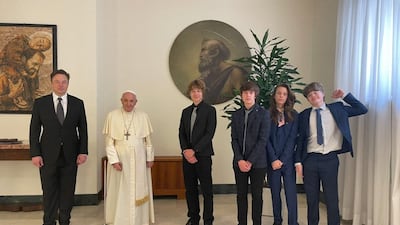
  • Tesla chief Elon Musk and his children Damian, Kai, Saxon and Griffin meet Pope Francis in July at the Vatican. AFP
    Tesla chief Elon Musk and his children Damian, Kai, Saxon and Griffin meet Pope Francis in July at the Vatican. AFP
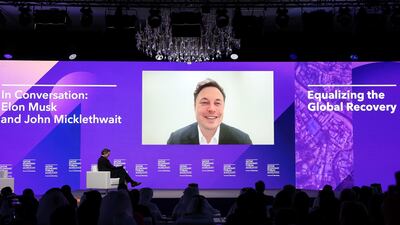
  • Mr Musk speaks by video in June to the Qatar Economic Forum in Doha. Bloomberg
    Mr Musk speaks by video in June to the Qatar Economic Forum in Doha. Bloomberg
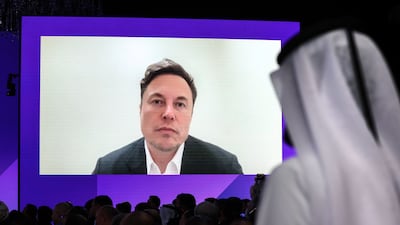
  • Mr Musk answers questions at the Qatar Economic Forum. Bloomberg
    Mr Musk answers questions at the Qatar Economic Forum. Bloomberg
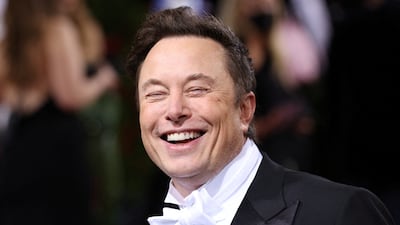
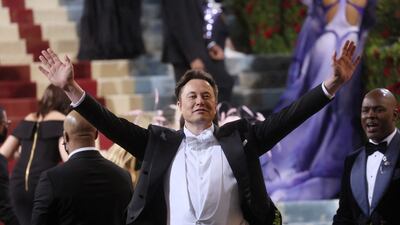
  • Mr Musk arrives at the Met Gala at the Metropolitan Museum of Art in New York City in May. Reuters
    Mr Musk arrives at the Met Gala at the Metropolitan Museum of Art in New York City in May. Reuters
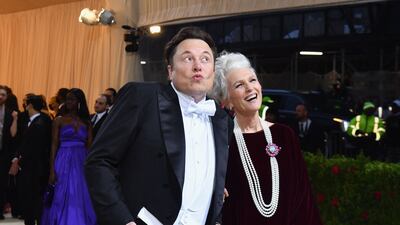
  • Mr Musk and his mother Maye Musk arrive at the Met Gala in May. AFP
    Mr Musk and his mother Maye Musk arrive at the Met Gala in May. AFP
  • The Musks pose and laugh on the Met Gala red carpet. EPA
    The Musks pose and laugh on the Met Gala red carpet. EPA
  • Mr Musk waves at the Met Gala. Reuters
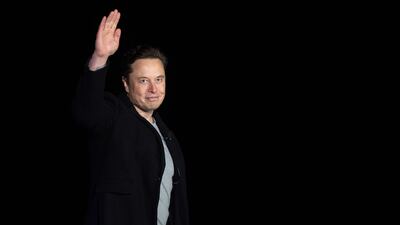
    Mr Musk waves at the Met Gala. Reuters
  • Mr Musk joins in online at the 'Financial Times' Future of the Car Summit in May. Financial Times
    Mr Musk joins in online at the 'Financial Times' Future of the Car Summit in May. Financial Times
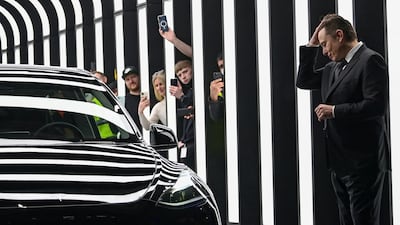
  • Mr Musk attends the opening ceremony of the new Tesla Gigafactory for electric cars in Gruenheide, Germany, in March. Reuters
    Mr Musk attends the opening ceremony of the new Tesla Gigafactory for electric cars in Gruenheide, Germany, in March. Reuters
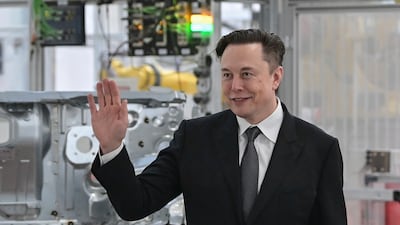
  • Mr Musk at the Tesla factory in Berlin, Germany, in March. AP
    Mr Musk at the Tesla factory in Berlin, Germany, in March. AP
  • Mr Musk speaks at SpaceX's Starbase centre in South Texas in February. AFP
    Mr Musk speaks at SpaceX's Starbase centre in South Texas in February. AFP
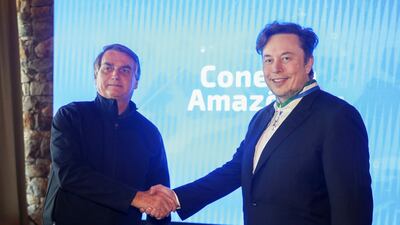
  • The entrepreneur shakes hands with Brazilian President Jair Bolsonaro in Porto Feliz, Brazil, in May. AP
    The entrepreneur shakes hands with Brazilian President Jair Bolsonaro in Porto Feliz, Brazil, in May. AP
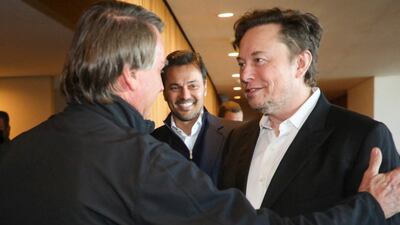
  • Mr Bolsonaro and Mr Musk greet each other in Sao Paulo. Reuters
    Mr Bolsonaro and Mr Musk greet each other in Sao Paulo. Reuters
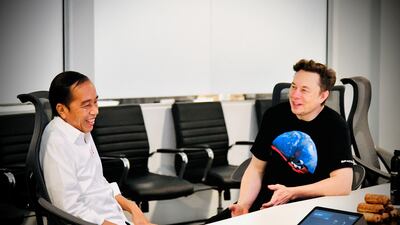
  • Indonesian President Joko Widodo meets Mr Musk at the SpaceX launch site in Boca Chica, Texas, in May. Reuters
    Indonesian President Joko Widodo meets Mr Musk at the SpaceX launch site in Boca Chica, Texas, in May. Reuters
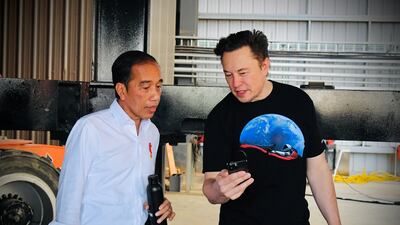
  • Mr Musk shows Mr Widodo his mobile phone during a tour of the SpaceX launch site in Texas. Reuters
    Mr Musk shows Mr Widodo his mobile phone during a tour of the SpaceX launch site in Texas. Reuters
COMPANY%20PROFILE
%3Cp%3E%3Cstrong%3ECompany%20name%3A%3C%2Fstrong%3E%20Mozn%3C%2Fp%3E%0A%3Cp%3E%3Cstrong%3EStarted%3A%3C%2Fstrong%3E%202017%3C%2Fp%3E%0A%3Cp%3E%3Cstrong%3EFounders%3A%3C%2Fstrong%3E%20Mohammed%20Alhussein%2C%20Khaled%20Al%20Ghoneim%2C%20Abdullah%20Alsaeed%20and%20Malik%20Alyousef%3C%2Fp%3E%0A%3Cp%3E%3Cstrong%3EBased%3A%3C%2Fstrong%3E%20Riyadh%2C%20Saudi%20Arabia%3C%2Fp%3E%0A%3Cp%3E%3Cstrong%3EIndustry%3A%3C%2Fstrong%3E%20FinTech%3C%2Fp%3E%0A%3Cp%3E%3Cstrong%3EFunding%3A%3C%2Fstrong%3E%20%2410%20million%3C%2Fp%3E%0A%3Cp%3E%3Cstrong%3EInvestors%3A%3C%2Fstrong%3E%20Raed%20Ventures%2C%20Shorooq%20Partners%2C%20VentureSouq%2C%20Sukna%20Ventures%20and%20others%3C%2Fp%3E%0A
Some of Darwish's last words

"They see their tomorrows slipping out of their reach. And though it seems to them that everything outside this reality is heaven, yet they do not want to go to that heaven. They stay, because they are afflicted with hope." - Mahmoud Darwish, to attendees of the Palestine Festival of Literature, 2008

His life in brief: Born in a village near Galilee, he lived in exile for most of his life and started writing poetry after high school. He was arrested several times by Israel for what were deemed to be inciteful poems. Most of his work focused on the love and yearning for his homeland, and he was regarded the Palestinian poet of resistance. Over the course of his life, he published more than 30 poetry collections and books of prose, with his work translated into more than 20 languages. Many of his poems were set to music by Arab composers, most significantly Marcel Khalife. Darwish died on August 9, 2008 after undergoing heart surgery in the United States. He was later buried in Ramallah where a shrine was erected in his honour.

Mercer, the investment consulting arm of US services company Marsh & McLennan, expects its wealth division to at least double its assets under management (AUM) in the Middle East as wealth in the region continues to grow despite economic headwinds, a company official said.

Mercer Wealth, which globally has $160 billion in AUM, plans to boost its AUM in the region to $2-$3bn in the next 2-3 years from the present $1bn, said Yasir AbuShaban, a Dubai-based principal with Mercer Wealth.

Within the next two to three years, we are looking at reaching $2 to $3 billion as a conservative estimate and we do see an opportunity to do so,” said Mr AbuShaban.

Mercer does not directly make investments, but allocates clients’ money they have discretion to, to professional asset managers. They also provide advice to clients.

“We have buying power. We can negotiate on their (client’s) behalf with asset managers to provide them lower fees than they otherwise would have to get on their own,” he added.

Mercer Wealth’s clients include sovereign wealth funds, family offices, and insurance companies among others.

From its office in Dubai, Mercer also looks after Africa, India and Turkey, where they also see opportunity for growth.

Wealth creation in Middle East and Africa (MEA) grew 8.5 per cent to $8.1 trillion last year from $7.5tn in 2015, higher than last year’s global average of 6 per cent and the second-highest growth in a region after Asia-Pacific which grew 9.9 per cent, according to consultancy Boston Consulting Group (BCG). In the region, where wealth grew just 1.9 per cent in 2015 compared with 2014, a pickup in oil prices has helped in wealth generation.

BCG is forecasting MEA wealth will rise to $12tn by 2021, growing at an annual average of 8 per cent.

Drivers of wealth generation in the region will be split evenly between new wealth creation and growth of performance of existing assets, according to BCG.

Another general trend in the region is clients’ looking for a comprehensive approach to investing, according to Mr AbuShaban.

“Institutional investors or some of the families are seeing a slowdown in the available capital they have to invest and in that sense they are looking at optimizing the way they manage their portfolios and making sure they are not investing haphazardly and different parts of their investment are working together,” said Mr AbuShaban.

Some clients also have a higher appetite for risk, given the low interest-rate environment that does not provide enough yield for some institutional investors. These clients are keen to invest in illiquid assets, such as private equity and infrastructure.

“What we have seen is a desire for higher returns in what has been a low-return environment specifically in various fixed income or bonds,” he said.

“In this environment, we have seen a de facto increase in the risk that clients are taking in things like illiquid investments, private equity investments, infrastructure and private debt, those kind of investments were higher illiquidity results in incrementally higher returns.”

The Abu Dhabi Investment Authority, one of the largest sovereign wealth funds, said in its 2016 report that has gradually increased its exposure in direct private equity and private credit transactions, mainly in Asian markets and especially in China and India. The authority’s private equity department focused on structured equities owing to “their defensive characteristics.”

Conflict, drought, famine

Estimates of the number of deaths caused by the famine range from 400,000 to 1 million, according to a document prepared for the UK House of Lords in 2024.
It has been claimed that the policies of the Ethiopian government, which took control after deposing Emperor Haile Selassie in a military-led revolution in 1974, contributed to the scale of the famine.
Dr Miriam Bradley, senior lecturer in humanitarian studies at the University of Manchester, has argued that, by the early 1980s, “several government policies combined to cause, rather than prevent, a famine which lasted from 1983 to 1985. Mengistu’s government imposed Stalinist-model agricultural policies involving forced collectivisation and villagisation [relocation of communities into planned villages].
The West became aware of the catastrophe through a series of BBC News reports by journalist Michael Buerk in October 1984 describing a “biblical famine” and containing graphic images of thousands of people, including children, facing starvation.

Band Aid

Bob Geldof, singer with the Irish rock group The Boomtown Rats, formed Band Aid in response to the horrific images shown in the news broadcasts.
With Midge Ure of the band Ultravox, he wrote the hit charity single Do They Know it’s Christmas in December 1984, featuring a string of high-profile musicians.
Following the single’s success, the idea to stage a rock concert evolved.
Live Aid was a series of simultaneous concerts that took place at Wembley Stadium in London, John F Kennedy Stadium in Philadelphia, the US, and at various other venues across the world.
The combined event was broadcast to an estimated worldwide audience of 1.5 billion.

Men from Barca's class of 99

Crystal Palace - Frank de Boer

Everton - Ronald Koeman

Manchester City - Pep Guardiola

Manchester United - Jose Mourinho

Southampton - Mauricio Pellegrino

Updated: November 04, 2022, 8:20 AM