

Live updates: follow the latest news on Russia-Ukraine
RELATED: Brent oil soars above $100 for first time since 2014 as Russia-Ukraine crisis escalates
Brent crude and West Texas Intermediate breached the $100 psychological mark on Thursday and markets tumbled after Russian President Vladimir Putin decided to conduct a special military operation in the Donbas region of Ukraine. Mr Putin's move comes as separatist leaders in the Donetsk and Luhansk enclaves of eastern Ukraine had appealed to Moscow for help against Ukrainian forces.
Although Mr Putin said that Russia had no plans to occupy Ukraine, the move has affected financial markets and invoked inflationary fears across the world, which has not yet recovered from the economic fallout from Covid-19 pandemic.
Here’s what analysts have to say about the Russia-Ukraine crisis and the impact on oil, markets and other commodities.
Emirates NBD Research
Although the scale and scope of the geopolitical crisis is an unknown variable at this time, the US, EU, UK and other nations could impose more sanctions on Russia’s economy, Emirates NBD economists said in a note. These could hinder economic activity in the country, but are unlikely to substantially derail global growth. But Russia's influence on the commodity markets, particularly oil, is sizeable and if there are curbs in supply of oil and gas from the country, it could materialise into inflationary pressures. This will also weigh on bond and currency markets, and is likely to feed through to equities as well with the threat of even higher input costs for firms.
"We don’t expect that the crisis and unfolding financial market volatility will prevent the Federal Reserve from increasing rates at their upcoming March FOMC as the Fed will still want to show a strong hand on damping down inflation pressures in the US economy. Financial market volatility may result in the Fed being less aggressive in tightening, however, such as waiting to unwind its balance sheet until later this year or slowing the pace of increases in H2. Our baseline view at this stage is that the Fed will follow through with a rise at its March meeting," economists at Dubai's largest lender said.

Saxo Bank
As Russia escalates the situation in Ukraine, analysts expect more sanctions on the country from the West. However, "the western powers will have to hurt themselves if they are to hurt Russia as new sanctions are likely to affect the flow of commodities itself and possibly Russia’s financial system and its access to the world. This will in itself lead to much higher inflation both in the short and medium term," said Steen Jakobsen, chief investment officer at Saxo Bank. Russia is a major exporter of oil and natural gas, particularly to Europe and how the continent reacts is to be closely watched, according to Saxo Bank. "This is an extreme situation. There is the possibility of 110-125 Brent oil prices or higher inside next week, if the conflict deepens and escalates in the wake of sanctions," said Mr Jakobsen.
-
Firefighters arrive at a military building in Kiev that was damaged in an explosion. EPA -

A man looks at the debris of an unidentified object in the aftermath of an explosion in Kiev. EPA -
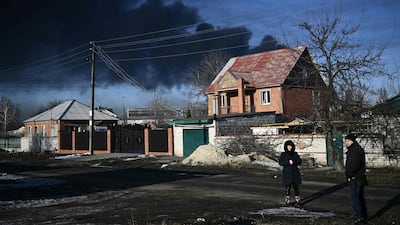
Black smoke rises from a military airport in Chuguyev near Kharkiv. AFP -

People take shelter in a Kiev subway station, after Russian President Vladimir Putin authorised a military operation in eastern Ukraine. Reuters -
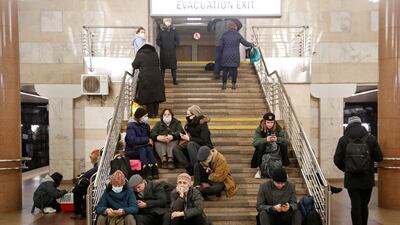
A Kiev underground train station provides some shelter. Reuters -

Clear airspace over Ukraine, shortly after the attack began, as shown on the Flightradar24 website. AP -

Kiev residents leave the city following pre-offensive missile strikes by the Russian armed forces and Belarus. Getty -
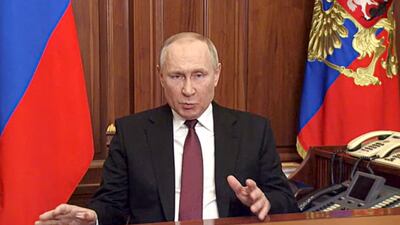
Russian President Vladimir Putin justified the attack in a televised address, saying it was to protect civilians in eastern Ukraine. AP -
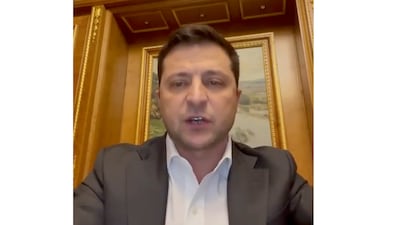
Ukrainian President Volodymyr Zelenskyy addresses the nation in Kiev. He has declared martial law, saying Russia has targeted Ukraine's military infrastructure. AP -
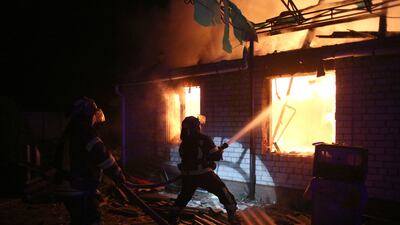
Firefighters extinguish a blaze at a house in Muratovo, in Ukraine's Luhansk enclave. AFP -

The house is said to have been hit during shelling by Russian-backed separatists. AFP -

The coffin of Capt Anton Sidorov is carried by members of the honour guard during a ceremony held at the Ministry of Defence in Kiev, Ukraine. Getty -
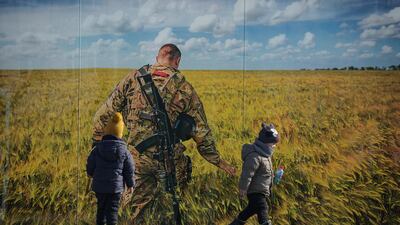
A picture memorial for those killed in the confrontation between Ukraine's military and pro-Russia separatist forces, in the Luhansk region in eastern Ukraine. AP -

UN Secretary General Antonio Guterres and Russia's Ambassador to the UN, Vassily Nebenzia, attend a Security Council meeting in New York to discuss the crisis in Ukraine. Reuters -
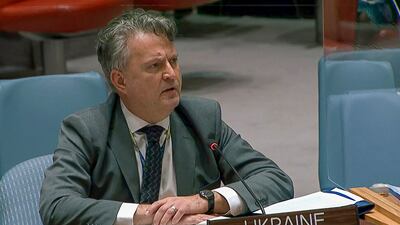
Ukraine's UN ambassador Sergey Kyslytsya speaks during an emergency meeting of the Security Council. AP -
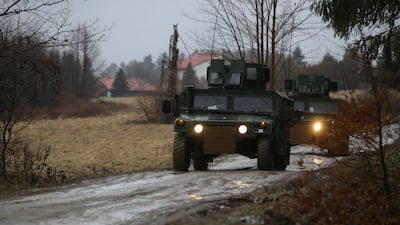
US Army soldiers from the 82nd Airborne Division head towards an air base near Arlamow, Poland. Reuters -

An employee works at the gun counter of a tactical equipment shop in Kiev, Ukraine. Getty -
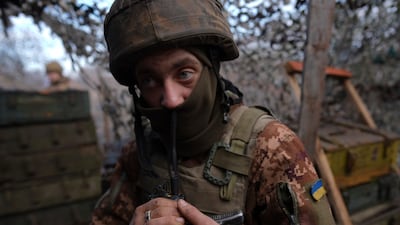
A Ukrainian soldier speaks on a walkie-talkie at his position at the line of separation between Ukraine-held territory and rebel-held territory near Svitlodarsk, eastern Ukraine. AP -
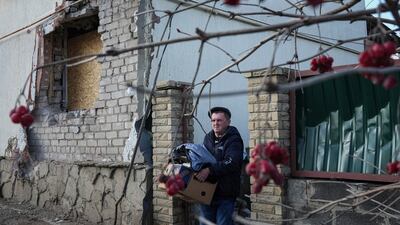
A man removes his belongings from his house after it was struck by artillery shells in Novoluhanske, eastern Ukraine. AP -
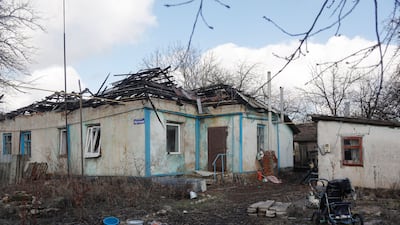
A damaged house in Vibrovka village. EPA -
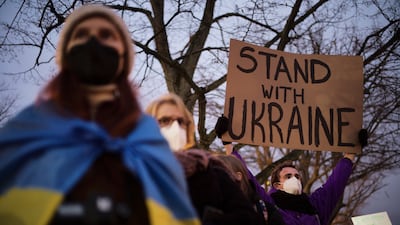
A man shows a poster in support of Ukraine as he protests against the escalation of the tension between Russia and Ukraine, in Berlin. AP -

Soldiers carry the coffin of Capt Anton Sydorov, 35, after he was killed in eastern Ukraine. AP -
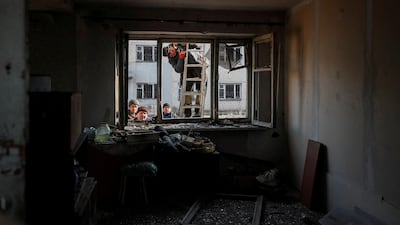
Workers look into a destroyed house after shelling near the city of Novoluhanske in Donetsk. Reuters -

Destroyed buildings in Krasnogorivka, Ukraine. AFP -
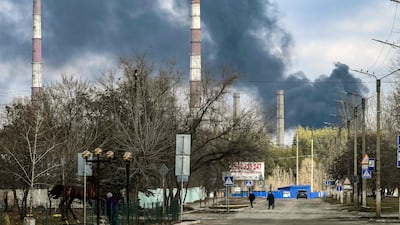
Smoke rises from a power plant after shelling outside the town of Schastia, a day after Moscow recognised two Ukrainian separatist republics and ordered the Russian Army to send in troops as ‘peacekeepers’. AFP -
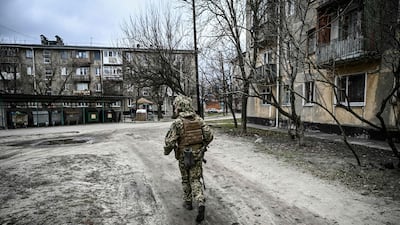
A Ukrainian Army soldier trudges through the wintry streets of Schastia on patrol. AFP -
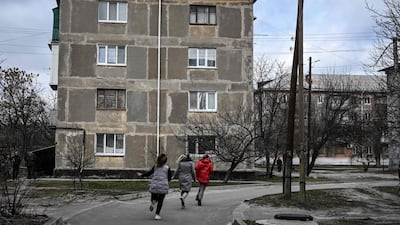
Three women run for cover during shelling in Schastia, eastern Ukraine. AFP -
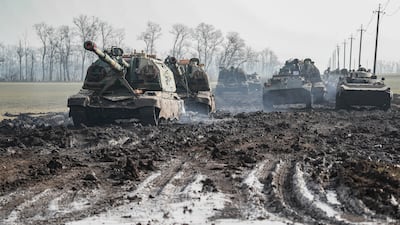
Russian tanks and armoured vehicles on the road in Rostov. EPA -
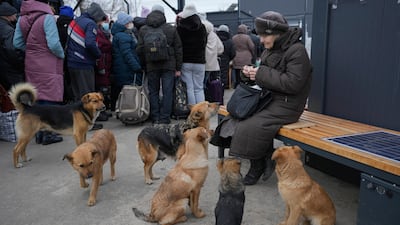
A woman shares food with dogs in Stanytsia Luhanska, a crossing point between Ukrainian government-controlled areas and pro-Russian separatists' territory. AP -
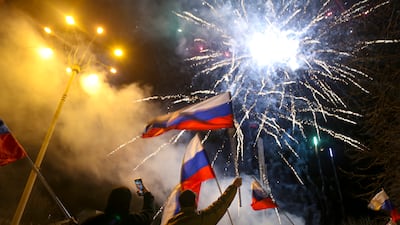
People wave Russian flags in Donetsk, the territory controlled by pro-Russian militants, in eastern Ukraine. AP -
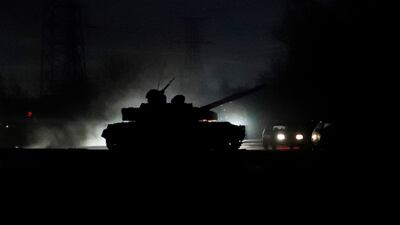
A tank drives along a street in the city of Donetsk. Reuters -
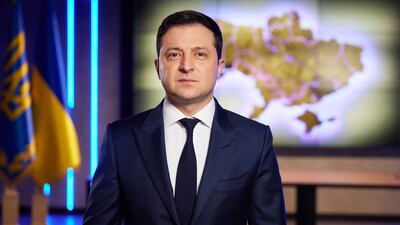
Ukrainian President Volodymyr Zelenskyy addresses the nation on TV and says 'we are not afraid' after Russian President Vladimir Putin ordered troops into Donetsk and Luhansk, two Moscow-backed rebel regions of Ukraine. AFP -
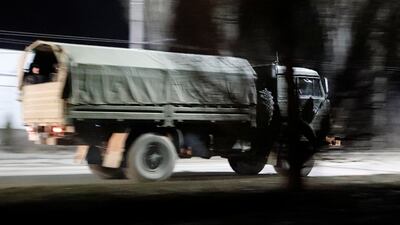
A military truck in Donetsk after Mr Putin ordered the deployment of Russian troops to the city. Reuters -
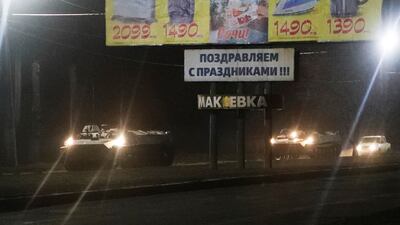
Russian state television showed Mr Putin signing a decree recognising the independence of the two Ukrainian breakaway regions. Reuters -
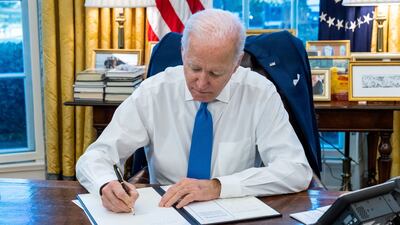
US President Joe Biden signs an executive order at the White House to prohibit trade and investment between US individuals and the two breakaway regions of eastern Ukraine. Reuters -
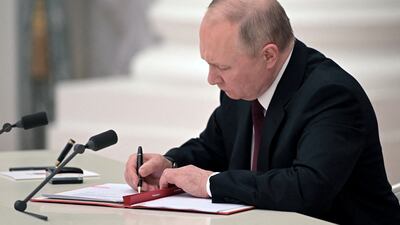
Mr Putin signs documents, including the decree recognising two Russian-backed breakaway regions in eastern Ukraine. Reuters -
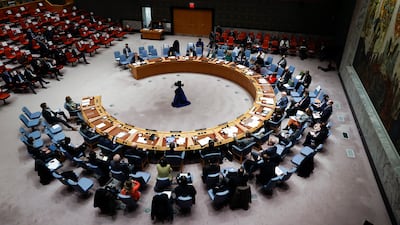
Ukraine ambassador to the United Nations, Sergiy Kyslytsya, addresses an emergency meeting of the UN Security Council on the situation between Ukraine and Russia in New York. EPA


Julius Baer
As fears of a full-blown conflict escalates, many are expecting a deep sell-off as investors rush to have assets. "We expect a strong downside for equities from current levels. Developed market equities could lose up to 10 per cent in the short term (unless this eventuality could be offset by a mediated policy response), mainly due to dampened investor sentiment and the growth outlook," said Leonardo Pellandini, an equity strategist at Swiss bank Julius Baer.
"The impact on the corporate earnings of the S&P 500 and Stoxx 600 is limited, as their index constituents only derive a marginal part of their revenue in Russia and Ukraine. Concerning Russian equities, which have already significantly derated since the start of the year (-18 per cent year-to-date in the MOEX Russia index), a further market sell-off on the local stock market given the war scenario could lead to further underperformance in the range of 15 per cent to 20 per cent, in our view."
Swissquote
Gold, known as a haven asset and a hedge against inflation, is rallying but the same does not apply to cryptocurrencies such as Bitcoin, which rapidly emerged as an alternative to equities and bonds.
"If the situation in Ukraine worsens, we could see the price of a coin fall towards the $30K and even below, depending on how bad the situation is," said Ipek Ozkardeskaya, a senior analyst at Swissquote.
"The other cryptocurrencies will also feel the pinch of the Ukrainian war. Remember, when Bitcoin sneezes, all the crypto-industry catches cold. There is also the fact that the higher energy prices make crypto mining more expensive. So that is also a fundamental reason that prevents Bitcoin from being a safe haven asset in the actual environment."
Vanda Insights
Sanctions on Russia and on its energy exports could mean a supply crunch that could push prices up. Opec+ has some spare capacity in oil, but it is not clear if the producers’ alliance will consider tapping into that capacity and if they can bring in an excess capacity in such a short time, according to Vandana Hari, founder of oil market analysis provider Vanda Insights.
"The producers bound by quotas were short of their collective target by nearly 1 million b/d in January. The handful of countries that have readily available spare capacity, such as Saudi Arabia, the UAE, Iraq and Kuwait, could open the spigots, but they will need to get all Opec+ members on board to agree to temporarily suspend production quotas," she said.
MUFG
Commodities too are set for a boost as geopolitical tensions ratchet up in Ukraine. "Markets remain mired in a state of extreme shortage with boisterous demand across most commodity subgroups outpacing inelastic supply," Japan's largest bank MUFG said. "Such depleted systems are highly vulnerable to the smallest shocks, with the prospect of armed conflict in Ukraine triggering precipitous upside price risks. With 22 out of 23 commodities in the Bloomberg Commodities Index up year-to-date, and 18 out of these 23 commodities trading in super backwardation (signalling market tightness) — most at any point since 1997 — the opportunity to go long commodities has seldom been this compelling."


Avatrade
Ukraine-Russia crisis, among other things, will affect investors' willingness to take risks. "Stock traders are faced with a myriad threats that are fuelling market uncertainty, with rising inflation at the heart of all concerns," said Naeem Aslam, chief market analyst at Avatrade. Consumer prices were already at a high due to the pandemic-induced supply chain bottlenecks and economic recovery. Now oil prices too could skyrocket. "These changes could cause inflation to rise even further, prompting the Federal Reserve to become more hawkish in 2022," Mr Aslam said.
EFG-Hermes
Rising energy prices add to inflation woes, Egypt's largest investment bank EFG-Hermes said. Higher energy prices are clearly a major driver of global inflation, which has already weighed heavily on emerging market (EM) currencies and rates in the past few months. The latest escalation adds to the woes of EM, especially oil importers, and gives rise to the possibility of continued elevated food inflation. However, GCC markets are likely to report heavy inflows.
"The combination of rising energy prices and caution towards EM makes GCC markets a clear winner, in our view. Political risk and rising US rates will mean weak flows into EM funds in 2022, but GCC markets will continue to see strong inflows," EFG said.
"The GCC will enjoy rising energy prices, replenishing their balance sheets, and US dollar pegs are a cushion for investors who are wary of an escalated global risk environment ... On the other hand, the combination of tightening monetary policy and rising inflationary pressures adds further pressure on oil-importing economies, led by Pakistan."
Meanwhile, the crisis presents risks to Kazakhstan and Georgia, two markets closely connected with Russia through trade, remittance flows and tourism.
Tellimer Research
Safe haven assets such as gold could see a massive surge in value in the coming months as investors seek it out amid rising tensions. "Our machine-learning forecast says that gold will move sharply higher from here until May, reaching a new high of US$2,100 — a gain of 10.6 per cent," Tellimer Research analysts said. "This steep increase will likely attract some short-term profit-taking, sending the price back down to current levels by September. From here, it will continue its multi-year bull run to yet another high, of $2,135, by the end of the forecast period."
AZA
The rise in oil prices as a result of Ukraine crisis will weigh heavy on crude-importing countries in Africa, according to Michael Nderitu, head of trading at AZA. Meanwhile, African countries, including Tanzania, Nigeria, Algeria and Mozambique, could benefit from a boost in exports of gas and oil to Europe and elsewhere to make up for a disruption in supply from Russia. "While Africa-Russia trade, amounting to $20bn of imports and exports last year, is likely to fall, the bigger impact for most Africans could be further increases in the price of food partly because Ukraine is one of the largest exporters of wheat, especially to the Middle East and North Africa," said Mr Nderitu.


