
The Covid-19 pandemic is accelerating the green transition of economies, particularly in the Middle East, where water is scarce in the region.
The UAE, which along with other Gulf economies relies heavily on desalination for potable water, is seeing an uptake in atmospheric water generation to supplement clean drinking water in homes and institutions.
Atmospheric water generation (AWG) refers to a method of producing drinkable water directly from air by condensing the H2O molecules below dew point.
The process has been used to provide water to regions struck by natural disasters, which disrupt supply. It has also been used to supply water in remote locations and is now being increasingly favoured in the GCC as a more sustainable way to produce water.
The GCC depends overwhelmingly on energy-intensive desalination plants to transform seawater to potable water for various uses.
However, the highly energy-intensive process takes up a significant portion of power loads of countries worldwide, and contributes to global warming. The region accounts for nearly 80 per cent of global desalination capacity and produces a fifth of desalinated water globally.
An unintended impact of the pandemic was slowing emissions as air and ground travel remained halted during the more severe lockdowns experienced globally during the first and second half of the year.
Vahid Fotuhi, vice president - Europe, Middle East and Africa at Source Global, which produces clean drinking water using renewable energy says the pandemic has been a boon for his industry.
The company, previously known as Zero Mass Water, relies on hydropanels to produce water directly from air using solar heat.
“[It is] completely grid free," Mr Fotuhi says. It's also "completely independent and scalable and resilient and will play a very important role as water security, localisation become more important, in this post-Covid era.”
The technology perfected in the deserts of Phoenix, Arizona operates at low levels of humidity, making it quite ideal for the arid conditions of the Middle East.
Conventional atmospheric water generators require more than 20 per cent humidity to operate. However, Source Global’s hydropanels start producing water at 6 per cent humidity in the air, Mr Fotuhi explains.
The company operates the platinum heritage desert safari camp next to a conservation reserve in Dubai, which does not use any plastic in packaging to dispense water to visitors. Globally, the company estimates around 1 million single-use plastic bottles are consumed every minute.
Another company, the Abu Dhabi-based Eshara has also taken up fight against plastic bottle consumption, starting with hotels. The company trialled its atmospheric water generators at the Saadiyat Rotana hotel in Abu Dhabi.
“We completely replaced all of their plastic bottles from the pool and beach area,” said Eshara chief executive Keith Gardner.
Since the pandemic, which crippled the hospitality industry across the world, Eshara has seen growing interest from health-conscious individuals and institutions, who have reached out to the company for units at their establishments.
Mr Gardner sees a unique intersection of clients, particularly in the UAE who are environmentally conscious and also keen to save money.
-
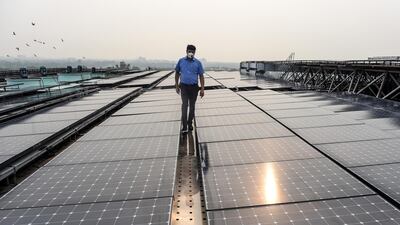
An employee walks among solar panels installed on the building of Indira Paryavaran Bhawan or the Indian Environment Ministry in New Delhi. Source's regional vice president Vahid Fotuhi sees parallels in the evolution of the hydropanel technology to that of solar photovoltaic panels. AFP -

Hydropanels, produced by Zero Mass Water, now known as Source, stand at the planned site of the IBV drinking water plant in Lehbab, Dubai. Bloomberg -

The Arizona-based water technology company, does not consider the lack of rivers or even seawater a problem because it has technology that can extract moisture from the atmosphere using energy from the sun. Bloomberg -

Source is also expanding its reach within Neom - Saudi Arabia’s sustainable city, which straddles the Jordanian and Egyptian borders. The company already supplies clean drinking water to the staff working at the carbon neutral city and has plans to scale up its operations. Bloomberg -
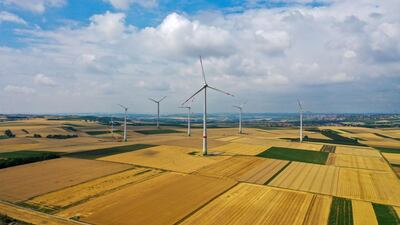
The Covid-19 pandemic has accelerated the green transition in economies. Wind turbines stand near the hydrogen electrolysis plant stands at Energiepark Mainz, operated by Linde, in Mainz, Germany. Bloomberg -
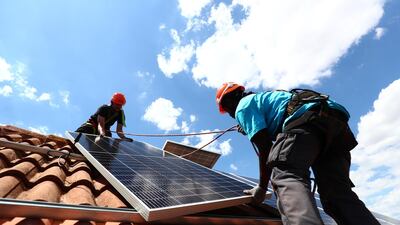
A deep overhaul of fossil fuel-wired economies to function on cleaner energy sources could require as much as $130tn in spending, according to Irena. Rodrigue Kauahou and Jose Carlos Navarro, workers of the installation company Alromar, set up solar panels on the roof of a home in Colmenar Viejo, Spain. REUTERS


"For those that want to save money, we're saying: 'listen, we're going to save you $10,000 a year on what you're spending on water,'” he says.
Eshara, which is run by a family business has now expanded its reach and is present in countries such as Kenya and Nigeria and even further afield in Peru. The Abu Dhabi-based firm, which still relies on conventional energy to produce water, is looking to bring manufacturing capabilities for atmospheric water to the UAE.
"So at the moment, very proudly our products are all stamped with designed in the UAE,” says Mr Gardner.
The company is currently in discussions with a few government agencies to garner support for a manufacturing hub to thrive in the UAE for the industry.
Eshara is keen to relocate its manufacturing “as soon as possible”.
A big stumbling block for the greater adoption of air-to-water technology is obviously the upfront cost. Eshara helps hotels and institutions tide over these difficulties by offering them a subscription or rental-based model keeping in mind tight budgets this year. Individuals are more likely to pay upfront for their unit, and are also likely to customise their units to their aesthetic specifications, Mr Gardner says.
Meanwhile, Mayee, a startup, which emerged during the Covid-19 lockdown in Dubai, is offering discounts on subscriptions to encourage people to have their own systems and produce water at home. Subscriptions start from just Dh195 per month, with the company providing units that produce clean drinking water and also emit dehumidified, particle and pathogen-free air back into the surroundings.
Its founder, who wished to remain anonymous, says there is an increasing interest in the units, particularly as families with young children wish to avoid buying plastic gallons that may have passed multiple hands before reaching their homes.
While start-ups, family businesses and others are looking to democratise the availability of water in one of the more arid places in the world, a fully green solution is still an expensive proposition.
Source Global’s Fotuhi compares the evolution of the hydropanel technology to that of solar photovoltaic panels.
"You'll remember even here in the UAE, people were laughing at solar PV," he says. "They were saying it's a nice trophy project here. Look at us today, you have two gigawatt solar PV arrays in the desert producing power day in and day out.”
With costs for solar falling - Abu Dhabi announced during the lockdown that it had received one of the world’s lowest tariffs for a 2GW scheme in the desert at the height of the pandemic.
“There's no limit to how much water you can produce,” says Mr Fotuhi.
"All you need is some land. And that's it, you just put the panels and because they're modular, you know, you could satisfy the needs of let's say of a 100 people or 10,000 people because there is no limit we have. We have now made water become an unlimited resource,” he added.
Source Global is also expanding its reach within Neom - Saudi Arabia’s sustainable city, which straddles the Jordanian and Egyptian borders. The company already supplies clean drinking water to the staff working at the carbon neutral city and has plans to scale up its operations.
“We see huge potential in Saudi Arabia, and we anticipate that the next two years, we'll be producing over 10 million litres of drinking water purely from the air in Saudi Arabia alone,” says Mr Fotuhi.
Roland Wahlgren, an expert on air-to-water technology and principal at Vancouver-based Atmoswater Research says the technology lends itself to decentralisation. He sees the technology plugging in many of the gaps in access to drinking water in many of the arid regions of the Middle East, but anticipates the adoption to have a very high cost.
"The conventional wisdom with water supply is that you have to build a large centralised plant, and then you distribute from there,” says Mr Wahlgren.
"That’s sort of the conventional utility approach to providing drinking water and is going to have a very expensive premium distribution infrastructure. And water-from-air does make sense as a way of filling in the gaps of conventional water distribution systems.”

