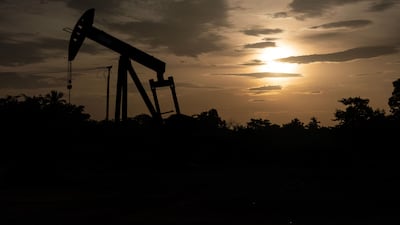
Venezuela’s vast oil reserves once promised enduring power and prosperity, but decades of political upheaval, mismanagement and foreign intervention have turned them into the centrepiece of a global energy contest.
The Latin American country has the world’s largest oil reserves, outstripping Saudi Arabia, Russia and Iran. However, despite having more than 300 billion barrels in reserves, Venezuela produced just over 1 million barrels per day (bpd) in 2025.
This year, Caracas found itself in the centre of global oil politics after Nicolas Maduro, who ruled Venezuela for 12 years, was deposed and extradited to the US. Now, the world’s largest energy companies are reassessing Venezuela’s potential to be a leading oil exporter.

The country's rise and decline as an oil producer serves as cautionary tale of politics and hubris.
From the 1960s to Hugo Chavez
Venezuela was in a golden age of oil production several decades ago. Output peaked at 3.7 million bpd, nearly three times its current level. However, years after the oil was discovered, the Venezuelan government limited production to conserve its reserves and prevent exhaustion of existing fields.
Venezuela’s confidence grew after increased revenue from not participating in the 1973 oil embargo, followed by reassurance of larger oil reserves. Production rose steadily in the mid-1980s, reaching 3.1 million bpd in 1998.
The following years were marked by Hugo Chavez's presidency, from 1999 until his death in 2013, as well as his ideology, which was founded on expelling American influence from the region, and competing with the US politically and economically.
Venezuela nationalised its oil industry in 1976 and created the state-owned oil company Petroleos de Venezuela SA (PDVSA).
Nicolas Maduro years
In 2013, Nicolas Maduro became Venezuela’s President with a small margin of 1.6 percentage points. He inherited Chavez's political views, an oil-dependent economic model and an unhappy country.
In August 2017, in an effort to force Maduro’s government from power, the US imposed sanctions on Venezuela. It first blocked Venezuela's access to US financial markets and eventually halted oil trade between the two countries.
However, Venezuela’s crude continued to flow to China, which had become its major oil trading partner, accounting for 40 per cent to 60 per cent of its exports. During the Biden administration, sanctions were lifted in October 2023 for six months to allow limited trade with the US to resume.
Trump's deal
On January 3, US Special Forces entered Venezuelan territory and captured Maduro and his wife, Cilia Flores, on charges of narco-terrorism and conspiracy to import cocaine.
Seven months later, on August 31, the White House announced its “biggest oil deal in world history”, an agreement that allows the US to take 65 billion barrels from Venezuela – more than 21 per cent of its reserves – and through which North American Blue Energy Partners (Nabep) plans to invest $100 billion in new oil infrastructure.
More than 90 per cent of Venezuelan crude is heavy sour crude, which is more difficult and expensive to transform into petrol and diesel, and trades at a lower price than light sweet crude. Sour crude is the kind the US imports the most, and the one its refineries are equipped to transform into cleaner, lighter and sweeter products. With more cheap crude entering, US profits from crude exports could increase in the following years.
The US says the privatisation and investment in Venezuela’s energy sector are part of the Trump administration’s plan for regime change. Perhaps Venezuela could come full circle with the re-entry of US oil giants, ending years of nationalised production that had mixed benefits for its population.