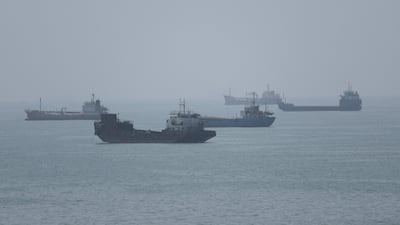

Oil prices rose on Monday morning after the US and Iran exchanged strikes for the first time in a month, with Washington also threatening to increase economic pressure on Tehran's trading allies.
Brent, the benchmark for two thirds of the world's oil, was up 3.34 per cent at $91.04 a barrel at 12.52pm UAE time. West Texas Intermediate, the gauge that tracks US crude, was trading 3.27 per cent higher at $86.13 a barrel.
Oil prices rose after the US struck Iranian targets linked to potential mining activity near the Strait of Hormuz. “Further US secondary sanctions on Iran are also expected, keeping geopolitical risk embedded in energy prices,” said Daniel Richards, senior economist at Emirates NBD.

US forces hit Iranian rocket launchers on Larak Island near the Strait of Hormuz on Sunday, marking the first American military action against Iran in a month.
Iran's Islamic Revolutionary Guard Corps was preparing to launch rockets carrying sea mines into the strait when US forces struck, a US official said.
Iran responded with strikes on two US bases in Jordan, Iranian media said. Eight missiles were intercepted, the kingdom's military said.
US President Donald Trump also shared a one-line post on Truth Social threatening “Kharg Island being blown to smithereens”, without any further details.
Kharg Island, which lies off Iran's south-western coast, handles about 90 per cent of the country's oil exports, with estimates pegging its loading capacity at seven million barrels per day and storage capacity at 30 million barrels.
Meanwhile, US Treasury Secretary Scott Bessent told Reuters he expects new secondary sanctions on Iran's trading partners to be unveiled on a weekly basis.
“We're starting with the banks and we're telling the banks it's not OK to have Iranian money and to aid the regime,” Mr Bessent said.
Crude oil prices have swung sharply throughout the six months of war, with Brent hitting an intraday high of about $126 a barrel in April before falling back as diplomatic efforts eased fears of a prolonged disruption to global supplies.
Shipping through the Strait of Hormuz, which, before the war, carried about a fifth of the world's energy exports, has dropped in recent days amid concerns about an escalation in hostilities.
The immediate bullish force is supply-security uncertainty, said Naeem Aslam, chief investment officer at Zaye Capital Markets.
“US-Iran tensions have increased the risk premium attached to Gulf barrels because the strait remains one of the world’s most important energy corridors,” he said. “At the same time, President Trump’s Venezuela agreement points in the opposite direction over the longer term.”
Mr Trump on Friday said Washington was making an unprecedented push to take control of about a fifth of Venezuela's vast oil reserves. The “biggest oil deal in world history” would give the US control over more than 65 billion barrels of crude, he said.
Mr Aslam said: “If Venezuelan production rises materially and more crude becomes available to the US market, that could increase supply and reduce some of the pressure currently supporting oil prices.
“The near-term market is therefore reacting more strongly to immediate Hormuz risk than to future Venezuelan barrels that still require investment, infrastructure and time before reaching the market,” he added.