Saudi Arabia's King Salman and Chinese President Xi Jinping in Riyadh in 2022. EPA

Growing Saudi-China ties make case for yuan-based trade but challenges remain, S&P says


  • English
  • Arabic

Strengthening ties between Saudi Arabia and China could enable oil trading between the two nations in the renminbi, according to S&P Global Ratings.

Yuan-based oil trade between Riyadh and Beijing faces “significant challenges” and may take decades to grow to a “meaningful scale”, but the deepening bilateral ties and aligning long-term interests may boost this process, the ratings agency said in a report on Wednesday.

“Aside from the booming oil trade that continues to anchor their core relationship, long-term plans such as Saudi Arabia's Vision 2030 are driving new institutional, financial and cultural linkages between the two countries,” said Charles Chang, Greater China country lead for corporates at S&P.

“These new linkages will provide the Saudis more outlets for the renminbi's use, such as paying for Chinese engineering and construction services in the kingdom or investing in Chinese firms across a widening range of sectors."

10th Ministerial Meeting of China-Arab States Co-operation Forum – in pictures

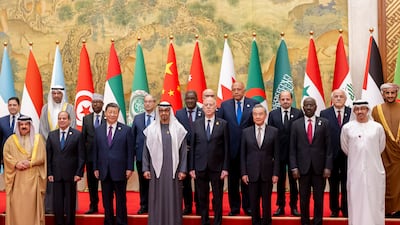
  • President Sheikh Mohamed during the China-Arab States Co-operation Forum, at Diaoyutai State Guesthouse alongside Sheikh Abdullah bin Zayed, UAE Minister of Foreign Affairs, Tunisian President Kais Saied, Chinese President Xi Jinping, Egyptian President Abdel Fattah El Sisi and Bahrain's King Hamad. Photo: Mohamed Al Hammadi / UAE Presidential Court
    President Sheikh Mohamed during the China-Arab States Co-operation Forum, at Diaoyutai State Guesthouse alongside Sheikh Abdullah bin Zayed, UAE Minister of Foreign Affairs, Tunisian President Kais Saied, Chinese President Xi Jinping, Egyptian President Abdel Fattah El Sisi and Bahrain's King Hamad. Photo: Mohamed Al Hammadi / UAE Presidential Court
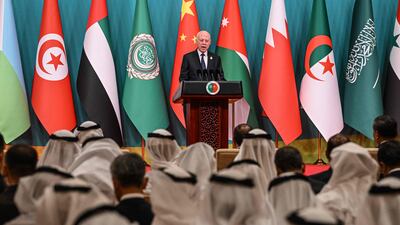
  • President Sheikh Mohamed delivers a speech during the China-Arab States Co-operation Forum. Photo: Omar Askar / UAE Presidential Court
    President Sheikh Mohamed delivers a speech during the China-Arab States Co-operation Forum. Photo: Omar Askar / UAE Presidential Court
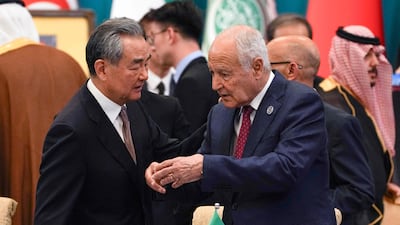
  • Chinese Foreign Minister Wang Yi talks with Arab League Secretary General Ahmed Aboul Gheit during the 10th Ministerial Meeting of China-Arab States Co-operation Forum in Beijing. AFP
    Chinese Foreign Minister Wang Yi talks with Arab League Secretary General Ahmed Aboul Gheit during the 10th Ministerial Meeting of China-Arab States Co-operation Forum in Beijing. AFP
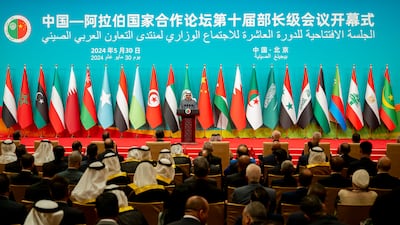
  • China’s President Xi Jinping gives a speech during the opening ceremony in Beijing. AFP
    China’s President Xi Jinping gives a speech during the opening ceremony in Beijing. AFP
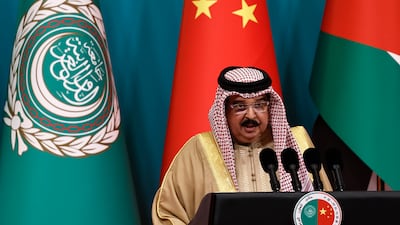
  • Bahrain's King Hamad at the China-Arab States Co-operation Forum. AP
    Bahrain's King Hamad at the China-Arab States Co-operation Forum. AP
  • Tunisia’s President Kais Saied delivers a speech during the opening ceremony in Beijing. AFP
    Tunisia’s President Kais Saied delivers a speech during the opening ceremony in Beijing. AFP
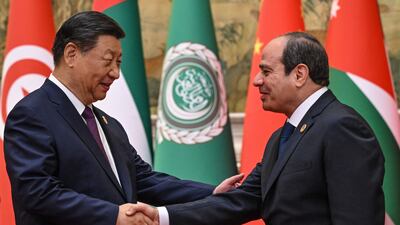
  • China’s President Xi Jinping greets Egypt’s President Abdel Fattah El Sisi before the opening ceremony of the summit in Beijing. AFP
    China’s President Xi Jinping greets Egypt’s President Abdel Fattah El Sisi before the opening ceremony of the summit in Beijing. AFP
  • Chinese Foreign Minister Wang Yi speaks to Arab League Secretary General Ahmed Aboul Gheit as he chairs the 10th ministerial meeting of the China-Arab States Co-operation Forum. AP
    Chinese Foreign Minister Wang Yi speaks to Arab League Secretary General Ahmed Aboul Gheit as he chairs the 10th ministerial meeting of the China-Arab States Co-operation Forum. AP

The potential for more renminbi-based oil trade hinges on exporters' willingness to accept the Chinese currency for payment and that depends on their ability to use the resulting proceeds, the report said.

However, since the yuan is not widely used in international trade and finance, there are relatively fewer spending opportunities, the agency added.

Saudi Arabia is China's largest trading partner in the Gulf. The kingdom's trade surplus with China has widened from the lows of $5 billion to $10 billion in 2015-2016 to $20 billion to $40 billion in the past three years, the report said.

Crude oil accounted for about 84 per cent of China’s imports from Saudi Arabia in 2023, up from about 67 per cent a decade ago, S&P said.

The yuan is now the fourth most-transacted currency, having overtaken the Japanese yen last year, according to data from Swift.

Its rise represents a shift in the global financial landscape towards a more multipolar system, challenging the historical dominance of western currencies and financial markets.

The Chinese currency’s share as a global trade settlement currency has continued to grow despite China’s weakening exports to western countries.

Attempts to increase the yuan's global use were undone by a sharp depreciation in late 2015. However, by early 2022, escalating geopolitical risks caused a resurgence in its role in global trade.

“These episodes underscore the pull forces of trade and the push forces of geopolitical risks that continue to characterise the renminbi’s use,” S&P said.

“Both these forces are at play in the use of the currency in Saudi-China trade.”

Riyadh has been focused on maintaining a balance between its relationship with its primary security ally, the US, and its relationships with China and Russia, its key energy partner within Opec.

Last year, China and Saudi Arabia signed a local currency swap agreement worth $7 billion as part of efforts to boost trade using their currencies and reduce reliance on the dollar.

More recently, Saudi Arabia became a participant in the mBridge project, a collaborative effort to develop a new system for cross-border payments using central bank digital currencies.

It was launched in 2021 between the central banks of China, Hong Kong, Thailand and the UAE.

“Escalating geopolitical events, shifting national interests and growing non-US trade, particularly with Asia, in recent years led some emerging economies to look to diversify their external relations,” S&P said.

Dollar dominance

Gulf exporters’ currencies are pegged to the US dollar, including those of Saudi Arabia, the UAE, Iraq and Oman.

If the dollar appreciates against the yuan, as it has been doing for the past year, selling oil in the Chinese currency will cut their incomes in domestic-currency terms, the agency said.

“Moreover, Beijing has yet to lay out a road map for resolving these issues and for liberalising the country’s currency and capital account,” S&P said.

“This leaves a high degree of uncertainty on the ability to manage future petroyuan-related risks.”

About 88 per cent of all foreign currency transactions have the dollar on one side, while half of all international trade is conducted in dollars.

Although the dollar remains the most dominant currency in the foreign exchange reserves of the world's central banks, its share in these reserves has decreased from more than 70 per cent in 2000 to about 55 per cent in the last quarter of 2023, after accounting for exchange-rate and interest-rate adjustments, International Monetary Fund data shows.

Growing partnership

Saudi Arabia’s Vision 2030 programme, which aims to reduce the country’s dependence on oil exports and diversify its economy, along with its plans to host major events, may lead to increased collaboration with Chinese entities, the report said.

The kingdom will host the Asian Winter Games 2029, Expo 2030 and the Fifa World Cup 2034.

“For China, yuan-based oil trade and the resulting Saudi need to spend future yuan proceeds would provide self-sustaining logic for Saudi Arabia’s participation in China’s Belt and Road Initiative,” S&P said.

The Belt and Road Initiative, a mega project launched in 2013, aims to connect several countries in Asia, Europe and Africa through a network of infrastructure and trade-related projects.


What is Folia?

Prince Khaled bin Alwaleed bin Talal's new plant-based menu will launch at Four Seasons hotels in Dubai this November. A desire to cater to people looking for clean, healthy meals beyond green salad is what inspired Prince Khaled and American celebrity chef Matthew Kenney to create Folia. The word means "from the leaves" in Latin, and the exclusive menu offers fine plant-based cuisine across Four Seasons properties in Los Angeles, Bahrain and, soon, Dubai.

Kenney specialises in vegan cuisine and is the founder of Plant Food Wine and 20 other restaurants worldwide. "I’ve always appreciated Matthew’s work," says the Saudi royal. "He has a singular culinary talent and his approach to plant-based dining is prescient and unrivalled. I was a fan of his long before we established our professional relationship."

Folia first launched at The Four Seasons Hotel Los Angeles at Beverly Hills in July 2018. It is available at the poolside Cabana Restaurant and for in-room dining across the property, as well as in its private event space. The food is vibrant and colourful, full of fresh dishes such as the hearts of palm ceviche with California fruit, vegetables and edible flowers; green hearb tacos filled with roasted squash and king oyster barbacoa; and a savoury coconut cream pie with macadamia crust.

In March 2019, the Folia menu reached Gulf shores, as it was introduced at the Four Seasons Hotel Bahrain Bay, where it is served at the Bay View Lounge. Next, on Tuesday, November 1 – also known as World Vegan Day – it will come to the UAE, to the Four Seasons Resort Dubai at Jumeirah Beach and the Four Seasons DIFC, both properties Prince Khaled has spent "considerable time at and love". 

There are also plans to take Folia to several more locations throughout the Middle East and Europe.

While health-conscious diners will be attracted to the concept, Prince Khaled is careful to stress Folia is "not meant for a specific subset of customers. It is meant for everyone who wants a culinary experience without the negative impact that eating out so often comes with."

Jetour T1 specs

Engine: 2-litre turbocharged

Power: 254hp

Torque: 390Nm

Price: From Dh126,000

Available: Now

MATCH INFO

Serie A

Juventus v Fiorentina, Saturday, 8pm (UAE)

Match is on BeIN Sports

COMPANY PROFILE
Name: Kumulus Water
 
Started: 2021
 
Founders: Iheb Triki and Mohamed Ali Abid
 
Based: Tunisia 
 
Sector: Water technology 
 
Number of staff: 22 
 
Investment raised: $4 million 
SHALASH%20THE%20IRAQI
%3Cp%3EAuthor%3A%20Shalash%3Cbr%3ETranslator%3A%20Luke%20Leafgren%3Cbr%3EPages%3A%20352%3Cbr%3EPublisher%3A%20And%20Other%20Stories%3C%2Fp%3E%0A

Directed: Smeep Kang
Produced: Soham Rockstar Entertainment; SKE Production
Cast: Rishi Kapoor, Jimmy Sheirgill, Sunny Singh, Omkar Kapoor, Rajesh Sharma
Rating: Two out of five stars 

How to play the stock market recovery in 2021?

If you are looking to build your long-term wealth in 2021 and beyond, the stock market is still the best place to do it as equities powered on despite the pandemic.

Investing in individual stocks is not for everyone and most private investors should stick to mutual funds and ETFs, but there are some thrilling opportunities for those who understand the risks.

Peter Garnry, head of equity strategy at Saxo Bank, says the 20 best-performing US and European stocks have delivered an average return year-to-date of 148 per cent, measured in local currency terms.

Online marketplace Etsy was the best performer with a return of 330.6 per cent, followed by communications software company Sinch (315.4 per cent), online supermarket HelloFresh (232.8 per cent) and fuel cells specialist NEL (191.7 per cent).

Mr Garnry says digital companies benefited from the lockdown, while green energy firms flew as efforts to combat climate change were ramped up, helped in part by the European Union’s green deal. 

Electric car company Tesla would be on the list if it had been part of the S&P 500 Index, but it only joined on December 21. “Tesla has become one of the most valuable companies in the world this year as demand for electric vehicles has grown dramatically,” Mr Garnry says.

By contrast, the 20 worst-performing European stocks fell 54 per cent on average, with European banks hit by the economic fallout from the pandemic, while cruise liners and airline stocks suffered due to travel restrictions.

As demand for energy fell, the oil and gas industry had a tough year, too.

Mr Garnry says the biggest story this year was the “absolute crunch” in so-called value stocks, companies that trade at low valuations compared to their earnings and growth potential.

He says they are “heavily tilted towards financials, miners, energy, utilities and industrials, which have all been hit hard by the Covid-19 pandemic”. “The last year saw these cheap stocks become cheaper and expensive stocks have become more expensive.” 

This has triggered excited talk about the “great value rotation” but Mr Garnry remains sceptical. “We need to see a breakout of interest rates combined with higher inflation before we join the crowd.”

Always remember that past performance is not a guarantee of future returns. Last year’s winners often turn out to be this year’s losers, and vice-versa.

Updated: August 22, 2024, 9:14 AM