

The EU's new carbon pricing scheme could bolster the Middle East's role as a viable energy trade partner, prompting increased investment in fuels such as green and blue hydrogen and the adaptation of existing regional carbon pricing mechanisms, experts say.
The first phase of the newly created Carbon Border Adjustment Mechanism (CBAM), designed to protect European companies that pay for their emissions under the EU's trading system from unfair competition from imports from countries without carbon pricing, went into effect on October 1, 2023.
Starting from January 1, 2026, importers will need to purchase certificates to cover the embodied emissions in the goods they import. The price of the certificates will be determined based on the weekly average auction price of EU Emissions Trading System (ETS) allowances, which is measured in euros per tonne of carbon dioxide emitted.
The regulation currently focuses on carbon-intensive goods like cement, iron and steel, aluminium, fertilisers, electricity, and hydrogen products.
Once CBAM is fully implemented in 2034, it is expected to increase the marginal cost of those commodities by an average of 10 per cent, according to consultancy Engie Impact.
-
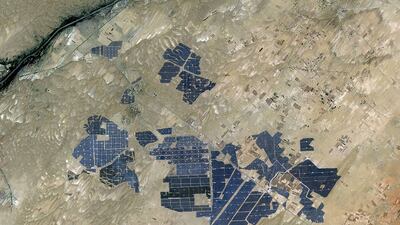
The solar park covers an area of 56 square kilometers. Photo: Alamy -
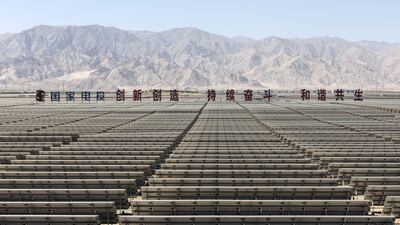
The 200 megawatt structure is the second biggest in the world. Bloomberg -
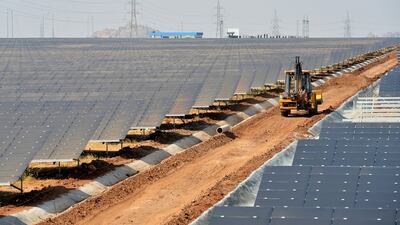
The park covers an area of 53 square kilometres. AFP -
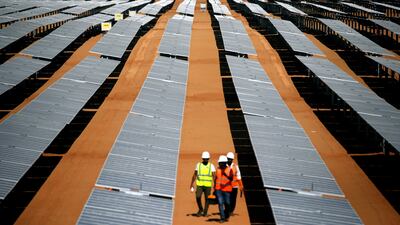
The Egyptian plant has a capacity of 1650 megawatts. Reuters. -
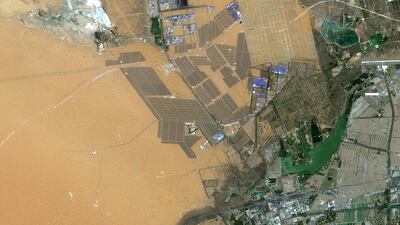
The solar farm in China is in the fourth largest desert in China. Getty


To avoid CBAM costs, energy exporting countries in the Gulf and the broader Middle East may develop their own compatible carbon pricing mechanisms, allowing the countries to capture and reinvest carbon revenue domestically, experts tell The National.
Among them is Evangelos Beis, executive director at Blue Marble Disruptive Technology, an Athens-based green energy company.
It is also one of the few companies in the EU that is certified to perform carbon sequestration or removals in compliance with the European climate law, whose main objective is to achieve climate neutrality in the bloc by 2050, claims Mr Beis.
Blue Marble is also involved in reducing emissions, producing clean energy, and providing carbon offsetting solutions to its clients, including telecom operators, utilities, and traders in Greece and wider Europe.
“A few of the Middle Eastern corporates will benefit substantially out of this process. I also believe that those who support the decarbonisation process by carbon offsetting, but under certain standards or regulations, will benefit even more,” Mr Beis said.
Mr Beis said that the Middle East, responsible for around a third of global crude supply, requires a “more formal” carbon offsetting market as opposed to the current system of voluntary carbon credits.
He said that the impact of existing voluntary carbon credits on decarbonisation process and climate crisis is limited. Mr Beis claimed that most of the credits in the global market were "stranded assets", which lose value or turn into liabilities over time.
Carbon credits, also known as carbon offsets, are permits that allow companies to emit a certain amount of carbon dioxide or other greenhouse gases. These credits can be bought if more are needed and sold if not used, with the proceeds from their sale used to finance climate action projects that would not otherwise be feasible
Although carbon offsets have faced criticism from some activists over transparency and the quality of certain projects, others believe carbon markets are more legitimate and realistic paths to clean energy transition.
"The voluntary carbon market is currently the most effective way for them (companies) to address these emissions by mobilising billions of dollars in private sector finance every year," said Campbell Moore, Managing Director of Carbon Markets at The Nature Conservatory, and others writing for the World Economic Forum in an August blog post last year titled "Why voluntary carbon markets for nature are needed right now”.
Major issues still remain, the post stated, citing that carbon credits need to be used properly to be effective in the still nascent market.
Andrea Zanon, chief executive of WeEmpower Capital, said that despite being in their early stages, voluntary carbon markets are gaining momentum.
He told The National that the Cop28 climate conference, which took place in Dubai last year, spurred several Middle Eastern countries to introduce carbon compliance regulations to hasten their transition to net-zero emissions.
Last year, the Dubai Financial Market announced a pilot programme for trading carbon credits. In 2022, Abu Dhabi Global Market, the UAE capital's financial free zone, teamed up with AirCarbon Exchange to create the “world’s first fully regulated” carbon trading exchange.
In Saudi Arabia, the Regional Voluntary Carbon Market Company (RVCMC) was established by the Public Investment Fund (PIF) and the stock exchange operator, the Tadawul Group, in October 2022.
"By establishing carbon markets and investing in carbon offsetting projects, Saudi Arabia and the UAE are attracting foreign investment in cleantech and forging new international partnerships," Mr Zanon said, including with EU countries.
There's also a wider push globally as international standardised frameworks for trading credits remain on hold. During Cop28, countries failed to reach agreement on the rules for key mechanisms, notably Article 6.4, which oversees the international market under the UN.
Therefore, the demand for independent regulation is growing, according to Wood Mackenzie, a UK-based energy consultancy.
"Reputable bodies are improving the guidance for project developers on what constitutes high-quality offset projects and providing clarity on offset choices for buyers," it said in a March research note.
Green push

Middle Eastern countries are already investing heavily in renewable energy and green hydrogen, and CBAM could accelerate these investments as producers seek to avoid carbon tariffs and position themselves as suppliers of low-carbon energy.
“The Gulf producers will be the biggest winners and beneficiaries of CBAM if they play their cards right, that is, accelerate investment in blue and green hydrogen, and secure long-term contracts for light crude delivery to Europe,” Mr Zanon said.
“Carbon-intensive hydrogen and derivatives from countries with low-cost feedstock like Saudi Arabia will still remain competitive into the EU for some time, but grey hydrogen will be replaced,” he added.
Blue and grey hydrogen are derived from natural gas while green hydrogen is produced using renewable sources.
Major national oil companies like Saudi Aramco and Adnoc are making substantial investments in carbon capture and establishing a hydrogen supply chain, which is seen as crucial for abating carbon emissions in industries such as shipping and steel manufacturing.
The UAE, through its clean energy company Masdar, has also signed several agreements to export green hydrogen to Europe and other regions. This includes partnerships to develop green hydrogen production facilities and infrastructure.
The EU has an ambitious green hydrogen import target of 10 million tonnes by 2030 and sees the Middle East as a significant supplier.
There are 14 potential supplier countries for renewable hydrogen; currently, only six of these – Australia, Chile, Morocco, Oman, Saudi Arabia, and the UAE – have indicated clear export intentions by 2030, the Oxford Institute for Energy Studies said in a report last year.
Saudi Arabia is the EU’s top trading partner among the GCC countries, with bilateral trade in goods worth €75 billion ($81.5 billion) annually and EU investments into the kingdom growing by 50 per cent between 2020 and 2022, according to EU data from last month.
Meanwhile, the GCC region is the EU’s 6th largest export market and an important source and destination of investment for EU member states.
Crude advantage
EU’s carbon framework currently does not cover liquefied natural gas and crude oil imports, but analysts have said those commodities could be added to the list in a few years.
Wood Mackenzie, which expects oil production and refining to be included in the regulation in 2028 and fully covered by 2036, said CBAM would increase the cost of doing business in the EU by stacking up carbon charges along the oil value chain.
However, crude oil exported from the Middle East, which generally has lower emissions compared to grades from regions like West Africa or Russia, could become more competitive in the European market under the new carbon regime, the consultancy said in a September report.
Under the pricing scheme, the cost of US West Texas Intermediate and Middle Eastern crudes such as Arab Heavy and Arab Light would rise by less than $1 per barrel, the report said.
Meanwhile, the cost of Bonny light, Nigeria's main crude grade, is set to jump by more than $3 a barrel, while Russia's Urals crude blend will see an increase of more than $2 a barrel for importers, it added.
Russia sanctions have made Europe more dependent on crude shipments from the Middle East.
In the second quarter of 2022, Russia was the top supplier of petroleum oils to the EU, with nearly 16 per cent of total imports, according to EU data.
However, by the second quarter of last year, Russia's ranking dropped to 12th place, with its share decreasing significantly to 2.7 per cent.
Saudi Arabia boosted its share by 2.3 percentage points to reach 9 per cent, while Libya also emerged as a significant partner, accounting for 8.1 per cent of EU petroleum oil imports.

