

India will auction about 20 blocks of critical minerals in the next week as the country looks to secure domestic supplies of the raw materials, considered key for clean energy transition.
India has made “necessary amendments” in its mines and minerals law to speed up the exploration of critical minerals, Kantha Rao, secretary of the ministry of mines, told attendees at the IEA Critical Minerals Summit in Paris on Thursday.
“The focus on critical minerals in India has been enhanced through more exploratory activities… and over the last couple of years we have about 124 new projects that have been lined up,” Mr Rao said.
Earlier this year, India found 5.9 million tonnes of lithium reserves in the Jammu and Kashmir region, and the government had said it hoped to find more reserves later this year.
The country aims to have electric vehicles account for 30 per cent of car sales by 2030, as it strives to cut its carbon emissions and dependence on crude oil imports. It plans to reach net-zero emissions by 2070.
Last month, an official from India’s mining ministry said preparations had begun to start the auction process for about 100 critical mineral blocks in the next four months.
The blocks are for minerals including nickel, lithium, cobalt, and platinum, along with rare earths, mines secretary Vivek Bharadwaj told Bloomberg.
The market for critical minerals, used in electric vehicles and renewable energy technologies, more than doubled in size over the past five years, according to the International Energy Agency.
From 2017 to 2022, the energy sector drove a threefold increase in lithium demand, a 70 per cent surge in cobalt demand and a 40 per cent increase in the demand for nickel, the Paris-based agency said in its Critical Minerals Market Review in July.
The energy transition minerals market reached $320 billion in 2022, moving it increasingly to the centre stage for the global mining industry, the IEA said.

“There is a risk that this clean energy transition moving fast may be hinging on whether or not the world will have enough critical minerals at the right time and at [an] affordable price,” Fatih Birol, IEA’s executive director, said on Thursday.
Mr Birol also said supply chain risks were posed by the concentration of production and refining of critical minerals in a few countries.
“The magic word is diversification… [and]while the investments are growing, the concentration is growing as well,” he said.
US energy secretary Jennifer Granholm, who was also speaking at the event, urged policymakers to think “creatively” when it came to critical minerals.
“We've got to align across our innovation ecosystems, permitting processes, market transparency, and more, so that when supply disruptions strike, we'll have a broad set of tools to aid in our response,” Ms Granholm said.
The exploitation of critical minerals should not turn into a “race to the bottom” and companies should look “beyond the balance sheets” to ensure fair wages, safe working conditions and environmental protections, she said.
EU internal market commissioner Thierry Breton told participants at the event that Europe intends to be a “strong partner” in critical minerals collaborations.
“Today, the EU industry remains a world leader in mining equipment as well as…recycling facilities, but it's fair to say that we lost we lost our competitive edge in mining and in processing for many reasons,” Mr Breton said.
Miners operating in the region face several hurdles including administrative complexity and high energy prices, he added.
“Also, let us be honest. We have [for] maybe too long considered that decarbonising meant relocating outside of the EU, and this was wrong. We need to change that.”
-
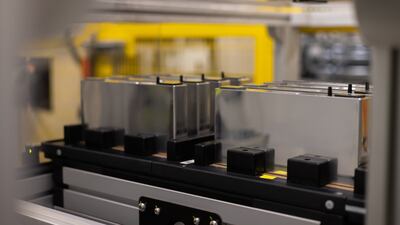
Northvolt, which counts BMW and Volkswagen among its investors, last year delivered its first battery cells from its gigafactory in Sweden. Photo: Northvolt AB -
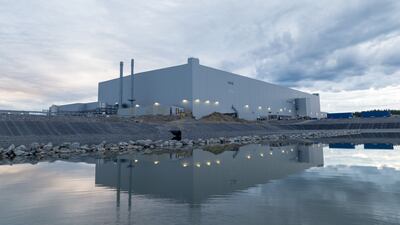
The factory is racing to electrify Europe's vehicle manufacturing sector as governments restrict the sale of petrol and diesel vehicles to meet decarbonisation targets. Photo: Northvolt AB -
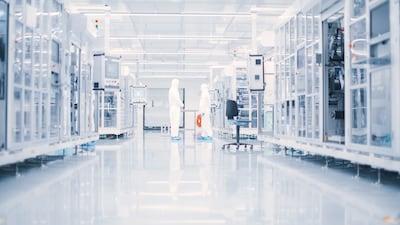
The electric battery plant aims to have an annual production capacity of 60 gigawatt hours, which will be enough to power hundreds of thousands of vehicles. Photo: Northvolt AB -

The power plant is located in Skelleftea, a small city in north-eastern Sweden, which is surrounded by pine forests and lakes. Daniel Bardsley / The National -

Northvolt is part of the Swedish green investment company Vargas. Photo: Northvolt AB -

The gigafactory has attracted workers from around the globe, with more than 80 nationalities working on site. Daniel Bardsley / The National -

The company has about 1,800 employees, but when the plant is completed in two years' time, that figure is set to rise to about 4,000. Daniel Bardsley / The National -

Helena Renstrom said that the company can guarantee 100 per cent renewable energy in Skelleftea. Daniel Bardsley / The National -

The company says it has been able to cut emissions by 70 per cent compared to a Chinese-produced electric cary battery. Daniel Bardsley / The National -

Sanna Backstrom, communications manager for Northvolt, said the company has grown from nothing to a functioning production facility in two years. Bardsley / The National -

Carl-Erik Lagercrantz, chief executive of parent company Vargas, said Northvolt is a key part of the European transition to electric vehicles. AFP



