The UK Minister for Energy Security and Net Zero, Grant Shapps. PA

UK and US back nuclear and renewables for greater energy independence


Soraya Ebrahimi
  • English
  • Arabic

British Energy Security Secretary Grant Shapps has committed the country to greater energy independence through nuclear and renewables after a meeting with his US equivalent, the government said.

Mr Shapps met US Energy Secretary Jennifer Granholm in London on Monday and said Russian President Vladimir Putin’s invasion of Ukraine in February 2022 has shown the need to hasten the move away from fossil fuel dependence.

They reaffirmed their support for Ukraine, whose citizens have suffered missile attacks on energy infrastructure in the winter, and said they wanted to undermine Mr Putin’s ability to wage war by weaning western countries off Russian oil and gas.

“Secretary Granholm and I stand shoulder to shoulder in our unending support for Ukraine and in ensuring that neither Putin nor any tyrant ever think they can hold the world to ransom through their energy supply," said Mr Shapps, head of the new Energy Security and Net Zero department.

“The war has shown the UK, the US and countries the world over the need for ever greater energy independence, fuelled by moves away from fossil fuels and towards homegrown sources like renewables and nuclear.

“Today I’m pledging to deliver that energy independence, backed by my ambition for lower wholesale electricity prices in the longer term.”

The two also met green entrepreneurs, the government said, to try to encourage more investment between British and American companies.

“This will also open up opportunities for UK and US companies to work together at the cutting edge of these technologies, while also strengthening the historic ties of co-operation between our two countries," Mr Shapps said.

The UK took delivery of its first nuclear reactor in more than 30 years at Hinkley Point C, in Somerset.

Green energy sources - in pictures

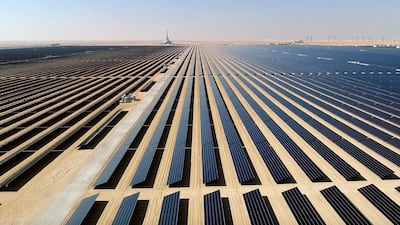
  • The Mohammed bin Rashid Al Maktoum Solar Park is located about 50 kilometres south of Dubai. AP
    The Mohammed bin Rashid Al Maktoum Solar Park is located about 50 kilometres south of Dubai. AP
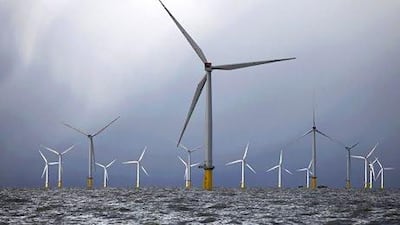
  • Masdar, the Abu Dhabi clean energy company, owns a one-fifth stake in London Array, the offshore wind farm in the Thames estuary. Chris Ratcliffe / Bloomberg News
    Masdar, the Abu Dhabi clean energy company, owns a one-fifth stake in London Array, the offshore wind farm in the Thames estuary. Chris Ratcliffe / Bloomberg News
  • A hydro plant in Himachal Pradesh, India. Photo: Abu Dhabi National Energy Company (TAQA)
    A hydro plant in Himachal Pradesh, India. Photo: Abu Dhabi National Energy Company (TAQA)
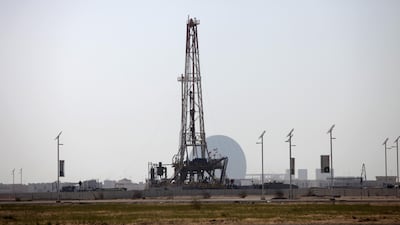
  • The Geothermal Pilot Project drills 4km beneath Masdar City in search of boiling temperatures to generate electricity and fuel the city's cooling system. Nicole Hill /The National
    The Geothermal Pilot Project drills 4km beneath Masdar City in search of boiling temperatures to generate electricity and fuel the city's cooling system. Nicole Hill /The National
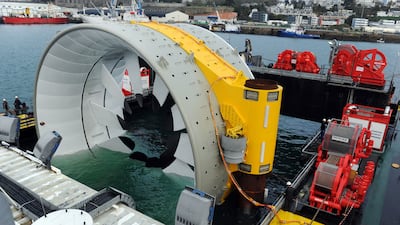
  • A hydroelectric motor at a tidal farm in the harbour of Brest, in western France. AFP
    A hydroelectric motor at a tidal farm in the harbour of Brest, in western France. AFP

The 500-tonne reactor is the first of two to be installed. The plant says it will produce enough electricity to power three million homes.

It was made in France and taken to the site from Avonmouth Docks in Bristol, having come from the same factory as the last reactor for a British power station, at Sizewell B in Suffolk, which became operational in 1995.

“The United States stands alongside the United Kingdom in support of Ukraine against Russia’s brutal war and its weaponisation of energy markets," Ms Granholm said.

“We are keenly aware that remaining overly reliant on fossil fuels puts our energy security at risk and that the solution lies in diversifying our fuel sources through the deployment of clean energy.

“The Biden-Harris administration has put into place powerful tools, such as the inflation reduction act and the bipartisan infrastructure law, to lower costs and advance new energy technologies.

"And we look forward to continue building on a long history of collaboration around our shared clean energy ambitions that will deliver homegrown security and greater independence.”


SUCCESSION%20SEASON%204%20EPISODE%201
%3Cp%3E%3Cstrong%3ECreated%20by%3A%20%3C%2Fstrong%3EJesse%20Armstrong%3C%2Fp%3E%0A%3Cp%3E%3Cstrong%3EStars%3A%3C%2Fstrong%3E%20Brian%20Cox%2C%20Jeremy%20Strong%2C%20Kieran%20Culkin%2C%20Sarah%20Snook%2C%20Nicholas%20Braun%3C%2Fp%3E%0A%3Cp%3E%3Cstrong%3ERating%3A%3C%2Fstrong%3E%204%2F5%3C%2Fp%3E%0A
The President's Cake

Director: Hasan Hadi

Starring: Baneen Ahmad Nayyef, Waheed Thabet Khreibat, Sajad Mohamad Qasem 

Rating: 4/5

Ten tax points to be aware of in 2026

1. Domestic VAT refund amendments: request your refund within five years

If a business does not apply for the refund on time, they lose their credit.

2. E-invoicing in the UAE

Businesses should continue preparing for the implementation of e-invoicing in the UAE, with 2026 a preparation and transition period ahead of phased mandatory adoption. 

3. More tax audits

Tax authorities are increasingly using data already available across multiple filings to identify audit risks. 

4. More beneficial VAT and excise tax penalty regime

Tax disputes are expected to become more frequent and more structured, with clearer administrative objection and appeal processes. The UAE has adopted a new penalty regime for VAT and excise disputes, which now mirrors the penalty regime for corporate tax.

5. Greater emphasis on statutory audit

There is a greater need for the accuracy of financial statements. The International Financial Reporting Standards standards need to be strictly adhered to and, as a result, the quality of the audits will need to increase.

6. Further transfer pricing enforcement

Transfer pricing enforcement, which refers to the practice of establishing prices for internal transactions between related entities, is expected to broaden in scope. The UAE will shortly open the possibility to negotiate advance pricing agreements, or essentially rulings for transfer pricing purposes. 

7. Limited time periods for audits

Recent amendments also introduce a default five-year limitation period for tax audits and assessments, subject to specific statutory exceptions. While the standard audit and assessment period is five years, this may be extended to up to 15 years in cases involving fraud or tax evasion. 

8. Pillar 2 implementation 

Many multinational groups will begin to feel the practical effect of the Domestic Minimum Top-Up Tax (DMTT), the UAE's implementation of the OECD’s global minimum tax under Pillar 2. While the rules apply for financial years starting on or after January 1, 2025, it is 2026 that marks the transition to an operational phase.

9. Reduced compliance obligations for imported goods and services

Businesses that apply the reverse-charge mechanism for VAT purposes in the UAE may benefit from reduced compliance obligations. 

10. Substance and CbC reporting focus

Tax authorities are expected to continue strengthening the enforcement of economic substance and Country-by-Country (CbC) reporting frameworks. In the UAE, these regimes are increasingly being used as risk-assessment tools, providing tax authorities with a comprehensive view of multinational groups’ global footprints and enabling them to assess whether profits are aligned with real economic activity. 

Contributed by Thomas Vanhee and Hend Rashwan, Aurifer

Updated: February 28, 2023, 2:24 AM