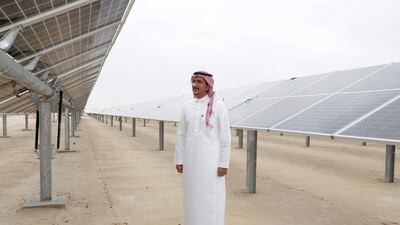
The share of renewable energy in the UAE’s power generation mix is set to increase from 7 per cent in 2020 to 21 per cent in 2030, and to 44 per cent by 2050. Photo: Masdar

AD Ports' Kezad Group and TotalEnergies to explore solar power generation


  • English
  • Arabic

Kezad Group, a subsidiary of AD Ports Group, has signed an agreement with French energy company TotalEnergies to explore solar power generation in its economic zones.

Under the deal, the companies will conduct a series of feasibility studies for distributed solar generation at Kezad covering economic, commercial, regulatory and technical aspects, AD Ports said in a statement on Monday.

The deal was signed with TotalEnergies' Renewables Distributed Generation, which develops and operates solar installations for industrial and commercial clients.

“We are keen to realise the complete potential of distributed solar generation across our integrated ecosystem at Kezad Group, and to enhance the value proposition we can offer to our investors while supporting Abu Dhabi and the UAE’s sustainability goals,” Mohamed Al Ahmed, chief executive of Kezad Group, said.

AD Ports, the operator of industrial cities and free zones in Abu Dhabi, launched Kezad Group in September to consolidate and grow its Economic Cities & Free Zones offering, as it seeks to strengthen the emirate's position as an industrial and manufacturing hub.

The company's Khalifa Industrial Zone Abu Dhabi (Kizad) and ZonesCorp (specialised economic zones) have been integrated into the newly formed Kezad Group (Khalifa Economic Zones Abu Dhabi Group), which comprises 12 economic zones with a total area of 550 square kilometres, including 100 sq km designated as free zones.

The UAE is pursuing goals to reduce its carbon footprint and became the first country in the Middle East to set a net-zero target last year. The Emirates aims to achieve carbon neutrality by 2050 and plans to invest $160 billion on clean and renewable energy sources over the next three decades.

It is building the Mohammed bin Rashid Solar Park in Dubai with a five-gigawatt capacity. Abu Dhabi, which is developing a two-gigawatt solar plant in its Al Dhafra region, has set a target of 5.6 gigawatts of solar PV capacity by 2026.

“This agreement is a stepping stone for many future opportunities,” said Hamady Sy, managing director of TotalEnergies Renewables Distributed Generation Middle East and Africa.

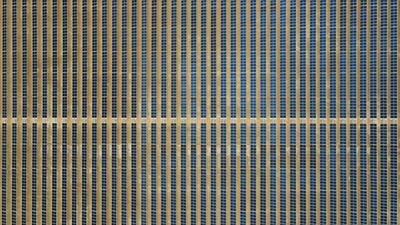
  • An aerial view of Mohammed bin Rashid Solar Park in Dubai in January 2022. Solar is essential to the UAE's new energy mix. All photos by Pawan Singh / The National
    An aerial view of Mohammed bin Rashid Solar Park in Dubai in January 2022. Solar is essential to the UAE's new energy mix. All photos by Pawan Singh / The National
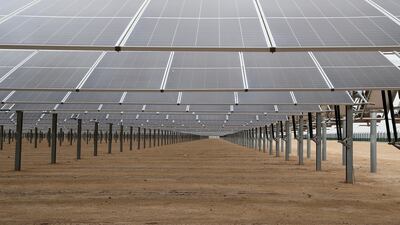
  • The fifth phase of a clean energy project at the Mohammed bin Rashid Solar Park will further help reduce carbon emissions.
    The fifth phase of a clean energy project at the Mohammed bin Rashid Solar Park will further help reduce carbon emissions.
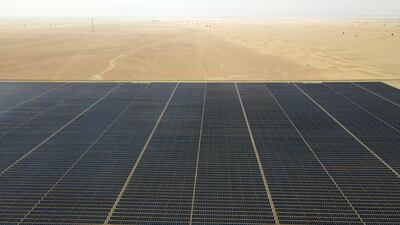
  • An aerial view of the Solar Park in the Dubai desert.
    An aerial view of the Solar Park in the Dubai desert.
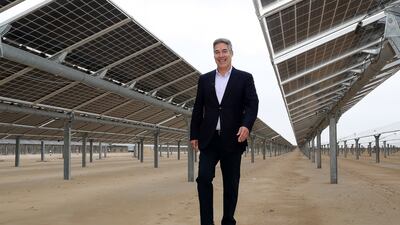
  • Marco Garcia, chief commercial officer of Nextracker, a US company which has provided photovoltaic technology used in the project.
    Marco Garcia, chief commercial officer of Nextracker, a US company which has provided photovoltaic technology used in the project.
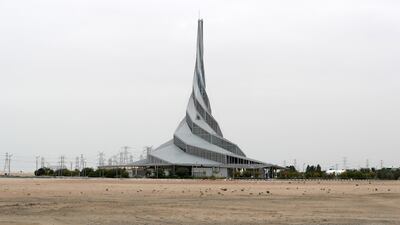
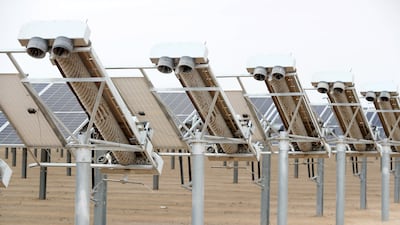
  • The Innovation Centre at the MBR Solar Park in Dubai, where machine learning is being utilised to track direct sunlight to maximise efficient energy capture, storage and transmission.
    The Innovation Centre at the MBR Solar Park in Dubai, where machine learning is being utilised to track direct sunlight to maximise efficient energy capture, storage and transmission.
  • The solar powered panels follow the path of the sun to help the emirate reach its clean energy transition goals.
    The solar powered panels follow the path of the sun to help the emirate reach its clean energy transition goals.
  • Omar Al Hassan, chief executive of Shuaa Energy 3, the company operating the scheme, says the vast project will ultimately create clean energy to power more than 250,000 houses in Dubai.
    Omar Al Hassan, chief executive of Shuaa Energy 3, the company operating the scheme, says the vast project will ultimately create clean energy to power more than 250,000 houses in Dubai.
  • Robotic cleaning systems are installed on the solar panels.
    Robotic cleaning systems are installed on the solar panels.
  • More than 2.5 million photovoltaic modules have been fitted during phase 5 of the project.
    More than 2.5 million photovoltaic modules have been fitted during phase 5 of the project.

The UAE has also been investing heavily in renewable energy projects in other markets.

Last week, Abu Dhabi’s clean energy company Masdar signed a preliminary agreement with Jordan’s Ministry of Energy and Mineral Resources to develop renewable energy projects in the kingdom, strengthening its commitment to sustainability and decarbonisation.

The two entities will explore investment in renewable energy projects in Jordan with a production capacity of up to two gigawatts.

Masdar has more than $20bn of investments globally and is rapidly expanding its renewables portfolio as countries focus on cutting emissions to limit global warming.

This year, the company signed a number of new agreements to explore and develop renewable energy and green hydrogen projects after increasing its global clean energy portfolio capacity by 40 per cent in 2021.

Dubai-based AMEA Power signed a framework agreement with Egypt last week to develop a 1,000-megawatt green hydrogen project for the production of green ammonia.

The project, to be located in Egypt’s Suez Governorate, will have a capacity to produce 800,000 tonnes of green ammonia a year for domestic use and export.


Aston martin DBX specs

Engine: 4.0-litre twin-turbo V8

Transmission: nine-speed automatic

Power: 542bhp

Torque: 700Nm

Top speed: 291kph

Price: Dh848,000

On sale: Q2, 2020
 

The specs: 2018 Nissan 370Z Nismo

The specs: 2018 Nissan 370Z Nismo
Price, base / as tested: Dh182,178
Engine: 3.7-litre V6
Power: 350hp @ 7,400rpm
Torque: 374Nm @ 5,200rpm
Transmission: Seven-speed automatic
​​​​​​​Fuel consumption, combined: 10.5L / 100km

Mercer, the investment consulting arm of US services company Marsh & McLennan, expects its wealth division to at least double its assets under management (AUM) in the Middle East as wealth in the region continues to grow despite economic headwinds, a company official said.

Mercer Wealth, which globally has $160 billion in AUM, plans to boost its AUM in the region to $2-$3bn in the next 2-3 years from the present $1bn, said Yasir AbuShaban, a Dubai-based principal with Mercer Wealth.

Within the next two to three years, we are looking at reaching $2 to $3 billion as a conservative estimate and we do see an opportunity to do so,” said Mr AbuShaban.

Mercer does not directly make investments, but allocates clients’ money they have discretion to, to professional asset managers. They also provide advice to clients.

“We have buying power. We can negotiate on their (client’s) behalf with asset managers to provide them lower fees than they otherwise would have to get on their own,” he added.

Mercer Wealth’s clients include sovereign wealth funds, family offices, and insurance companies among others.

From its office in Dubai, Mercer also looks after Africa, India and Turkey, where they also see opportunity for growth.

Wealth creation in Middle East and Africa (MEA) grew 8.5 per cent to $8.1 trillion last year from $7.5tn in 2015, higher than last year’s global average of 6 per cent and the second-highest growth in a region after Asia-Pacific which grew 9.9 per cent, according to consultancy Boston Consulting Group (BCG). In the region, where wealth grew just 1.9 per cent in 2015 compared with 2014, a pickup in oil prices has helped in wealth generation.

BCG is forecasting MEA wealth will rise to $12tn by 2021, growing at an annual average of 8 per cent.

Drivers of wealth generation in the region will be split evenly between new wealth creation and growth of performance of existing assets, according to BCG.

Another general trend in the region is clients’ looking for a comprehensive approach to investing, according to Mr AbuShaban.

“Institutional investors or some of the families are seeing a slowdown in the available capital they have to invest and in that sense they are looking at optimizing the way they manage their portfolios and making sure they are not investing haphazardly and different parts of their investment are working together,” said Mr AbuShaban.

Some clients also have a higher appetite for risk, given the low interest-rate environment that does not provide enough yield for some institutional investors. These clients are keen to invest in illiquid assets, such as private equity and infrastructure.

“What we have seen is a desire for higher returns in what has been a low-return environment specifically in various fixed income or bonds,” he said.

“In this environment, we have seen a de facto increase in the risk that clients are taking in things like illiquid investments, private equity investments, infrastructure and private debt, those kind of investments were higher illiquidity results in incrementally higher returns.”

The Abu Dhabi Investment Authority, one of the largest sovereign wealth funds, said in its 2016 report that has gradually increased its exposure in direct private equity and private credit transactions, mainly in Asian markets and especially in China and India. The authority’s private equity department focused on structured equities owing to “their defensive characteristics.”

The specs
  • Engine: 3.9-litre twin-turbo V8
  • Power: 640hp
  • Torque: 760nm
  • On sale: 2026
  • Price: Not announced yet
Rebel%20Moon%20-%20Part%20One%3A%20A%20Child%20of%20Fire
%3Cp%3E%3Cstrong%3EDirector%3A%20%3C%2Fstrong%3EZack%20Snyder%3Cbr%3E%3Cstrong%3EStars%3A%20%3C%2Fstrong%3ESofia%20Boutella%2C%20Djimon%20Hounsou%2C%20Ed%20Skrein%2C%20Michiel%20Huisman%2C%20Charlie%20Hunnam%3Cbr%3E%3Cstrong%3ERating%3A%20%3C%2Fstrong%3E2%2F5%3C%2Fp%3E%0A
Singham Again

Director: Rohit Shetty

Stars: Ajay Devgn, Kareena Kapoor Khan, Ranveer Singh, Akshay Kumar, Tiger Shroff, Deepika Padukone

Rating: 3/5

The Gandhi Murder
  • 71 - Years since the death of MK Gandhi, also christened India's Father of the Nation
  • 34 - Nationalities featured in the film The Gandhi Murder
  • 7 - million dollars, the film's budget 
Teaching your child to save

Pre-school (three - five years)

You can’t yet talk about investing or borrowing, but introduce a “classic” money bank and start putting gifts and allowances away. When the child wants a specific toy, have them save for it and help them track their progress.

Early childhood (six - eight years)

Replace the money bank with three jars labelled ‘saving’, ‘spending’ and ‘sharing’. Have the child divide their allowance into the three jars each week and explain their choices in splitting their pocket money. A guide could be 25 per cent saving, 50 per cent spending, 25 per cent for charity and gift-giving.

Middle childhood (nine - 11 years)

Open a bank savings account and help your child establish a budget and set a savings goal. Introduce the notion of ‘paying yourself first’ by putting away savings as soon as your allowance is paid.

Young teens (12 - 14 years)

Change your child’s allowance from weekly to monthly and help them pinpoint long-range goals such as a trip, so they can start longer-term saving and find new ways to increase their saving.

Teenage (15 - 18 years)

Discuss mutual expectations about university costs and identify what they can help fund and set goals. Don’t pay for everything, so they can experience the pride of contributing.

Young adulthood (19 - 22 years)

Discuss post-graduation plans and future life goals, quantify expenses such as first apartment, work wardrobe, holidays and help them continue to save towards these goals.

* JP Morgan Private Bank 

The%20specs
%3Cp%3E%3Cstrong%3EEngine%3A%20%3C%2Fstrong%3E4.0-litre%20twin-turbo%20V8%0D%3Cbr%3E%3Cstrong%3EPower%3A%20%3C%2Fstrong%3E640hp%20at%206%2C000rpm%0D%3Cbr%3E%3Cstrong%3ETorque%3A%20%3C%2Fstrong%3E850Nm%20from%202%2C300-4%2C500rpm%0D%3Cbr%3E%3Cstrong%3ETransmission%3A%20%3C%2Fstrong%3E8-speed%20auto%0D%3Cbr%3E%3Cstrong%3EFuel%20consumption%3A%20%3C%2Fstrong%3E11.9L%2F100km%0D%3Cbr%3E%3Cstrong%3EPrice%3A%20%3C%2Fstrong%3EDh749%2C800%0D%3Cbr%3E%3Cstrong%3EOn%20sale%3A%20%3C%2Fstrong%3Enow%3C%2Fp%3E%0A
Profile

Co-founders of the company: Vilhelm Hedberg and Ravi Bhusari

Launch year: In 2016 ekar launched and signed an agreement with Etihad Airways in Abu Dhabi. In January 2017 ekar launched in Dubai in a partnership with the RTA.

Number of employees: Over 50

Financing stage: Series B currently being finalised

Investors: Series A - Audacia Capital 

Sector of operation: Transport

The drill

Recharge as needed, says Mat Dryden: “We try to make it a rule that every two to three months, even if it’s for four days, we get away, get some time together, recharge, refresh.” The couple take an hour a day to check into their businesses and that’s it.

Stick to the schedule, says Mike Addo: “We have an entire wall known as ‘The Lab,’ covered with colour-coded Post-it notes dedicated to our joint weekly planner, content board, marketing strategy, trends, ideas and upcoming meetings.”

Be a team, suggests Addo: “When training together, you have to trust in each other’s abilities. Otherwise working out together very quickly becomes one person training the other.”

Pull your weight, says Thuymi Do: “To do what we do, there definitely can be no lazy member of the team.” 

Dr Amal Khalid Alias revealed a recent case of a woman with daughters, who specifically wanted a boy.

A semen analysis of the father showed abnormal sperm so the couple required IVF.

Out of 21 eggs collected, six were unused leaving 15 suitable for IVF.

A specific procedure was used, called intracytoplasmic sperm injection where a single sperm cell is inserted into the egg.

On day three of the process, 14 embryos were biopsied for gender selection.

The next day, a pre-implantation genetic report revealed four normal male embryos, three female and seven abnormal samples.

Day five of the treatment saw two male embryos transferred to the patient.

The woman recorded a positive pregnancy test two weeks later. 

Key findings of Jenkins report
  • Founder of the Muslim Brotherhood, Hassan al Banna, "accepted the political utility of violence"
  • Views of key Muslim Brotherhood ideologue, Sayyid Qutb, have “consistently been understood” as permitting “the use of extreme violence in the pursuit of the perfect Islamic society” and “never been institutionally disowned” by the movement.
  • Muslim Brotherhood at all levels has repeatedly defended Hamas attacks against Israel, including the use of suicide bombers and the killing of civilians.
  • Laying out the report in the House of Commons, David Cameron told MPs: "The main findings of the review support the conclusion that membership of, association with, or influence by the Muslim Brotherhood should be considered as a possible indicator of extremism."
Updated: November 21, 2022, 2:16 PM