


In past booms, oil companies have been the fabled grasshopper in summer, enjoying the good times while laughing at the ants storing up food for winter.
Cash has been ploughed into more ambitious upstream projects at times of rising costs. Now, oil companies have a brief season of opportunity to transform themselves.
All the major European oil companies have big plans to expand into renewables and other low-carbon energy systems such as hydrogen, batteries and electric-vehicle charging.
They have set targets to be net-zero carbon in the “nearish” future and completely carbon neutral, including products they sell to their customers, by about 2050.
In April, Shell paid $1.8 billion inclusive of debt for Sprng Energy, a company in India with 2.9 gigawatts of renewables.
In June, BP took a 40.5 per cent stake in the Asian Renewable Energy Hub in Australia, which aims to develop up to 26 gigawatts of solar and wind, as well as hydrogen production.
Yet this shift faces four major challenges.
First, timing. Shell, TotalEnergies and Eni have all enjoyed major exploration success in Africa in recent months.
Along with the American majors, they have been awarded stakes in Qatar’s huge liquefied natural gas expansion, which will find a ready market in a Europe racing to get off Russian supplies.
Their legacy assets churn out cash at current high prices: Shell made almost $15bn from operations in the first quarter.
So, in the face of activist, shareholder and legal pressure, how fast do they pivot spending away from such profitable opportunities to renewables?
Second, returns in green energy have generally been expected to be lower, but less volatile, than those in hydrocarbons.
BP expects to make an 8 per cent to 10 per cent return from renewables, including the impact of trading and financial optimisation. It would target at least 15 per cent from petroleum production. With heavy upfront capital requirements, an oil company’s renewables division will be a money sink for years.
The European oil companies’ renewable portfolios are concentrated on their once apparently safe home continent but now are exposed to abrupt shifts in government policy and huge swings in market exposure because of shortages and conflict.
-

An Adnoc plant in Abu Dhabi's downstream centre of Ruwais. Adnoc is an early pioneer in the emerging hydrogen market. All photos: Adnoc -

An artist's impression of hydrogen-powered lorry. Gulf oil exporters such as Adnoc are looking to capitalise on their oil trading relationships with buyers in Asia to sell hydrogen. -

Fertiglobe, the joint venture between Adnoc and Amsterdam-listed OCI, is developing a large blue ammonia plant in Ruwais that will have a production capacity of 1,000 kilotonnes a year. -

Ruwais, Abu Dhabi. Adnoc formed a hydrogen alliance with ADQ and investment company Mubadala for the development of the hydrogen economy in the UAE. -

The ammonia market was valued at about $48.65 billion in 2016, according to Grand View Research. -
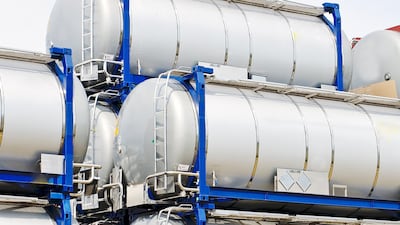
Blue ammonia is a chemical compound produced using hydrogen that is manufactured through steam methane reformation. -
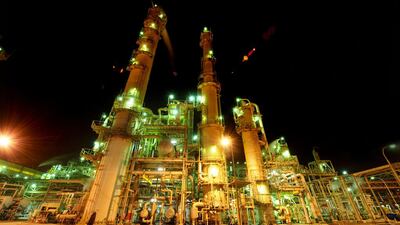
A fertiliser plant in Ruwais. Ammonia, which is used in fertiliser production, allows for the easy transport of hydrogen. -
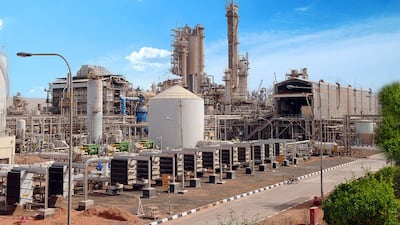
Adnoc already produces 300,000 tonnes of hydrogen on an annual basis for its downstream operations and plans to increase its output significantly. -

Adnoc and ADQ signed an agreement with Japan's Mitsui and South Korea's GS Energy to help develop a blue ammonia project in Ruwais, in partnership with Ta’ziz and Fertiglobe.


In October, BP withdrew backing from Pure Planet, a UK domestic energy supplier, in which it held a 24 per cent stake, and — like several other British gas and electricity retailers — the company went bankrupt.
Third, do their skills and mindset match the renewables business? They are used to dealing with a combination of geological risk, commodity price volatility and tough political situations such as Nigeria, Russia and Iraq.
They build on legacy assets and infrastructure, including Middle East holdings whose genesis dates to the 1930s.
These advantages do not apply to renewables, a new business at this scale, dominated by more stable jurisdictions, and where the quality of the wind or solar resource is easily observable.
Wind power at sea might seem comparable to offshore oil; Norwegian state oil corporation Equinor has been an early leader in floating wind turbines. But it seems unlikely this will give a decisive advantage over existing offshore wind specialists.
Fourth is the scale of ambition. The boldest is TotalEnergies of France, which wants to go from about 9.5 gigawatts of capacity today to 100 gigawatts by 2030.
Abundant investment dollars are flowing from their oil and gas units. Yet these are huge expansions, requiring many new employees, reskilling and changed business models.
Even if successful, they would still be primarily hydrocarbon firms.
Comparing renewable capacity to oil production is difficult but on rough figures, TotalEnergies’ 2030 renewables would represent about 40 per cent of its oil and gas output in terms of useful energy. For the others, it is significantly less.
How do oil companies get round these conundrums? One answer: acquire a big green energy company, such as Iberdrola of Spain, Enel of Italy, France’s Engie and Denmark’s Ørsted, currently valued in the $30bn to $60bn range each.
Enel manages 54 gigawatts of renewables worldwide and aims for 145 gigawatts by 2030 — more than enough to hit even TotalEnergies’ target.
This would be quicker and maybe even cheaper than building their own portfolios.
To take one example, Enel’s enterprise value is equivalent to roughly $2bn per gigawatt of capacity. This does not account for its other assets in fossil power and in gas and electricity transmission and retail. Offshore wind costs at least $3bn per gigawatt.
chief executive of Qamar Energy
Last year, it looked like the oil companies had missed the boat. Their targets had simply got too big.
This year, with the rebound in hydrocarbon prices, they may have another shot.
In August 2021, BP’s market capitalisation was smaller than Enel’s; now it is twice the size. The equivalent is true of Equinor and Ørsted, which look like a good strategic and geographic fit. Bloomberg reports that Shell had considered buying Iberdrola, Ørsted or Scotland’s SSE; Equinor had also studied SSE.
What of non-European companies?
Abu Dhabi’s Masdar has a portfolio of 23 gigawatts in operation or under development, and a long-term ambition of 200 gigawatts.
Last month, Adnoc, Taqa and Mubadala finalised their acquisition of stakes in Masdar’s renewables unit, valuing it at $1.9bn. Could the new Masdar pounce to accelerate its growth?
Of course, there are plenty of barriers: differing company cultures and business models, as well as valuations.
Would an oil-renewable major be valued at Shell’s 8.7 price-to-earnings ratio, or Iberdrola’s 18, or somewhere in-between? Would environmental investors be able to own the stock?
Protectionist continental governments could block deals; the Italian state owns almost 24 per cent of Enel.
But as they seek to mobilise renewable investment while digging their way out of debt holes, tie-ups with a well-capitalised partner may tick fiscal and environmental boxes.
The first oil company to move will face scepticism and hostility, but it may be assuring its future in a hydrocarbon winter.
Robin M Mills is chief executive of Qamar Energy and author of The Myth of the Oil Crisis

