

India plans to issue tenders for the second expansion phase of its strategic petroleum reserves imminently, as the world’s third-largest crude importer accelerates efforts to improve its energy security.
The country plans to build added storage in Chandikhole in Odisha state on the eastern coast as well in Padur in the southern Indian state of Karnataka with a total capacity to store 6.5 million metric tonnes.
The additional volumes will raise India's overall strategic reserves from 77 days to 90 days, which is the minimum required by the International Energy Agency to meet emergency needs.
“We are floating the RFPs [requests for proposal] let's say as soon as possible,” Indian petroleum minister Hardeep Singh Puri told The National in an interview in Abu Dhabi during Adipec.
South Asia's largest economy, which imports most of its energy needs, has a total of 5.33 million metric tonnes of strategic reserves, including commercial stocks held by Indian refiners.
“Countries are supposed to have a 90-day strategic reserve. We have now about 77 days so we are trying to augment that,” Mr Puri said.
The country currently maintains strategic petroleum reserves in three locations — in Mangalore and Padur in Karnataka as well in Visakhapatnam in Andhra Pradesh on the eastern coast.
With the second phase of expansion, India will be able to maintain 90 days of strategic reserves within “five years”, he said.
Indian petroleum minister
Ensuring energy security is a major concern for India, whose economy is forecast to grow 9.5 per cent this year and 8.5 per cent in 2022, according to the International Monetary Fund, after shrinking 7.3 per cent in 2020 because of the Covid-19 pandemic.
With rising demand for fuel to meet the needs of a growing population, locking affordable supply for the future is the main mandate for Mr Puri, who was appointed to his position three months ago by Prime Minister Narendra Modi.
India has an existing agreement with the UAE's Abu Dhabi National Oil Company to store crude in the country's strategic petroleum reserves in Mangalore. India has also signed preliminary agreements with Saudi Aramco to keep millions of barrels of crude in its underground storage facilities.
Indian petroleum minister
The country is also looking to lock in crude supplies by building an integrated refining and petrochemicals complex on the western coast. The planned $44 billion Ratnagiri project in Maharashtra state will have Saudi Aramco and Adnoc as joint developers, alongside state-backed Indian refiners.
However, the project has been delayed due to issues with land acquisition.
“I have had some discussions recently. My own sense is that if [there are] problems on land acquisition and land availability, we will have to make some hard decisions in terms of capacity. One proposal is to pare this down a bit. Those are hard decisions. We'll have to take them,” Mr Puri said.
The refinery was earlier earmarked to have a capacity of 60 million tonnes.
Mr Puri spoke out against high oil prices, which he blamed for the rise in inflation and for slowing the recovery of the world economy.
Key crude benchmarks Brent and West Texas Intermediate have rallied 60 per cent since the start of the year, which has prompted concerns from oil-consuming nations such as India and other net-importers.
_________________
Adipec 2021 - in pictures
-
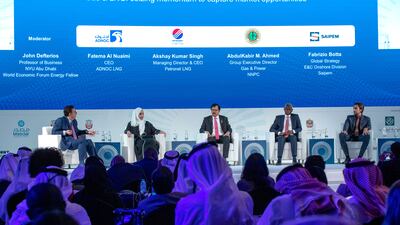
Strategic panel: Gas and LNG: Seizing Momentum to Capture Market Opportunities. From left, John Defterios, professor of business, NYU Abu Dhabi; Fatema Al Nuaimi, chief executive, Adnoc LNG; Akshay Kumar Singh, managing director chief executive, Petronet LNG; AbdulKabir M Ahmed, group executive director gas and power, NNPC; and Fabrizio Botta, global strategy E&C onshore division, Saipem. All photos Victor Besa / The National. -
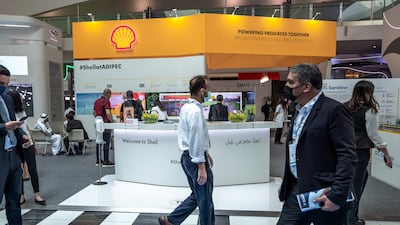
The Shell stand at Adipec. -

'The National' stand at Adipec. -
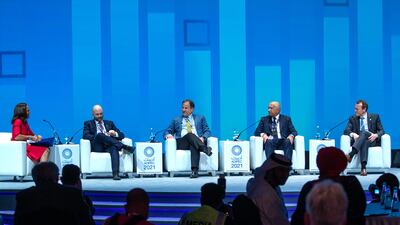
IFAD: The Story So Far. From left, Helima Croft, managing director and global head of strategy, RBC Capital Markets; Stuart Williams, president, Ice Futures Europe; Mike Muller, head of Vitol Asia; Philippe Khoury, executive vice president sales and trading DM&T, Adnoc; Thomas Weymel, president of trading and shipping, Totsa Totalenergies Trading SA. -
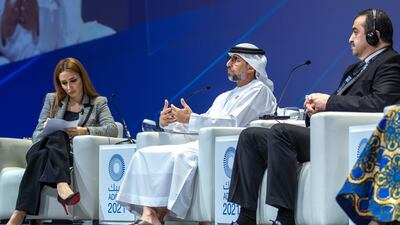
Suhail Al Mazrouei, Minister of Energy and Infrastructure, during the Ministerial Hydrogen Panel: What Policies are Needed to Support the Development of a Sustainable Hydrogen Industry? -
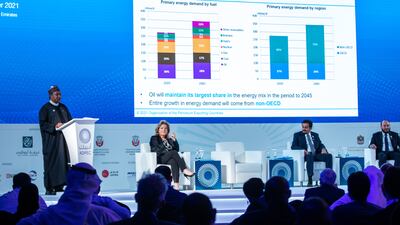
Opec's World Oil Outlook 2021. Mohammad Barkindo, secretary general, Opec. -
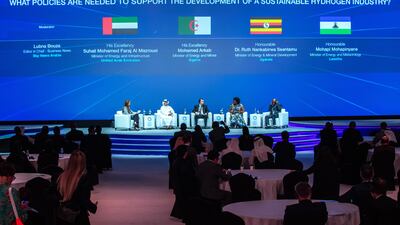
Suhail Al Mazrouei, Minister of Energy and Infrastructure, during the Ministerial Hydrogen Panel: What Policies are Needed to Support the Development of a Sustainable Hydrogen Industry? -
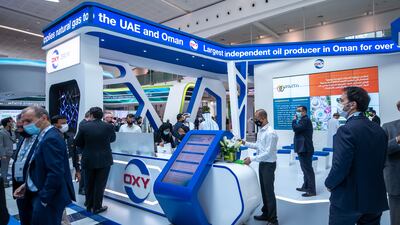
The Occidental stand at Adipec. -
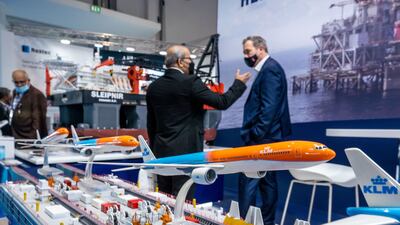
Visitors in discussion at Adipec. -
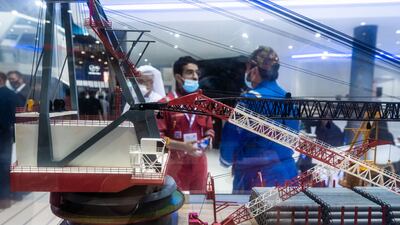
Adipec brings together oil, gas and energy professionals from around the world. -
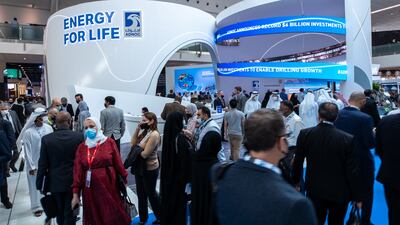
Crowds of visitors throng to Adipec. -

A bustling scene at Adipec. -
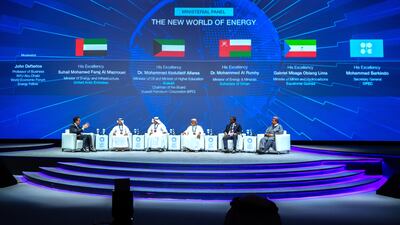
Ministerial Panel: The New World of Energy. -
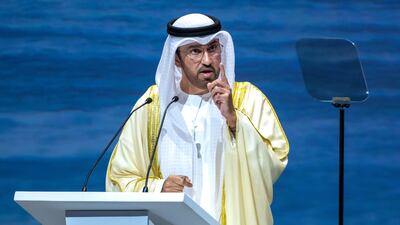
Dr Sultan Al Jaber, Minister of Industry and Advanced Technology, and managing director and group chief executive, Adnoc. -

Energy of the Future: How are Oil and Gas Companies Evolving? -
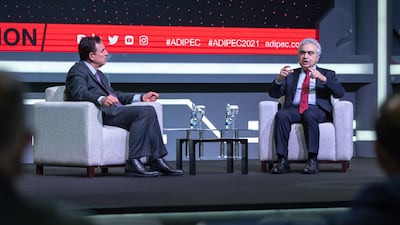
Fatih Birol, right, executive director, International Energy Agency, in discussion with John Defterios, professor of business, NYU Abu Dhabi. Mr Birol received a Lifetime Achievement award at the Adipec Awards. -

Visitors to Adipec on the first day of the event. -
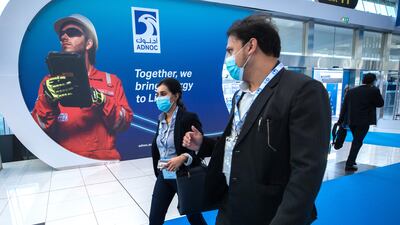
Visitors arrive for the first day of Adipec.


_________________
“My view is the pandemic period was difficult enough. Economic activity virtually ground to a halt. Today economic activity is being revived. The largest economy, the United States, is facing inflation figures which are the highest in 30 years. So I think the first assertion I make to everybody is that higher oil prices will lead to inflation, on which one has enough evidence,” Mr Puri said.
India recently pledged to reach net-zero emissions by 2070, two decades later than the timeline suggested under the Paris Agreement. However, the country plans to decarbonise its grid sooner and looks to generate up to 50 per cent of its electricity needs from renewables by 2030.
India along with China came under criticism following the latest Conference of Parties (Cop26) held in the UK city of Glasgow, with both countries singled out for slowing the global momentum towards phasing out coal.
Mr Puri said it was unfair to associate India with the dilution of the language surrounding future coal use.
“Please explain to me what the difference in terms of timelines is for phase out and phase down. I mean, nobody knows actually. I don't know where it came from. And India is being associated,” he said.
India, which generates 70 per cent of its power needs from coal is said to have helped to amend the Glasgow Climate Pact to insist on “phasing down” unabated coal power rather than ending the use of the polluting fuel completely.
“But I don't think that's an Indian position. In a multilateral bilateral negotiation, a lot of people are saying [things] and some statements get picked [up]” Mr Puri said.

