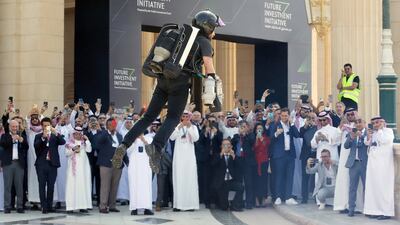
Future Investment Initiative, Saudi Arabia’s annual investment summit attended by global heads of major finance and technology firms, is postponed untill 2021 due to difficulties in travel amid the coronavirus pandemic.
The fourth FII event, which is hosted each year by the kingdom’s sovereign wealth fund, the Public Investment Fund, had been due to take place in Riyadh in October.
“After careful consideration and assessment of the global travel and airline outlook, as well as the regulations imposed by a significant number of countries, and in the context of the efforts deployed to overcome the impact of Covid-19, we have decided to postpone the fourth edition of the Future Investment Initiative (FII),” a statement from the organisers said.
The event, which has been nicknamed 'Davos in the Desert', will now take place from 26-28 January 2021. The theme of the fourth edition will be "The Neo-Renaissance", organisers said.
Investment deals worth $20 billion (Dh73.4bn) were sealed at the 2019 summit, including a $5bn agreement between the Saudi Real Estate Company and US mall operator Triple 5 to develop the Arabian Dream – the world’s largest shopping and entertainment complex in Riyadh.
Other deals signed last year included a $700 million investment by Modular Middle East to set up a prefabricated building facility, a $300m investment from Chinese shopping platform OneDeal for a new distribution hub and a $200m deal with the UK’s Shiloh Minerals to develop production capacity in the kingdom.

Avatar: Fire and Ash
Director: James Cameron
Starring: Sam Worthington, Sigourney Weaver, Zoe Saldana
Rating: 4.5/5
While you're here
Hussein Ibish: Could it be game over for Donald Trump?
Joyce Karam: Trump's campaign thrown off balance
Trump tests positive: everything we know so far
Virus and the economy
Harvey Jones: Stock market crash could be buying opportunity
Peter Cooper: Key is adopting a long-term financial strategy
Harvey Jones: Steps to take to protect your money amid crisis
Ten tax points to be aware of in 2026
1. Domestic VAT refund amendments: request your refund within five years
If a business does not apply for the refund on time, they lose their credit.
2. E-invoicing in the UAE
Businesses should continue preparing for the implementation of e-invoicing in the UAE, with 2026 a preparation and transition period ahead of phased mandatory adoption.
3. More tax audits
Tax authorities are increasingly using data already available across multiple filings to identify audit risks.
4. More beneficial VAT and excise tax penalty regime
Tax disputes are expected to become more frequent and more structured, with clearer administrative objection and appeal processes. The UAE has adopted a new penalty regime for VAT and excise disputes, which now mirrors the penalty regime for corporate tax.
5. Greater emphasis on statutory audit
There is a greater need for the accuracy of financial statements. The International Financial Reporting Standards standards need to be strictly adhered to and, as a result, the quality of the audits will need to increase.
6. Further transfer pricing enforcement
Transfer pricing enforcement, which refers to the practice of establishing prices for internal transactions between related entities, is expected to broaden in scope. The UAE will shortly open the possibility to negotiate advance pricing agreements, or essentially rulings for transfer pricing purposes.
7. Limited time periods for audits
Recent amendments also introduce a default five-year limitation period for tax audits and assessments, subject to specific statutory exceptions. While the standard audit and assessment period is five years, this may be extended to up to 15 years in cases involving fraud or tax evasion.
8. Pillar 2 implementation
Many multinational groups will begin to feel the practical effect of the Domestic Minimum Top-Up Tax (DMTT), the UAE's implementation of the OECD’s global minimum tax under Pillar 2. While the rules apply for financial years starting on or after January 1, 2025, it is 2026 that marks the transition to an operational phase.
9. Reduced compliance obligations for imported goods and services
Businesses that apply the reverse-charge mechanism for VAT purposes in the UAE may benefit from reduced compliance obligations.
10. Substance and CbC reporting focus
Tax authorities are expected to continue strengthening the enforcement of economic substance and Country-by-Country (CbC) reporting frameworks. In the UAE, these regimes are increasingly being used as risk-assessment tools, providing tax authorities with a comprehensive view of multinational groups’ global footprints and enabling them to assess whether profits are aligned with real economic activity.
Contributed by Thomas Vanhee and Hend Rashwan, Aurifer
War 2
Director: Ayan Mukerji
Stars: Hrithik Roshan, NTR, Kiara Advani, Ashutosh Rana
Rating: 2/5
Classification of skills
A worker is categorised as skilled by the MOHRE based on nine levels given in the International Standard Classification of Occupations (ISCO) issued by the International Labour Organisation.
A skilled worker would be someone at a professional level (levels 1 – 5) which includes managers, professionals, technicians and associate professionals, clerical support workers, and service and sales workers.
The worker must also have an attested educational certificate higher than secondary or an equivalent certification, and earn a monthly salary of at least Dh4,000.
The National Archives, Abu Dhabi
Founded over 50 years ago, the National Archives collects valuable historical material relating to the UAE, and is the oldest and richest archive relating to the Arabian Gulf.
Much of the material can be viewed on line at the Arabian Gulf Digital Archive - https://www.agda.ae/en
Jeff Buckley: From Hallelujah To The Last Goodbye
By Dave Lory with Jim Irvin
More on animal trafficking
More on Quran memorisation:
Founders: Ines Mena, Claudia Ribas, Simona Agolini, Nourhan Hassan and Therese Hundt
Date started: January 2017, app launched November 2017
Based: Dubai, UAE
Sector: Private/Retail/Leisure
Number of Employees: 18 employees, including full-time and flexible workers
Funding stage and size: Seed round completed Q4 2019 - $1m raised
Funders: Oman Technology Fund, 500 Startups, Vision Ventures, Seedstars, Mindshift Capital, Delta Partners Ventures, with support from the OQAL Angel Investor Network and UAE Business Angels
Timeline
1947
Ferrari’s road-car company is formed and its first badged car, the 125 S, rolls off the assembly line
1962
250 GTO is unveiled
1969
Fiat becomes a Ferrari shareholder, acquiring 50 per cent of the company
1972
The Fiorano circuit, Ferrari’s racetrack for development and testing, opens
1976
First automatic Ferrari, the 400 Automatic, is made
1987
F40 launched
1988
Enzo Ferrari dies; Fiat expands its stake in the company to 90 per cent
2002
The Enzo model is announced
2010
Ferrari World opens in Abu Dhabi
2011
First four-wheel drive Ferrari, the FF, is unveiled
2013
LaFerrari, the first Ferrari hybrid, arrives
2014
Fiat Chrysler announces the split of Ferrari from the parent company
2015
Ferrari launches on Wall Street
2017
812 Superfast unveiled; Ferrari celebrates its 70th anniversary
Company%20profile
Citizenship-by-investment programmes
United Kingdom
The UK offers three programmes for residency. The UK Overseas Business Representative Visa lets you open an overseas branch office of your existing company in the country at no extra investment. For the UK Tier 1 Innovator Visa, you are required to invest £50,000 (Dh238,000) into a business. You can also get a UK Tier 1 Investor Visa if you invest £2 million, £5m or £10m (the higher the investment, the sooner you obtain your permanent residency).
All UK residency visas get approved in 90 to 120 days and are valid for 3 years. After 3 years, the applicant can apply for extension of another 2 years. Once they have lived in the UK for a minimum of 6 months every year, they are eligible to apply for permanent residency (called Indefinite Leave to Remain). After one year of ILR, the applicant can apply for UK passport.
The Caribbean
Depending on the country, the investment amount starts from $100,000 (Dh367,250) and can go up to $400,000 in real estate. From the date of purchase, it will take between four to five months to receive a passport.
Portugal
The investment amount ranges from €350,000 to €500,000 (Dh1.5m to Dh2.16m) in real estate. From the date of purchase, it will take a maximum of six months to receive a Golden Visa. Applicants can apply for permanent residency after five years and Portuguese citizenship after six years.
“Among European countries with residency programmes, Portugal has been the most popular because it offers the most cost-effective programme to eventually acquire citizenship of the European Union without ever residing in Portugal,” states Veronica Cotdemiey of Citizenship Invest.
Greece
The real estate investment threshold to acquire residency for Greece is €250,000, making it the cheapest real estate residency visa scheme in Europe. You can apply for residency in four months and citizenship after seven years.
Spain
The real estate investment threshold to acquire residency for Spain is €500,000. You can apply for permanent residency after five years and citizenship after 10 years. It is not necessary to live in Spain to retain and renew the residency visa permit.
Cyprus
Cyprus offers the quickest route to citizenship of a European country in only six months. An investment of €2m in real estate is required, making it the highest priced programme in Europe.
Malta
The Malta citizenship by investment programme is lengthy and investors are required to contribute sums as donations to the Maltese government. The applicant must either contribute at least €650,000 to the National Development & Social Fund. Spouses and children are required to contribute €25,000; unmarried children between 18 and 25 and dependent parents must contribute €50,000 each.
The second step is to make an investment in property of at least €350,000 or enter a property rental contract for at least €16,000 per annum for five years. The third step is to invest at least €150,000 in bonds or shares approved by the Maltese government to be kept for at least five years.
Candidates must commit to a minimum physical presence in Malta before citizenship is granted. While you get residency in two months, you can apply for citizenship after a year.
Egypt
A one-year residency permit can be bought if you purchase property in Egypt worth $100,000. A three-year residency is available for those who invest $200,000 in property, and five years for those who purchase property worth $400,000.
Source: Citizenship Invest and Aqua Properties
Key findings of Jenkins report
- Founder of the Muslim Brotherhood, Hassan al Banna, "accepted the political utility of violence"
- Views of key Muslim Brotherhood ideologue, Sayyid Qutb, have “consistently been understood” as permitting “the use of extreme violence in the pursuit of the perfect Islamic society” and “never been institutionally disowned” by the movement.
- Muslim Brotherhood at all levels has repeatedly defended Hamas attacks against Israel, including the use of suicide bombers and the killing of civilians.
- Laying out the report in the House of Commons, David Cameron told MPs: "The main findings of the review support the conclusion that membership of, association with, or influence by the Muslim Brotherhood should be considered as a possible indicator of extremism."
Up in the air
World record transfers
1. Kylian Mbappe - to Real Madrid in 2017/18 - €180 million (Dh770.4m - if a deal goes through)
2. Paul Pogba - to Manchester United in 2016/17 - €105m
3. Gareth Bale - to Real Madrid in 2013/14 - €101m
4. Cristiano Ronaldo - to Real Madrid in 2009/10 - €94m
5. Gonzalo Higuain - to Juventus in 2016/17 - €90m
6. Neymar - to Barcelona in 2013/14 - €88.2m
7. Romelu Lukaku - to Manchester United in 2017/18 - €84.7m
8. Luis Suarez - to Barcelona in 2014/15 - €81.72m
9. Angel di Maria - to Manchester United in 2014/15 - €75m
10. James Rodriguez - to Real Madrid in 2014/15 - €75m
Transgender report
Other acts on the Jazz Garden bill
Sharrie Williams
The American singer is hugely respected in blues circles due to her passionate vocals and songwriting. Born and raised in Michigan, Williams began recording and touring as a teenage gospel singer. Her career took off with the blues band The Wiseguys. Such was the acclaim of their live shows that they toured throughout Europe and in Africa. As a solo artist, Williams has also collaborated with the likes of the late Dizzy Gillespie, Van Morrison and Mavis Staples.
Lin Rountree
An accomplished smooth jazz artist who blends his chilled approach with R‘n’B. Trained at the Duke Ellington School of the Arts in Washington, DC, Rountree formed his own band in 2004. He has also recorded with the likes of Kem, Dwele and Conya Doss. He comes to Dubai on the back of his new single Pass The Groove, from his forthcoming 2018 album Stronger Still, which may follow his five previous solo albums in cracking the top 10 of the US jazz charts.
Anita Williams
Dubai-based singer Anita Williams will open the night with a set of covers and swing, jazz and blues standards that made her an in-demand singer across the emirate. The Irish singer has been performing in Dubai since 2008 at venues such as MusicHall and Voda Bar. Her Jazz Garden appearance is career highlight as she will use the event to perform the original song Big Blue Eyes, the single from her debut solo album, due for release soon.
While you're here
Sholto Byrnes: Here's how this century can still belong to Asia
Brahma Chellaney: South China Sea is Asean's Achilles heel
The National Editorial: Territorial disputes require a mediator
Key figures in the life of the fort
Sheikh Dhiyab bin Isa (ruled 1761-1793) Built Qasr Al Hosn as a watchtower to guard over the only freshwater well on Abu Dhabi island.
Sheikh Shakhbut bin Dhiyab (ruled 1793-1816) Expanded the tower into a small fort and transferred his ruling place of residence from Liwa Oasis to the fort on the island.
Sheikh Tahnoon bin Shakhbut (ruled 1818-1833) Expanded Qasr Al Hosn further as Abu Dhabi grew from a small village of palm huts to a town of more than 5,000 inhabitants.
Sheikh Khalifa bin Shakhbut (ruled 1833-1845) Repaired and fortified the fort.
Sheikh Saeed bin Tahnoon (ruled 1845-1855) Turned Qasr Al Hosn into a strong two-storied structure.
Sheikh Zayed bin Khalifa (ruled 1855-1909) Expanded Qasr Al Hosn further to reflect the emirate's increasing prominence.
Sheikh Shakhbut bin Sultan (ruled 1928-1966) Renovated and enlarged Qasr Al Hosn, adding a decorative arch and two new villas.
Sheikh Zayed bin Sultan (ruled 1966-2004) Moved the royal residence to Al Manhal palace and kept his diwan at Qasr Al Hosn.
Sources: Jayanti Maitra, www.adach.ae
The burning issue
The internal combustion engine is facing a watershed moment – major manufacturer Volvo is to stop producing petroleum-powered vehicles by 2021 and countries in Europe, including the UK, have vowed to ban their sale before 2040. The National takes a look at the story of one of the most successful technologies of the last 100 years and how it has impacted life in the UAE.
Read part three: the age of the electric vehicle begins
Read part two: how climate change drove the race for an alternative
Read part one: how cars came to the UAE
The specs
- Engine: 3.9-litre twin-turbo V8
- Power: 640hp
- Torque: 760nm
- On sale: 2026
- Price: Not announced yet

