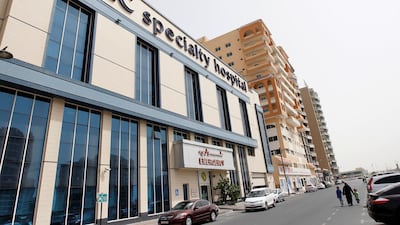
The management and administrators of NMC Healthcare have set out a new, three-year turnaround plan for the business that involves putting the hospital operator through an administration process in Abu Dhabi Global Markets Courts and raising $300m in additional funding from lenders.
Administrators are in the process of either selling or closing down most of its trading arm and are planning to exit several other businesses to concentrate on its core healthcare markets in the UAE and Oman.
"We made the decision that trading was not core and we wanted to divest it to get some value off it," Michael Davis, acting chief executive of NMC, told The National.
"We wanted to focus really on healthcare and not the trading side."
Three international businesses that make up about a quarter of its revenue – its Saudi Arabian joint venture, the UK-based Aspen Healthcare business and an IVF company that operates across Spain and Latin America – have all been deemed non-core and will be sold off either to repay debts or fund operations. Two of these, Aspen and the IVF company, Luarmia, are already generating "considerable interest from prospective buyers", according to the plan presented to stakeholders that has been seen by The National.
NMC Healthcare was founded by BR Shetty in 1975 and grew from a single hospital into the UAE’s biggest privately owned healthcare operator.
The company was listed on the London Stock Exchange in 2012 and was valued at £8.58 billion (Dh40bn) at its peak. However, its shares plunged after short seller Muddy Waters Research issued a report in December 2019 alleging the company had inflated its cash balances, overpaid for assets and understated its debts.
In its turnaround plan presented to lenders, NMC said the discovery of fraud "on a massive scale" in the early part of this year significantly damaged its reputation and threatened its survival.
It was placed into administration in April with debts of $6.6bn, which was considerably more than the $2.1bn on its balance sheet.
"Significant cash has been extracted from the company, resulting in constrained liquidity and payment default to lenders and suppliers," NMC said in its turnaround plan.
Administrators from Alvarez & Marsal are continuing to investigate fraudulent activity at the firm.
"We have got a lot of material and in the near future we hope to launch some actions,” Maria Simovic, managing director at Alvarez & Marsal said. No action has been brought by the administrator against any party to date.
-
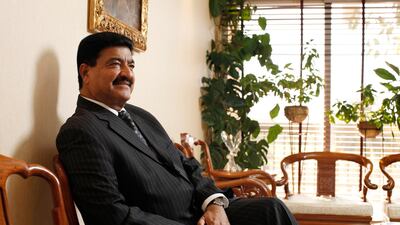
The order freezing Mr Shetty's assets limits him to a maximum of $7,000 a week to spend on ordinary living expenses and legal representation Ryan Carter / The National -
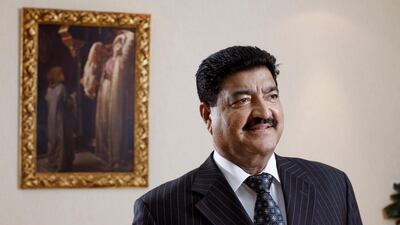
BR Shetty, founder of NMC Group, which consists of NMC Specialty Hospital, UAE Exchange and Neopharma, stands for a portrait in his office. Ryan Carter / The National -

People walk past a branch of Travelex Currency Exchange in London. Reuters -
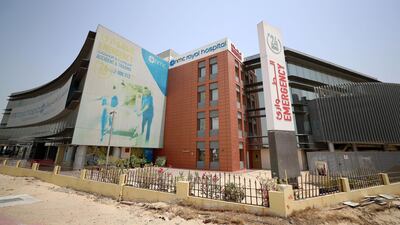
NMC Royal Hospital in Dubai Investments Park. Chris Whiteoak / The National -
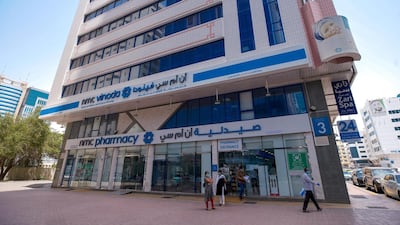
The NMC Pharmacy along the Zayed The First Street, Abu Dhabi. Victor Besa / The National -
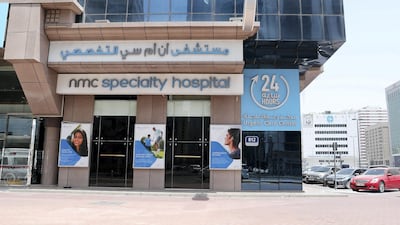
The NMC specialty hospital on Zayed the First street in Abu Dhabi. Pawan Singh / The National -
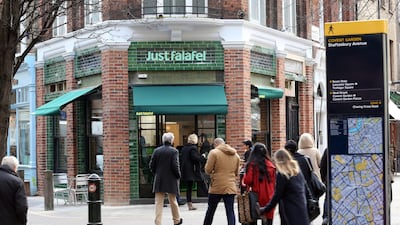
A Just Falafel franchise in Covent Garden, London, in 2013. Stephen Lock for The National -

Reema Shetty, the co-founder of the Foodsters food-lorry company. Victor Besa for The National


NMC's revival has also suffered as a result of the Covid-19 outbreak. Gross revenue increased 7 per cent in the first two months, but then dropped by 25 per cent between March and May and fell by 35 per cent at the peak of movement restrictions in April.
The company is forecasting full-year gross revenue at its core operations to be 16 per cent lower in 2020 as a result, but is expecting an 18 per cent revival in revenue and a 13 per cent increase in earnings before interest, tax, depreciation and amortisation in 2021 as it lowers its cost base.
NMC has managed to retain most of its staff despite a difficult period that has included the administration, reputational damage and a global pandemic.
“We still have close to 20,000 employees globally, we’ve got 2,000 physicians. In the UAE, [there are] between 13,000 and 15,000 employees and around 1,800 doctors,” Mr Davis said.
Administrators and management have also been faced with a number of legal claims.
Credit Europe Bank brought a claim in the DIFC Courts against Mr Shetty, NMC Healthcare and New Medical Centre Trading to recoup an $8m loan as security cheques provided by Mr Shetty defaulted. Mr Shetty denies writing the cheques, claiming the signatures are fraudulent.
Claims have also been filed by law firms in the US looking to bring class action suits on behalf of investors who held American Depsoitory Receipts in NMC Healthcare.
Ms Simovic said these claims are being dealt with on an individual basis.

