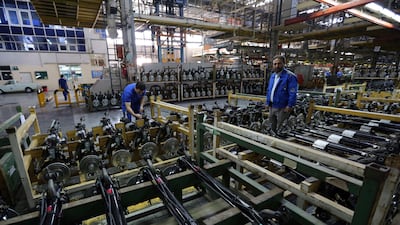

The US has blacklisted two of Iran's biggest car makers and major railway operators, extending its economic pressure campaign against Tehran from shipping and oil exports to industries and transport networks on land.
The Treasury Department on Thursday designated Iran Khodro and Saipa, which together account for more than 90 per cent of Iran’s domestic market. It also sanctioned the state-owned Islamic Republic of Iran Railway Company, Raja Passenger Trains Company and Railway Transportation Company, a major private freight operator. Foreign suppliers to Iran’s automotive sector, including companies in the UAE, Indonesia and Turkey, were also targeted.
The measures are part of Operation Economic Outcast, a campaign launched by the Treasury on August 24 to restrict funding available to Tehran for the war, its missile programme, cyber attacks and the Islamic Revolutionary Guard Corps.

The latest targets reflect how Washington’s pressure campaign is broadening. With the US blockade restricting Iranian oil shipments through the Strait of Hormuz, Tehran has increasingly relied on road and rail networks to move petroleum, fertiliser, chemicals and other goods. Thursday’s measures target those alternative routes as well as some of Iran’s biggest industrial companies.
The action “directly targets Iran’s enablers and lays the groundwork for the United States and our partners to drain the regime’s revenue once and for all”, US Treasury Secretary Scott Bessent said.
The sanctions came as Washington sought to widen international scrutiny of Iran. The US said on Thursday it would push for an independent multilateral body to monitor compliance with sanctions after Russia and China blocked the renewal of a UN panel that tracked violations.
The move comes against a broader dispute over the status of UN sanctions on Tehran. The US, Britain, France and Germany said they triggered the “snapback” mechanism under the 2015 nuclear deal last year, restoring penalties that had been lifted under the agreement. Russia and China rejected that interpretation and said the previous sanctions remain terminated.
Iran’s automotive industry has long been vulnerable to US sanctions. Washington first targeted the sector in 2013, eased restrictions following the 2015 nuclear agreement and reimposed them in 2018. European car makers, including PSA Group and Renault, subsequently withdrew from partnerships with Iran Khodro and Saipa.
Iranian manufacturers have since become more reliant on domestic production and Chinese components, leaving overseas suppliers increasingly exposed to Washington’s sanctions campaign. Thursday’s measures also give the US authority to impose sanctions on people and companies operating in Iran’s automotive and rail sectors.

