
Iran’s economy will face a hard hit from the war with Israel, as it continues to grapple with western sanctions, high inflation and currency devaluation, analysts say.
Israel made a surprise attack on nuclear sites in Iran on June 13, claiming Tehran was close to developing a nuclear weapon. As the conflict dragged on with tit-for-tat attacks, the US entered it on Saturday, bombing three nuclear facilities in Iran.
“The impact of the continuing war on Iran's economy will be devastating, particularly because the economy has lost its resilience after 14 years of sanctions,” said Mahdi Ghodsi, an economist at The Vienna Institute for International Economic Studies.
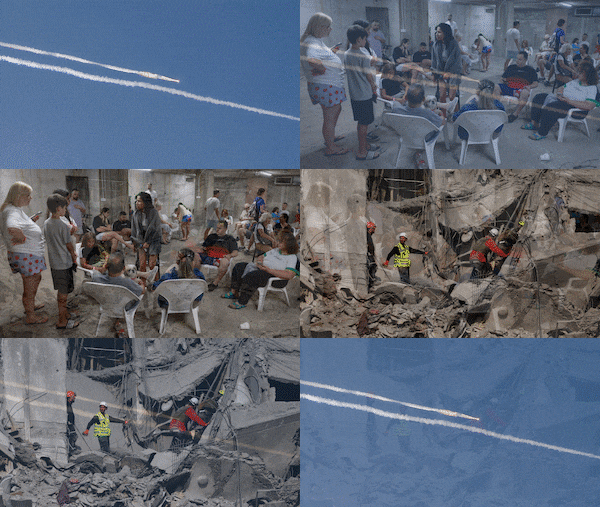
Residents have begun leaving cities such as Tehran, Tabriz and Isfahan, indicating that economic activity and employment have been “severely paralysed across sectors”, he said.
Capital market reactions are likely to be negative with the stock market currently closed, said Mohammad Farzanegan, professor of Middle East economics at the Centre for Near and Middle Eastern Studies, Philipps-University Marburg in Germany.
“The market is marked by a high degree of uncertainty,” he said. “The war has placed an additional burden on Iran’s foreign trade, which was already strained by sanctions.”
Iran's economy has suffered under the extraneous sanctions reimposed by Washington in 2018 after US President Donald Trump in his previous term removed the US from the Joint Comprehensive Plan of Action nuclear deal.
The sanctions are yet to be lifted. The country is also on the Financial Action Task Force's blacklist.
Iran’s economic growth is forecast to flatline at 0.3 per cent in 2025, down from 3.5 per cent in 2024, according to the International Monetary Fund. It is forecast to expand 1.1 per cent next year, the fund said in April.
The fund also expects Iran’s inflation rate to rise to 43.3 per cent this year, from 32.6 per cent in 2024, before slightly easing to 42.5 per cent next year.
Due to the lorry drivers’ strikes and the Bandar Abbas explosion just before the Israeli attacks, transport may be the most affected sector, according to Mr Ghodsi.
“This disruption is causing severe supply chain bottlenecks and shortages of goods and resources across cities of all sizes,” he said.
“The prices of goods and commodities are likely to surge substantially due to these supply shocks, further accelerating inflation.”
While the government has announced penalties for shopkeepers raising prices, such measures are unlikely to be effective, he added.
“Sanctions have weakened Iran’s economy and eroded the middle class. Real incomes have declined due to inflation, leading to a higher incidence of poverty,” Mr Farzanegan said.
He also said sanctions reduce Iran’s military spending, which “increases vulnerability to external aggression”.
Iran’s military spending fell by 10 per cent in real terms to $7.9 billion last year despite its involvement in regional conflicts and its support for regional proxies, according to the Stockholm International Peace Research Institute (Sipri).
The impact of sanctions on Iran severely limited its capacity to increase spending, Sipri said in an April report.
Meanwhile, oil revenue have also been affected as a result of disrupted economic activity. While the damage to energy infrastructure by Israeli attacks has not been significant, fear of bombardment has “already driven workers away from the refineries, significantly hampering production”, Mr Ghodsi said.
“Moreover, strikes have damaged parts of Iran’s energy, electricity, and water infrastructure, which poses a serious risk to civilian life. Without basic access to energy, even food preparation becomes a challenge, a scenario that could escalate into a humanitarian catastrophe,” he added.
Currency devaluation
The Iranian rial, which has been devalued significantly in recent months, fell sharply after the first Israeli attack.
“Subsequently, the government imposed restrictive capital controls and supplied foreign currency to the market”, which temporarily supported the rial, Mr Ghodsi said.
The exchange rate on the parallel market was at about 92,250 rials to a dollar at 1.15pm UAE time on June 23, according to Bonbast.com, which gathers live data from Iranian exchanges.
In April, Iran’s currency fell below the psychologically important level of 1,039,000 rials to the US dollar after US President Donald Trump's administration pressed on with its “maximum pressure” campaign against Tehran with a new round of sanctions.
Further currency devaluation is expected, according to Mr Farzanegan.
Mr Ghodsi agreed, adding that the capital controls on the stock exchange and banking sector have so far prevented a financial meltdown and bank runs.
“However, the increasing exodus to neighbouring countries indicates a capital flight in motion. Every time these controls are loosened, the rial nosedives, worsening instability, driving up import prices, and triggering economic shocks,” he said.
'Regime change on the cards'
Mr Ghodsi said the indicators point towards a regime change in Iran. “I believe the early stages of state failure are now emerging. The Islamic Republic is on a slippery slope,” he said.
He cited the Weberian theory with four criteria “indicative of state failure, all of which now apply to Iran”.
They include loss of monopoly on the use of force, erosion of legitimate authority, inability to provide essential public services and inability to engage as a sovereign peer in the international system.
“Given the continuing retaliatory attacks and the involvement of the United States, we are witnessing clear indicators of regime change,” he said.
According to Mr Farzanegan, even if Iran and its government withstand the aggressions, they will need to “significantly revise their economic, political, social, and security agendas”.
“Whether Iran can resist aggressors (Israel and the US) depends not only on its economic conditions but also on factors like internal unity and the extent of rally-around-the-flag effects during invasion,” he said.
Reforms will need to be undertaken. “The immediate priority is to preserve Iran’s territorial integrity and reduce the risk of a civil war instigated by external actors seeking to turn Iran into a failed state. Such a collapse would be the worst possible,” he added.

Company Fact Box
Company name/date started: Abwaab Technologies / September 2019
Founders: Hamdi Tabbaa, co-founder and CEO. Hussein Alsarabi, co-founder and CTO
Based: Amman, Jordan
Sector: Education Technology
Size (employees/revenue): Total team size: 65. Full-time employees: 25. Revenue undisclosed
Stage: early-stage startup
Investors: Adam Tech Ventures, Endure Capital, Equitrust, the World Bank-backed Innovative Startups SMEs Fund, a London investment fund, a number of former and current executives from Uber and Netflix, among others.
Mercer, the investment consulting arm of US services company Marsh & McLennan, expects its wealth division to at least double its assets under management (AUM) in the Middle East as wealth in the region continues to grow despite economic headwinds, a company official said.
Mercer Wealth, which globally has $160 billion in AUM, plans to boost its AUM in the region to $2-$3bn in the next 2-3 years from the present $1bn, said Yasir AbuShaban, a Dubai-based principal with Mercer Wealth.
“Within the next two to three years, we are looking at reaching $2 to $3 billion as a conservative estimate and we do see an opportunity to do so,” said Mr AbuShaban.
Mercer does not directly make investments, but allocates clients’ money they have discretion to, to professional asset managers. They also provide advice to clients.
“We have buying power. We can negotiate on their (client’s) behalf with asset managers to provide them lower fees than they otherwise would have to get on their own,” he added.
Mercer Wealth’s clients include sovereign wealth funds, family offices, and insurance companies among others.
From its office in Dubai, Mercer also looks after Africa, India and Turkey, where they also see opportunity for growth.
Wealth creation in Middle East and Africa (MEA) grew 8.5 per cent to $8.1 trillion last year from $7.5tn in 2015, higher than last year’s global average of 6 per cent and the second-highest growth in a region after Asia-Pacific which grew 9.9 per cent, according to consultancy Boston Consulting Group (BCG). In the region, where wealth grew just 1.9 per cent in 2015 compared with 2014, a pickup in oil prices has helped in wealth generation.
BCG is forecasting MEA wealth will rise to $12tn by 2021, growing at an annual average of 8 per cent.
Drivers of wealth generation in the region will be split evenly between new wealth creation and growth of performance of existing assets, according to BCG.
Another general trend in the region is clients’ looking for a comprehensive approach to investing, according to Mr AbuShaban.
“Institutional investors or some of the families are seeing a slowdown in the available capital they have to invest and in that sense they are looking at optimizing the way they manage their portfolios and making sure they are not investing haphazardly and different parts of their investment are working together,” said Mr AbuShaban.
Some clients also have a higher appetite for risk, given the low interest-rate environment that does not provide enough yield for some institutional investors. These clients are keen to invest in illiquid assets, such as private equity and infrastructure.
“What we have seen is a desire for higher returns in what has been a low-return environment specifically in various fixed income or bonds,” he said.
“In this environment, we have seen a de facto increase in the risk that clients are taking in things like illiquid investments, private equity investments, infrastructure and private debt, those kind of investments were higher illiquidity results in incrementally higher returns.”
The Abu Dhabi Investment Authority, one of the largest sovereign wealth funds, said in its 2016 report that has gradually increased its exposure in direct private equity and private credit transactions, mainly in Asian markets and especially in China and India. The authority’s private equity department focused on structured equities owing to “their defensive characteristics.”
COMPANY%20PROFILE
%3Cp%3E%3Cstrong%3ECompany%3A%20%3C%2Fstrong%3EEducatly%3Cbr%3E%3Cstrong%3EStarted%3A%20%3C%2Fstrong%3E2020%3Cbr%3E%3Cstrong%3EBased%3A%20%3C%2Fstrong%3EUAE%3Cbr%3E%3Cstrong%3EFounders%3A%20%3C%2Fstrong%3EMohmmed%20El%20Sonbaty%2C%20Joan%20Manuel%20and%20Abdelrahman%20Ayman%3Cbr%3E%3Cstrong%3EIndustry%3A%20%3C%2Fstrong%3EEducation%20technology%3Cbr%3E%3Cstrong%3EFunding%20size%3A%20%3C%2Fstrong%3E%242%20million%3Cbr%3E%3Cstrong%3EInvestors%3A%20%3C%2Fstrong%3EEnterprise%20Ireland%2C%20Egypt%20venture%2C%20Plus%20VC%2C%20HBAN%2C%20Falak%20Startups%3C%2Fp%3E%0A
Will the pound fall to parity with the dollar?
The idea of pound parity now seems less far-fetched as the risk grows that Britain may split away from the European Union without a deal.
Rupert Harrison, a fund manager at BlackRock, sees the risk of it falling to trade level with the dollar on a no-deal Brexit. The view echoes Morgan Stanley’s recent forecast that the currency can plunge toward $1 (Dh3.67) on such an outcome. That isn’t the majority view yet – a Bloomberg survey this month estimated the pound will slide to $1.10 should the UK exit the bloc without an agreement.
New Prime Minister Boris Johnson has repeatedly said that Britain will leave the EU on the October 31 deadline with or without an agreement, fuelling concern the nation is headed for a disorderly departure and fanning pessimism toward the pound. Sterling has fallen more than 7 per cent in the past three months, the worst performance among major developed-market currencies.
“The pound is at a much lower level now but I still think a no-deal exit would lead to significant volatility and we could be testing parity on a really bad outcome,” said Mr Harrison, who manages more than $10 billion in assets at BlackRock. “We will see this game of chicken continue through August and that’s likely negative for sterling,” he said about the deadlocked Brexit talks.
The pound fell 0.8 per cent to $1.2033 on Friday, its weakest closing level since the 1980s, after a report on the second quarter showed the UK economy shrank for the first time in six years. The data means it is likely the Bank of England will cut interest rates, according to Mizuho Bank.
The BOE said in November that the currency could fall even below $1 in an analysis on possible worst-case Brexit scenarios. Options-based calculations showed around a 6.4 per cent chance of pound-dollar parity in the next one year, markedly higher than 0.2 per cent in early March when prospects of a no-deal outcome were seemingly off the table.
Bloomberg
The biog
Hometown: Cairo
Age: 37
Favourite TV series: The Handmaid’s Tale, Black Mirror
Favourite anime series: Death Note, One Piece and Hellsing
Favourite book: Designing Brand Identity, Fifth Edition
The rules on fostering in the UAE
A foster couple or family must:
- be Muslim, Emirati and be residing in the UAE
- not be younger than 25 years old
- not have been convicted of offences or crimes involving moral turpitude
- be free of infectious diseases or psychological and mental disorders
- have the ability to support its members and the foster child financially
- undertake to treat and raise the child in a proper manner and take care of his or her health and well-being
- A single, divorced or widowed Muslim Emirati female, residing in the UAE may apply to foster a child if she is at least 30 years old and able to support the child financially
From exhibitions to the battlefield
In 2016, the Shaded Dome was awarded with the 'De Vernufteling' people's choice award, an annual prize by the Dutch Association of Consulting Engineers and the Royal Netherlands Society of Engineers for the most innovative project by a Dutch engineering firm.
It was assigned by the Dutch Ministry of Defence to modify the Shaded Dome to make it suitable for ballistic protection. Royal HaskoningDHV, one of the companies which designed the dome, is an independent international engineering and project management consultancy, leading the way in sustainable development and innovation.
It is driving positive change through innovation and technology, helping use resources more efficiently.
It aims to minimise the impact on the environment by leading by example in its projects in sustainable development and innovation, to become part of the solution to a more sustainable society now and into the future.
BMW M5 specs
Engine: 4.4-litre twin-turbo V-8 petrol enging with additional electric motor
Power: 727hp
Torque: 1,000Nm
Transmission: 8-speed auto
Fuel consumption: 10.6L/100km
On sale: Now
Price: From Dh650,000
Most sought after workplace benefits in the UAE
- Flexible work arrangements
- Pension support
- Mental well-being assistance
- Insurance coverage for optical, dental, alternative medicine, cancer screening
- Financial well-being incentives
The specs
Engine: 2.2-litre, turbodiesel
Transmission: 6-speed auto
Power: 160hp
Torque: 385Nm
Price: Dh116,900
On sale: now
UAE currency: the story behind the money in your pockets
More coverage from the Future Forum
GAC GS8 Specs
Engine: 2.0-litre 4cyl turbo
Power: 248hp at 5,200rpm
Torque: 400Nm at 1,750-4,000rpm
Transmission: 8-speed auto
Fuel consumption: 9.1L/100km
On sale: Now
Price: From Dh149,900
WHY%20AAYAN%20IS%20'PERFECT%20EXAMPLE'
%3Cp%3EDavid%20White%20might%20be%20new%20to%20the%20country%2C%20but%20he%20has%20clearly%20already%20built%20up%20an%20affinity%20with%20the%20place.%3Cbr%3E%3Cbr%3EAfter%20the%20UAE%20shocked%20Pakistan%20in%20the%20semi-final%20of%20the%20Under%2019%20Asia%20Cup%20last%20month%2C%20White%20was%20hugged%20on%20the%20field%20by%20Aayan%20Khan%2C%20the%20team%E2%80%99s%20captain.%3Cbr%3E%3Cbr%3EWhite%20suggests%20that%20was%20more%20a%20sign%20of%20Aayan%E2%80%99s%20amiability%20than%20anything%20else.%20But%20he%20believes%20the%20young%20all-rounder%2C%20who%20was%20part%20of%20the%20winning%20Gulf%20Giants%20team%20last%20year%2C%20is%20just%20the%20sort%20of%20player%20the%20country%20should%20be%20seeking%20to%20produce%20via%20the%20ILT20.%3Cbr%3E%3Cbr%3E%E2%80%9CHe%20is%20a%20delightful%20young%20man%2C%E2%80%9D%20White%20said.%20%E2%80%9CHe%20played%20in%20the%20competition%20last%20year%20at%2017%2C%20and%20look%20at%20his%20development%20from%20there%20till%20now%2C%20and%20where%20he%20is%20representing%20the%20UAE.%3Cbr%3E%3Cbr%3E%E2%80%9CHe%20was%20influential%20in%20the%20U19%20team%20which%20beat%20Pakistan.%20He%20is%20the%20perfect%20example%20of%20what%20we%20are%20all%20trying%20to%20achieve%20here.%3Cbr%3E%3Cbr%3E%E2%80%9CIt%20is%20about%20the%20development%20of%20players%20who%20are%20going%20to%20represent%20the%20UAE%20and%20go%20on%20to%20help%20make%20UAE%20a%20force%20in%20world%20cricket.%E2%80%9D%C2%A0%3C%2Fp%3E%0A
The%20specs
%3Cp%3E%3Cstrong%3EEngine%3A%3C%2Fstrong%3E%201.8-litre%204-cyl%20turbo%0D%3Cbr%3E%3Cstrong%3EPower%3A%20%3C%2Fstrong%3E190hp%20at%205%2C200rpm%0D%3Cbr%3E%3Cstrong%3ETorque%3A%3C%2Fstrong%3E%20320Nm%20from%201%2C800-5%2C000rpm%0D%3Cbr%3E%3Cstrong%3ETransmission%3A%20%3C%2Fstrong%3ESeven-speed%20dual-clutch%20auto%0D%3Cbr%3E%3Cstrong%3EFuel%20consumption%3A%3C%2Fstrong%3E%206.7L%2F100km%0D%3Cbr%3E%3Cstrong%3EPrice%3A%3C%2Fstrong%3E%20From%20Dh111%2C195%0D%3Cbr%3E%3Cstrong%3EOn%20sale%3A%20%3C%2Fstrong%3ENow%3C%2Fp%3E%0A
North Pole stats
Distance covered: 160km
Temperature: -40°C
Weight of equipment: 45kg
Altitude (metres above sea level): 0
Terrain: Ice rock
South Pole stats
Distance covered: 130km
Temperature: -50°C
Weight of equipment: 50kg
Altitude (metres above sea level): 3,300
Terrain: Flat ice
