

Any change in Iran’s economic fortunes is tied to how successful the country’s new reformist president-elect Masoud Pezeshkian will be in easing the impact of strangling western sanctions, before getting them eventually lifted, and how quickly he brings rampant inflation under control, analysts said.
Mr Pezeshkian, 69, was elected as Iran’s President after defeating hardline candidate Saeed Jalili in Friday’s run-off vote, with his agenda expected to be a marked shift from that of his predecessor late Ebrahim Raisi, who was a cleric and a former member of the Iranian judiciary.
Reviving the 2015 nuclear accord, which sought to curb Tehran's nuclear activity in return for sanctions relief and pursuing reforms to support economic growth in the country are the top priorities for the heart surgeon-turned-politician who is expected to be sworn in next month.
“A rapid recovery of the Iranian economy is unlikely without resolving the issue of sanctions, which is crucial for any significant improvement in welfare indicators for Iranians,” said Mohammad Farzanegan, professor of Middle East economics at the Centre for Near and Middle Eastern Studies, Philipps-University Marburg in Germany.
“Mr Pezeshkian has expressed his willingness to address the foreign policy challenge with the West over Iran's nuclear programme. A major concern is whether the rest of the government will co-operate with him on this front.”
The president will need the support of Iran’s supreme leader, Ayatollah Ali Khamenei, to address the issue of sanctions and revisit Tehran’s stance on relations with the West.
He is expected to face resistance from the conservative political leadership and the country’s military in efforts to normalise foreign policy, Mr Farzanegan said.
The biggest uncertainty on the horizon that could be a determining factor in whether the incoming Iranian president will succeed or not is the US elections in November.
Donald Trump, who broke off the deal during his last presidency, is one of the candidates and is in a close race for the White House with the incumbent Joe Biden.
While the pathway to a potential deal is unclear, it is important to note that the US and Iran continued indirect talks even after the nuclear talks failed last time, Esfandyar Batmanghelidj, founder and chief executive of the Bourse & Bazaar Foundation think tank said.
“Iran could make narrow concessions on its nuclear programme, for example by capping enrichment and restoring access for IAEA monitors, in exchange for limited sanctions relief. This approach is most likely to get the blessing of the hardliners who dominate Iran’s Supreme National Security Council,” he said.
Iran’s economy has continued to grow in the past few years, with real gross domestic product rising by 3.8 per cent in 2022 and 4.7 per cent last year, according to estimates by the International Monetary Fund.
However, the economy “continues to face growth constraints notably related to the economic sanctions, restricted access to external markets and to the latest technology, and much needed foreign investment”, the World Bank said in a report last year.
The country’s real GDP is forecast to slow to 3.3 per cent this year and 3.1 per cent in 2025, according to the IMF.
Over the past four years, the Iranian economy has adjusted to pressure mounted by sanctions and it will continue to grow at a slow pace amid continued headwinds, said Mr Batmanghelidj.
However, the current pace of economic growth is “insufficient to lift the country’s middle and working classes”.
“So, while the economic situation will appear somewhat stable, there will continue to be considerable pressure on the Pezeshkian administration to pursue major … reforms, including sanctions relief, to help ordinary Iranians meet their economic potential.”
-
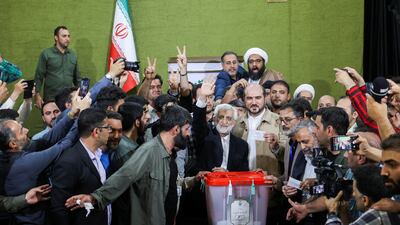
Iranian presidential candidate Saeed Jalili waves at supporters in Tehran, during the run-off election against Masoud Pezeshkian. Reuters -
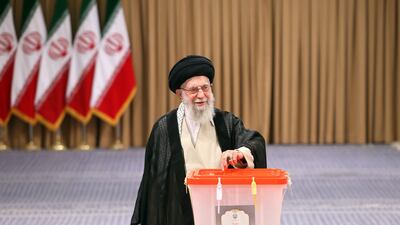
Iranian Supreme Leader Ayatollah Ali Khamenei casts his vote in the presidential election. EPA -
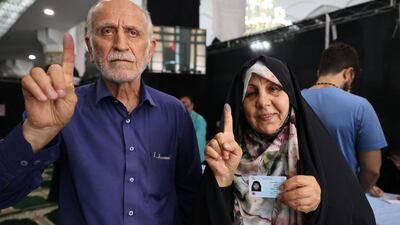
Voters show their ink-stained index fingers after casting their ballots at a polling station in Tehran. AFP -
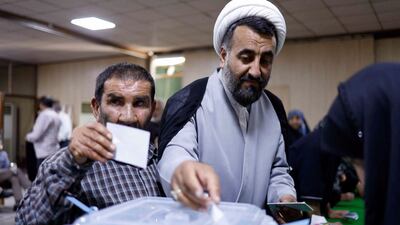
Iranians cast their ballots at the Iranian consulate in Najaf, central Iraq. Reuters -
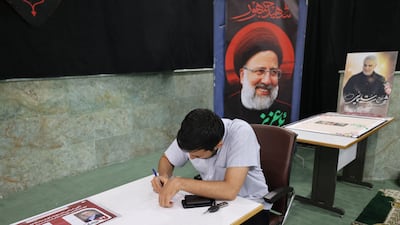
A voter prepares to cast his ballot in Tehran. AFP -
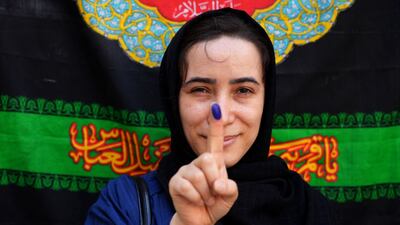
A woman shows that she has voted, at a polling station in Qarchak Varamin south-west of Tehran. AFP -
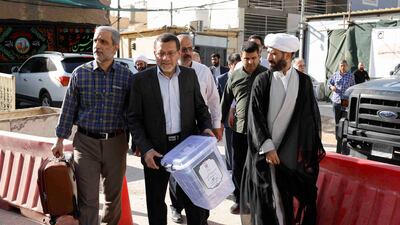
Election officials arriver at a polling station at the Iranian consulate in Najaf, central Iraq. Reuters -
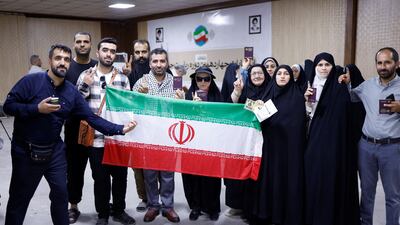
Voters hold up the Iranian flag, at Tehran's consulate in Najaf, central Iraq. Reuters -
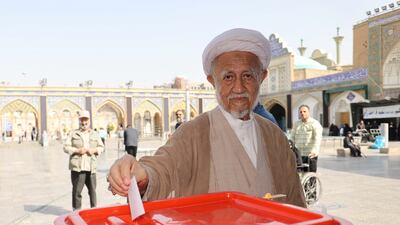
A cleric casts his ballot in Tehran. Reuters -
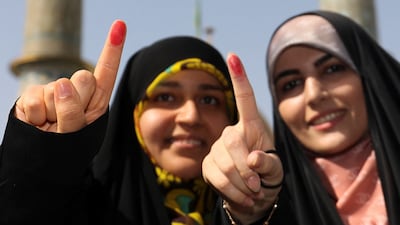
Women show they have cast their vote, in Tehran. Reuters -

A woman puts up a sign featuring images of Iranian presidential candidates Saeed Jalili and Masoud Pezeshkian, in Tehran. Reuters


Inflation pain
Another crucial area that will require attention from the new president and his team of economic policy advisers is inflation, with consumer prices rising by 45.8 per cent last year.
Inflation is expected to slow this year but will remain at a steep 37.5 per cent this year, according to the IMF.
High consumer price inflation has been a “chronic economic challenge in Iran, with annual inflation rates averaging above 20 per cent in the last four decades”, the World Bank said.
In recent years, the situation has worsened, with a record four-year streak of inflation above 40 per cent that has affected the livelihoods of low-income households.
“The size of the middle class is shrinking under inflationary pressures, which reduces the opportunity costs of conflict and violence, especially given Iran's young demographic structure,” Mr Farzanegan said.
“The primary losers in this scenario are Iranian consumers, while politically connected firms and individuals benefit from the economic rents generated by the distortionary effects of sanctions and government interventions, such as in the currency market.”
During the reformist regime of Mohammad Khatami between 1997-2005, the average annual inflation stood at only 15 per cent, said Dr Mahdi Ghodsi, an economist at The Vienna Institute for International Economic Studies, adding “it was the era of growth and minimal two-digit inflation”.
The period recorded a high in average annual GDP growth driven by significant increases in investment, household consumption and government expenditure, allowing the economy to employ 5.7 million new people.
“To replicate the economic improvements of the 1997-2005 period and enhance Iran's economy and people's welfare, we should consider implementing similar policies,” Mr Ghodsi said.
According to the World Bank, the main drivers of high inflation are the budget deficit and imbalances in the balance sheets of Iranian banks that are reflected in an inflated monetary aggregate growth rate.
However, the new president is also likely to face resistance in his bid to reshape and overhaul the troubled banking system in the country, Hasnain Malik, head of emerging markets strategy at Tellimer, an investment research firm in Dubai, said.
“Restructuring of legacy bad loans in the banks and encouragement of private sector competition may require a challenge to vested interest, which is well beyond the presidency,” Mr Malik said.
Removal, or at least softening the intensity of sanctions, is also critical in how well Iran will be able to tackle the inflation problem.
While inflation has fallen over the past year, “it may prove difficult for Pezeshkian’s economic team to drive it down further without major improvements in Iran’s trade balance, fiscal position, or access to central bank reserves”, said Mr Batmanghelidj.
“ In each of those areas, sanctions have tied the hands of Iranian policymakers.”
Fight against corruption
Sanctions have been a major driver of higher trade, transactions and production costs in recent years while also contributing to a rise in corruption, according to Mr Farzanegan.
Alex Vatanka, senior fellow and the founding director of the Iran programme at the Middle East Institute in Washington said Iran needs a different approach to the outside world for its economic revival but before it amends its foreign policy, it needs to tackle corruption.
Before it aims to create investment opportunities for investors, the country needs to “roll back the power of illicit networks that have emerged in the last 20 years or so in the effort to circumvent sanctions as Tehran tried to sell its oil”, said Mr Vatanka.
“Then there are issues of management inside Iran, including the need to fight corruption and nepotism. In short, it’s a tall order and time will show if Pezeshkian can bring the rest of the regime with him as he attempts to go big in changing Iran’s economic realities.”
Mr Pezeshkian's crucial short-term goal “should be to restore macroeconomic stability in Iran through sound monetary and fiscal policies and active, constructive efforts to reduce the intensity of sanctions and ultimately achieve their lifting in the future”, Mr Farzanegan said.
Currency depreciation
A sharp depreciation of the Iranian currency is another challenge facing the new president.
The Iranian rial, which hit a record low of more than 705,000 against the US dollar in April after the country launched a missile strike against Israel, recovered to about 596,000 a dollar after the election results were announced, according to currency trading portal bonbast.com data.
Even with a reformist president in office, Fitch Ratings expected depreciation in the Iranian currency to continue this year “due to heightened geopolitical tensions and investor worries surrounding the US presidential election in November”.
“We expect a more modest depreciation in 2025, with the rial losing 21.3 per cent of its value, compared to 23.1 per cent in 2024,” Fitch said in its latest report on Iranian currency and financial scenario this year and next.
Meanwhile, the financial market in Iran also reacted slightly positively to the new regime, “anticipating better economic conditions due to opening the economy and reducing tensions that have increased due to hardline policies over the past two decades”, Mr Ghodsi said.
Since the public sector accounts for about 70 per cent to 80 per cent of Iran's total GDP, the president plays a crucial role in diversifying the country's resources according to his chosen direction, he said.
If the new president is unable to quickly introduce his election campaign promises to remove western sanctions, comply with FATF standards and regulations, create a better investment environment, improve social policies and lift internet filtering, “market expectations will diverge from reality, leading to increased uncertainty”.
If substantial institutional reforms are carried out, the country can expect average growth rates of about 4 per cent, driven by industrial growth rather than oil exports, Mr Ghodsi said.
“Whether Pezeshkian's policies will lead to an increase in public and private investment, thereby creating jobs and eradicating poverty, or continue the inflationary policies of direct cash handouts initiated during the Ahmadinejad era, remains to be seen in the future.”

