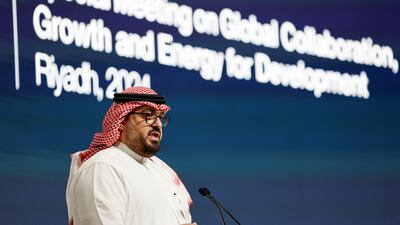
Saudi Arabia’s Finance Minister Mohammed Al Jadaan on Sunday said the kingdom would adapt to current economic and geopolitical challenges and “downscale” or “accelerate” some of the projects being carried out under its Vision 2030 programme.
Asked whether Saudi Arabia had to "mark-to-market" its expectations regarding the goals of the 14-year long programme, Mr Al Jadaan said: “Absolutely, yes.”
The kingdom could increase its gross domestic product growth rate by boosting oil production but such an expansion would not be "quality growth, but quantity growth," the minister said during a panel session at a special meeting of the World Economic Forum in Riyadh.
We don't have any ego. We will change, we will adjust [or] extend some of the projects. We will downscale some of the projects and accelerate others
Mohammed Al Jadaan,
Minister of Finance, Saudi Arabia
Saudi Arabia, the Arab world's largest economy, launched the 2030 vision programme in 2016 to diversify its economy away from oil, support private-sector growth, improve female workforce participation and reduce the unemployment rate among citizens.
The kingdom has also announced a host of ambitious new projects to support its plans, such as Neom and the Red Sea Project.
The government was aiming to accommodate 1.5 million residents within The Line, a 170km-long linear smart city under construction in Neom, which is in the kingdom's Tabuk province.
However, Bloomberg reported last week the project now looks set to host fewer than 300,000 residents by 2030, with officials expecting only 2.4km of the project to be completed by that time. Neom did not respond to a request for comment.
On Friday, the Saudi Press Agency reported that out of the 1,064 initiatives introduced under the Vision, 87 per cent were complete or on track.
"We are not complacent but we are very pleased with what was achieved," Mr Al Jadaan said.
"A lot of the targets have been overdelivered, there are challenges obviously, and this is why I said we don't have any ego. We will change, we will adjust [or] extend some of the projects. We will downscale some of the projects [and] accelerate other[s]."
The minister's remarks come months after Saudi Aramco abandoned a plan to increase its production capacity to 13 million barrels per day from 12 million bpd currently.
Aramco’s decision may have been influenced by escalating costs of developing new projects, ample spare capacity and weakening demand outlook for crude amid growing adoption of renewable energy and electric vehicles, analysts said at the time.
“This year we have seen Saudi Arabia review their upstream capacity ... this is not because the kingdom will not invest in the upstream sector. It’s because commercially it makes more sense to scale back the plan," Amena Bakr, senior Middle East research analyst at Energy Intelligence, told The National on the sidelines of the event.
“Rethinking and tweaking their strategy is key in achieving a balance between meeting Vision 2030 goals and budgetary constraints."
Mr Al Jadaan also said developing economies should not be forced to pick a side between China and the US and its allies.
“We should avoid forcing them to make a choice between two countries or two groups of countries,” he said.
"I think it is very difficult to go to Africa and say: 'Listen, if you want us to help you, you need to stop dealing with China or if you want us to help, you need to stop dealing with the G7 [Group of Seven nations] or the US'.
"That is not a clear choice for them because they need all the help we can [give], whether it is from the South or the North.”
Deepening divergence
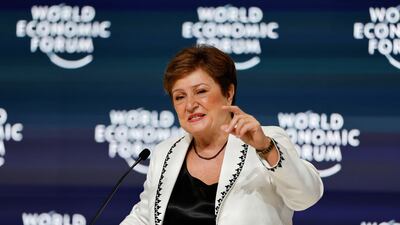
Meanwhile, Kristalina Georgieva, managing director of the International Monetary Fund, said the divergence in economic growth is “deepening”.
“In advanced economies, the US is doing well but the eurozone is not. Within the emerging market economies … India, Indonesia and Malaysia … are doing well. China came a bit above expectations in its first quarter but then we have a number of countries that are facing significant difficulties,” she said at the same panel.
"What has happened over the last years is countries used all the ammunition they had because of Covid, the war in Ukraine [and] then the cost-of-living crisis, but more shocks will come and rebuilding fiscal buffers is a priority."
Global debt hit a record $307 trillion in the third quarter of last year, with a big increase across the board in mature markets such as the US, UK and Japan as well as emerging markets, including China and India, according to the Institute of International Finance.
This year, a series of elections and persistent geopolitical tensions have raised worries about heightened government borrowing and fiscal restraint, in countries such as India, South Africa, Pakistan and the US.
Speaking about the need for greater co-operation between wealthy and developing countries, Ms Georgieva said poorer countries have to play their part by introducing economic reforms.
"They need to collect taxes, they need to fight corruption [and] they need to improve the quality of spending," she said.
"They need to demonstrate they are committed to their own people and the response must be that they get a huge deal of international support in debt restructuring."
Higher interest rates have made it difficult for countries to rebuild their capital buffers, while negatively impacting growth prospects around the world, the IMF chief said.
She also said elevated interest rates in the US lead to a stronger dollar, which, in turn, can cause the currencies of many other countries to depreciate, making it harder for them to combat inflation domestically.
"The path towards cutting interest rates in our view ... still remains open, we still think that we would enter 2025 in the US, with interest rates finally moving towards lower levels," Ms Georgieva said.
"But even with the start of interest rate cuts, it doesn't mean interest rates would fall down to where they were before the pandemic, so strong fiscal position [and] good management in our countries is necessity."

Where%20the%20Crawdads%20Sing
%3Cp%3E%3Cstrong%3EDirector%3A%20%3C%2Fstrong%3EOlivia%20Newman%3Cbr%3E%3Cstrong%3EStars%3A%3C%2Fstrong%3E%20Daisy%20Edgar-Jones%2C%20Taylor%20John%20Smith%2C%20Harris%20Dickinson%2C%20David%20Strathairn%3Cbr%3E%3Cstrong%3ERating%3A%3C%2Fstrong%3E%202%2F5%3C%2Fp%3E%0A
What is dialysis?
Dialysis is a way of cleaning your blood when your kidneys fail and can no longer do the job.
It gets rid of your body's wastes, extra salt and water, and helps to control your blood pressure. The main cause of kidney failure is diabetes and hypertension.
There are two kinds of dialysis — haemodialysis and peritoneal.
In haemodialysis, blood is pumped out of your body to an artificial kidney machine that filter your blood and returns it to your body by tubes.
In peritoneal dialysis, the inside lining of your own belly acts as a natural filter. Wastes are taken out by means of a cleansing fluid which is washed in and out of your belly in cycles.
It isn’t an option for everyone but if eligible, can be done at home by the patient or caregiver. This, as opposed to home haemodialysis, is covered by insurance in the UAE.
The alternatives
• Founded in 2014, Telr is a payment aggregator and gateway with an office in Silicon Oasis. It’s e-commerce entry plan costs Dh349 monthly (plus VAT). QR codes direct customers to an online payment page and merchants can generate payments through messaging apps.
• Business Bay’s Pallapay claims 40,000-plus active merchants who can invoice customers and receive payment by card. Fees range from 1.99 per cent plus Dh1 per transaction depending on payment method and location, such as online or via UAE mobile.
• Tap started in May 2013 in Kuwait, allowing Middle East businesses to bill, accept, receive and make payments online “easier, faster and smoother” via goSell and goCollect. It supports more than 10,000 merchants. Monthly fees range from US$65-100, plus card charges of 2.75-3.75 per cent and Dh1.2 per sale.
• 2checkout’s “all-in-one payment gateway and merchant account” accepts payments in 200-plus markets for 2.4-3.9 per cent, plus a Dh1.2-Dh1.8 currency conversion charge. The US provider processes online shop and mobile transactions and has 17,000-plus active digital commerce users.
• PayPal is probably the best-known online goods payment method - usually used for eBay purchases - but can be used to receive funds, providing everyone’s signed up. Costs from 2.9 per cent plus Dh1.2 per transaction.
Our family matters legal consultant
Name: Hassan Mohsen Elhais
Position: legal consultant with Al Rowaad Advocates and Legal Consultants.
Mercer, the investment consulting arm of US services company Marsh & McLennan, expects its wealth division to at least double its assets under management (AUM) in the Middle East as wealth in the region continues to grow despite economic headwinds, a company official said.
Mercer Wealth, which globally has $160 billion in AUM, plans to boost its AUM in the region to $2-$3bn in the next 2-3 years from the present $1bn, said Yasir AbuShaban, a Dubai-based principal with Mercer Wealth.
“Within the next two to three years, we are looking at reaching $2 to $3 billion as a conservative estimate and we do see an opportunity to do so,” said Mr AbuShaban.
Mercer does not directly make investments, but allocates clients’ money they have discretion to, to professional asset managers. They also provide advice to clients.
“We have buying power. We can negotiate on their (client’s) behalf with asset managers to provide them lower fees than they otherwise would have to get on their own,” he added.
Mercer Wealth’s clients include sovereign wealth funds, family offices, and insurance companies among others.
From its office in Dubai, Mercer also looks after Africa, India and Turkey, where they also see opportunity for growth.
Wealth creation in Middle East and Africa (MEA) grew 8.5 per cent to $8.1 trillion last year from $7.5tn in 2015, higher than last year’s global average of 6 per cent and the second-highest growth in a region after Asia-Pacific which grew 9.9 per cent, according to consultancy Boston Consulting Group (BCG). In the region, where wealth grew just 1.9 per cent in 2015 compared with 2014, a pickup in oil prices has helped in wealth generation.
BCG is forecasting MEA wealth will rise to $12tn by 2021, growing at an annual average of 8 per cent.
Drivers of wealth generation in the region will be split evenly between new wealth creation and growth of performance of existing assets, according to BCG.
Another general trend in the region is clients’ looking for a comprehensive approach to investing, according to Mr AbuShaban.
“Institutional investors or some of the families are seeing a slowdown in the available capital they have to invest and in that sense they are looking at optimizing the way they manage their portfolios and making sure they are not investing haphazardly and different parts of their investment are working together,” said Mr AbuShaban.
Some clients also have a higher appetite for risk, given the low interest-rate environment that does not provide enough yield for some institutional investors. These clients are keen to invest in illiquid assets, such as private equity and infrastructure.
“What we have seen is a desire for higher returns in what has been a low-return environment specifically in various fixed income or bonds,” he said.
“In this environment, we have seen a de facto increase in the risk that clients are taking in things like illiquid investments, private equity investments, infrastructure and private debt, those kind of investments were higher illiquidity results in incrementally higher returns.”
The Abu Dhabi Investment Authority, one of the largest sovereign wealth funds, said in its 2016 report that has gradually increased its exposure in direct private equity and private credit transactions, mainly in Asian markets and especially in China and India. The authority’s private equity department focused on structured equities owing to “their defensive characteristics.”
How Apple's credit card works
The Apple Card looks different from a traditional credit card — there's no number on the front and the users' name is etched in metal. The card expands the company's digital Apple Pay services, marrying the physical card to a virtual one and integrating both with the iPhone. Its attributes include quick sign-up, elimination of most fees, strong security protections and cash back.
What does it cost?
Apple says there are no fees associated with the card. That means no late fee, no annual fee, no international fee and no over-the-limit fees. It also said it aims to have among the lowest interest rates in the industry. Users must have an iPhone to use the card, which comes at a cost. But they will earn cash back on their purchases — 3 per cent on Apple purchases, 2 per cent on those with the virtual card and 1 per cent with the physical card. Apple says it is the only card to provide those rewards in real time, so that cash earned can be used immediately.
What will the interest rate be?
The card doesn't come out until summer but Apple has said that as of March, the variable annual percentage rate on the card could be anywhere from 13.24 per cent to 24.24 per cent based on creditworthiness. That's in line with the rest of the market, according to analysts
What about security?
The physical card has no numbers so purchases are made with the embedded chip and the digital version lives in your Apple Wallet on your phone, where it's protected by fingerprints or facial recognition. That means that even if someone steals your phone, they won't be able to use the card to buy things.
Is it easy to use?
Apple says users will be able to sign up for the card in the Wallet app on their iPhone and begin using it almost immediately. It also tracks spending on the phone in a more user-friendly format, eliminating some of the gibberish that fills a traditional credit card statement. Plus it includes some budgeting tools, such as tracking spending and providing estimates of how much interest could be charged on a purchase to help people make an informed decision.
* Associated Press
The specs
Engine: 6.2-litre V8
Transmission: ten-speed
Power: 420bhp
Torque: 624Nm
Price: Dh325,125
On sale: Now
Defence review at a glance
• Increase defence spending to 2.5% of GDP by 2027 but given “turbulent times it may be necessary to go faster”
• Prioritise a shift towards working with AI and autonomous systems
• Invest in the resilience of military space systems.
• Number of active reserves should be increased by 20%
• More F-35 fighter jets required in the next decade
• New “hybrid Navy” with AUKUS submarines and autonomous vessels
Related
Tamkeen's offering
- Option 1: 70% in year 1, 50% in year 2, 30% in year 3
- Option 2: 50% across three years
- Option 3: 30% across five years
Timeline
2012-2015
The company offers payments/bribes to win key contracts in the Middle East
May 2017
The UK SFO officially opens investigation into Petrofac’s use of agents, corruption, and potential bribery to secure contracts
September 2021
Petrofac pleads guilty to seven counts of failing to prevent bribery under the UK Bribery Act
October 2021
Court fines Petrofac £77 million for bribery. Former executive receives a two-year suspended sentence
December 2024
Petrofac enters into comprehensive restructuring to strengthen the financial position of the group
May 2025
The High Court of England and Wales approves the company’s restructuring plan
July 2025
The Court of Appeal issues a judgment challenging parts of the restructuring plan
August 2025
Petrofac issues a business update to execute the restructuring and confirms it will appeal the Court of Appeal decision
October 2025
Petrofac loses a major TenneT offshore wind contract worth €13 billion. Holding company files for administration in the UK. Petrofac delisted from the London Stock Exchange
November 2025
180 Petrofac employees laid off in the UAE
The%20specs%3A%20Panamera%20Turbo%20E-Hybrid
%3Cp%3E%3Cstrong%3EEngine%3A%20%3C%2Fstrong%3E4.0-litre%20twin-turbo%20V8%20hybrid%0D%3Cbr%3E%3Cstrong%3EPower%3A%20%3C%2Fstrong%3E680hp%0D%3Cbr%3E%3Cstrong%3ETorque%3A%20%3C%2Fstrong%3E930Nm%0D%3Cbr%3E%3Cstrong%3ETransmission%3A%20%3C%2Fstrong%3EEight-speed%20dual-clutch%20auto%0D%3Cbr%3E%3Cstrong%3EPrice%3A%20%3C%2Fstrong%3EFrom%20Dh749%2C000%0D%3Cbr%3E%3Cstrong%3EOn%20sale%3A%20%3C%2Fstrong%3ENow%3C%2Fp%3E%0A
The%20specs%3A%202024%20Panamera
%3Cp%3E%3Cstrong%3EEngine%3A%20%3C%2Fstrong%3E2.9-litre%20twin-turbo%20V6%0D%3Cbr%3E%3Cstrong%3EPower%3A%20%3C%2Fstrong%3E353hp%0D%3Cbr%3E%3Cstrong%3ETorque%3A%20%3C%2Fstrong%3E500Nm%0D%3Cbr%3E%3Cstrong%3ETransmission%3A%20%3C%2Fstrong%3EEight-speed%20dual-clutch%20auto%0D%3Cbr%3E%3Cstrong%3EPrice%3A%20%3C%2Fstrong%3EFrom%20Dh408%2C200%0D%3Cbr%3E%3Cstrong%3EOn%20sale%3A%3C%2Fstrong%3E%20Now%3C%2Fp%3E%0A
COMPANY%20PROFILE
%3Cp%3E%3Cstrong%3ECompany%3A%20%3C%2Fstrong%3EGrowdash%0D%3Cbr%3E%3Cstrong%3EStarted%3A%20%3C%2Fstrong%3EJuly%202022%0D%3Cbr%3E%3Cstrong%3EFounders%3A%20%3C%2Fstrong%3ESean%20Trevaskis%20and%20Enver%20Sorkun%0D%3Cbr%3E%3Cstrong%3EBased%3A%20%3C%2Fstrong%3EDubai%2C%20UAE%0D%3Cbr%3E%3Cstrong%3EIndustry%3A%20%3C%2Fstrong%3ERestaurant%20technology%0D%3Cbr%3E%3Cstrong%3EFunding%20so%20far%3A%3C%2Fstrong%3E%20%24750%2C000%0D%3Cbr%3E%3Cstrong%3EInvestors%3A%20%3C%2Fstrong%3EFlat6Labs%2C%20Plus%20VC%2C%20Judah%20VC%2C%20TPN%20Investments%20and%20angel%20investors%2C%20including%20former%20Talabat%20chief%20executive%20Abdulhamid%20Alomar%2C%20and%20entrepreneur%20Zeid%20Husban%3C%2Fp%3E%0A
GAC GS8 Specs
Engine: 2.0-litre 4cyl turbo
Power: 248hp at 5,200rpm
Torque: 400Nm at 1,750-4,000rpm
Transmission: 8-speed auto
Fuel consumption: 9.1L/100km
On sale: Now
Price: From Dh149,900
The bio
Favourite book: Peter Rabbit. I used to read it to my three children and still read it myself. If I am feeling down it brings back good memories.
Best thing about your job: Getting to help people. My mum always told me never to pass up an opportunity to do a good deed.
Best part of life in the UAE: The weather. The constant sunshine is amazing and there is always something to do, you have so many options when it comes to how to spend your day.
Favourite holiday destination: Malaysia. I went there for my honeymoon and ended up volunteering to teach local children for a few hours each day. It is such a special place and I plan to retire there one day.
THE SPECS
Engine: 1.5-litre turbocharged four-cylinder
Transmission: Constant Variable (CVT)
Power: 141bhp
Torque: 250Nm
Price: Dh64,500
On sale: Now
Huroob Ezterari
Director: Ahmed Moussa
Starring: Ahmed El Sakka, Amir Karara, Ghada Adel and Moustafa Mohammed
Three stars