Live updates: Follow the latest news on Israel-Gaza
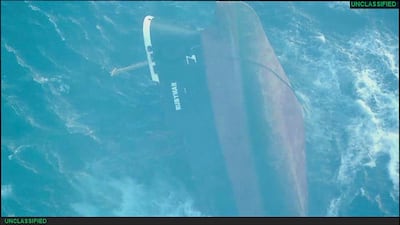
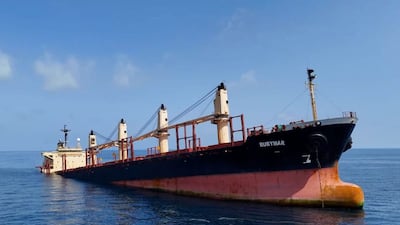
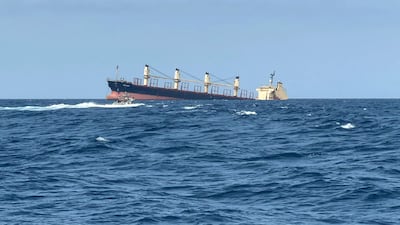
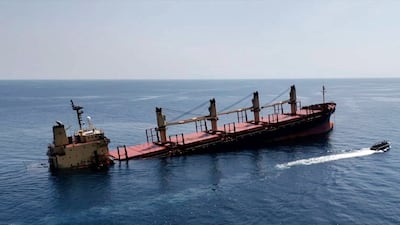
The sinking of the UK-owned bulk carrier Rubymar after a Houthi missile attack off the coast of Yemen threatens to further delay the global shipping industry’s recovery and heighten the worsening security risks at Bab Al Mandeb.
The incident, which marks the first vessel lost since attacks on Red Sea ships started in November, will force shipping companies to continue relying on the expensive and lengthy reroute around the southern tip of Africa, analysts say.
“This incident will do nothing to ease the concerns of ocean freight carriers, so it is likely the diversions around the Cape of Good Hope in Africa will be in place for the foreseeable future,” Peter Sand, chief analyst of freight platform Xeneta, told The National.
“This incident demonstrates the ongoing danger for vessels transiting the Red Sea and Gulf of Aden and why the majority of ocean freight container ships are continuing to avoid the region.”
Bab Al Mandeb is a critical strait connecting the Gulf of Aden to the Red Sea.
However, the long and expensive detour around the Cape of Good Hope has raised freight shipping prices amid transport delays that could lead to higher consumer prices for some goods.
The latest ocean freight shipping rates data by Xeneta shows that while rates softened slightly in recent weeks, they are still significantly up compared to mid-December when the escalation in the Red Sea began.
Freight rates jumped 164 per cent on March 3 to $4,954 a 40-foot container (FEU), compared with $1,873 on December 14 for routes from the Far East to the Mediterranean, according to Xeneta. These rates are for container ships rather than bulk ships such as the Rubymar.
The rates similarly rose 164 per cent on March 3 to $4,034 a FEU, compared with $1,526 on December 14, from the Far East to North Europe.
“This incident further delays any near-term relief to cargoes taking an alternate route,” Junaid Ansari, head of investment strategy and research at Kamco Invest, told The National.
“This could impact global inflation as the bulk of the shipping carriers would avoid taking this shorter route resulting in higher costs, higher demand for crude oil in the shipping sector, as well as [a] higher risk premium on crude oil and energy prices.”
In February, container prices rose by 10 per cent in north-east Asia, 7 per cent in Oceania and 2.5 per cent in South-East Asia, remaining stable in North America, shipping platform Container XChange said in its latest market report on Monday.
However, prices declined in Europe by about 5 per cent to 7 per cent, 5 per cent in Japan and Korea and 2.4 per cent in the Middle East and the Indian subcontinent region, it found.
Major shippers and operators have suspended operations in the Red Sea – a vital maritime route – following attacks on commercial shipping lines by Yemen’s Houthi rebels.
About 12 per cent of seaborne oil trade and 8 per cent of liquefied natural gas passes through Bab Al Mandeb.
Houthi rebels in Yemen began attacking commercial vessels to express solidarity with the Palestinians in the Israel-Gaza war.
The Iran-backed group show no signs of retreating despite the US and western allies attempting to deter the group with air strikes.
This has severely disrupted trade routes, resulting in longer transit times and affected the bottom line of shipping companies, which have, in response, raised their rates to cope with losses.
With the sinking of the Rubymar, container ships will continue to find alternative routes, according to maritime consultancy Drewry.
“The incident re-emphasises that the Red Sea crisis is not improving and our view is that the vast majority of container ships will continue to avoid the area for the foreseeable future,” said Simon Heaney, senior manager of container research at London-based Drewry.
Global trade ministers and delegates converging in Abu Dhabi last week at the13th World Trade Organisation Ministerial Conference raised concerns about the impact on international commerce from the shipping attacks in the Red Sea, which connects Europe with Asia.
Last week, the UAE's Minister of Economy Abdulla bin Touq said that challenges resulting from the conflict in the Red Sea have highlighted the need for new trade routes as well as investments to redesign logistics and ensure stable supply chains.
Global trade is expected to miss its growth forecast for 2024 as downside risks continue to persist.
On October 5, the WTO forecast a 3.3 per cent growth in global trade for 2024 – a strong improvement on last year's 0.8 per cent – but the projection was made before the Israel-Gaza war that began two days later.

ENGLAND SQUAD
Goalkeepers: Jack Butland, Jordan Pickford, Nick Pope
Defenders: John Stones, Harry Maguire, Phil Jones, Kyle Walker, Kieran Trippier, Gary Cahill, Ashley Young, Danny Rose, Trent Alexander-Arnold
Midfielders: Eric Dier, Jordan Henderson, Dele Alli, Jesse Lingard, Raheem Sterling, Ruben Loftus-Cheek, Fabian Delph
Forwards: Harry Kane, Jamie Vardy, Marcus Rashford, Danny Welbeck
Mercer, the investment consulting arm of US services company Marsh & McLennan, expects its wealth division to at least double its assets under management (AUM) in the Middle East as wealth in the region continues to grow despite economic headwinds, a company official said.
Mercer Wealth, which globally has $160 billion in AUM, plans to boost its AUM in the region to $2-$3bn in the next 2-3 years from the present $1bn, said Yasir AbuShaban, a Dubai-based principal with Mercer Wealth.
“Within the next two to three years, we are looking at reaching $2 to $3 billion as a conservative estimate and we do see an opportunity to do so,” said Mr AbuShaban.
Mercer does not directly make investments, but allocates clients’ money they have discretion to, to professional asset managers. They also provide advice to clients.
“We have buying power. We can negotiate on their (client’s) behalf with asset managers to provide them lower fees than they otherwise would have to get on their own,” he added.
Mercer Wealth’s clients include sovereign wealth funds, family offices, and insurance companies among others.
From its office in Dubai, Mercer also looks after Africa, India and Turkey, where they also see opportunity for growth.
Wealth creation in Middle East and Africa (MEA) grew 8.5 per cent to $8.1 trillion last year from $7.5tn in 2015, higher than last year’s global average of 6 per cent and the second-highest growth in a region after Asia-Pacific which grew 9.9 per cent, according to consultancy Boston Consulting Group (BCG). In the region, where wealth grew just 1.9 per cent in 2015 compared with 2014, a pickup in oil prices has helped in wealth generation.
BCG is forecasting MEA wealth will rise to $12tn by 2021, growing at an annual average of 8 per cent.
Drivers of wealth generation in the region will be split evenly between new wealth creation and growth of performance of existing assets, according to BCG.
Another general trend in the region is clients’ looking for a comprehensive approach to investing, according to Mr AbuShaban.
“Institutional investors or some of the families are seeing a slowdown in the available capital they have to invest and in that sense they are looking at optimizing the way they manage their portfolios and making sure they are not investing haphazardly and different parts of their investment are working together,” said Mr AbuShaban.
Some clients also have a higher appetite for risk, given the low interest-rate environment that does not provide enough yield for some institutional investors. These clients are keen to invest in illiquid assets, such as private equity and infrastructure.
“What we have seen is a desire for higher returns in what has been a low-return environment specifically in various fixed income or bonds,” he said.
“In this environment, we have seen a de facto increase in the risk that clients are taking in things like illiquid investments, private equity investments, infrastructure and private debt, those kind of investments were higher illiquidity results in incrementally higher returns.”
The Abu Dhabi Investment Authority, one of the largest sovereign wealth funds, said in its 2016 report that has gradually increased its exposure in direct private equity and private credit transactions, mainly in Asian markets and especially in China and India. The authority’s private equity department focused on structured equities owing to “their defensive characteristics.”
Syria squad
Goalkeepers: Ibrahim Alma, Mahmoud Al Youssef, Ahmad Madania.
Defenders: Ahmad Al Salih, Moayad Ajan, Jehad Al Baour, Omar Midani, Amro Jenyat, Hussein Jwayed, Nadim Sabagh, Abdul Malek Anezan.
Midfielders: Mahmoud Al Mawas, Mohammed Osman, Osama Omari, Tamer Haj Mohamad, Ahmad Ashkar, Youssef Kalfa, Zaher Midani, Khaled Al Mobayed, Fahd Youssef.
Forwards: Omar Khribin, Omar Al Somah, Mardik Mardikian.
Saturday's results
Brighton 1-1 Leicester City
Everton 1-0 Cardiff City
Manchester United 0-0 Crystal Palace
Watford 0-3 Liverpool
West Ham United 0-4 Manchester City
Overview
Cricket World Cup League Two: Nepal, Oman, United States tri-series, Tribhuvan University, Kathmandu
Fixtures
Wednesday February 5, Oman v Nepal
Thursday, February 6, Oman v United States
Saturday, February 8, United States v Nepal
Sunday, February 9, Oman v Nepal
Tuesday, February 11, Oman v United States
Wednesday, February 12, United States v Nepal
How to protect yourself when air quality drops
Install an air filter in your home.
Close your windows and turn on the AC.
Shower or bath after being outside.
Wear a face mask.
Stay indoors when conditions are particularly poor.
If driving, turn your engine off when stationary.
Company%C2%A0profile
%3Cp%3E%3Cstrong%3EDate%20started%3A%20%3C%2Fstrong%3EMay%202022%3Cbr%3E%3Cstrong%3EFounder%3A%20%3C%2Fstrong%3EHusam%20Aboul%20Hosn%3Cbr%3E%3Cstrong%3EBased%3A%20%3C%2Fstrong%3EDIFC%3Cbr%3E%3Cstrong%3ESector%3A%20%3C%2Fstrong%3EFinTech%20%E2%80%94%20Innovation%20Hub%3Cbr%3E%3Cstrong%3EEmployees%3A%20%3C%2Fstrong%3Eeight%3Cbr%3E%3Cstrong%3EStage%3A%20%3C%2Fstrong%3Epre-seed%3Cbr%3E%3Cstrong%3EInvestors%3A%20%3C%2Fstrong%3Epre-seed%20funding%20raised%20from%20family%20and%20friends%20earlier%20this%20year%3C%2Fp%3E%0A
First Person
Richard Flanagan
Chatto & Windus
Company profile
Name: Thndr
Started: October 2020
Founders: Ahmad Hammouda and Seif Amr
Based: Cairo, Egypt
Sector: FinTech
Initial investment: pre-seed of $800,000
Funding stage: series A; $20 million
Investors: Tiger Global, Beco Capital, Prosus Ventures, Y Combinator, Global Ventures, Abdul Latif Jameel, Endure Capital, 4DX Ventures, Plus VC, Rabacap and MSA Capital
How Tesla’s price correction has hit fund managers
Investing in disruptive technology can be a bumpy ride, as investors in Tesla were reminded on Friday, when its stock dropped 7.5 per cent in early trading to $575.
It recovered slightly but still ended the week 15 per cent lower and is down a third from its all-time high of $883 on January 26. The electric car maker’s market cap fell from $834 billion to about $567bn in that time, a drop of an astonishing $267bn, and a blow for those who bought Tesla stock late.
The collapse also hit fund managers that have gone big on Tesla, notably the UK-based Scottish Mortgage Investment Trust and Cathie Wood’s ARK Innovation ETF.
Tesla is the top holding in both funds, making up a hefty 10 per cent of total assets under management. Both funds have fallen by a quarter in the past month.
Matt Weller, global head of market research at GAIN Capital, recently warned that Tesla founder Elon Musk had “flown a bit too close to the sun”, after getting carried away by investing $1.5bn of the company’s money in Bitcoin.
He also predicted Tesla’s sales could struggle as traditional auto manufacturers ramp up electric car production, destroying its first mover advantage.
AJ Bell’s Russ Mould warns that many investors buy tech stocks when earnings forecasts are rising, almost regardless of valuation. “When it works, it really works. But when it goes wrong, elevated valuations leave little or no downside protection.”
A Tesla correction was probably baked in after last year’s astonishing share price surge, and many investors will see this as an opportunity to load up at a reduced price.
Dramatic swings are to be expected when investing in disruptive technology, as Ms Wood at ARK makes clear.
Every week, she sends subscribers a commentary listing “stocks in our strategies that have appreciated or dropped more than 15 per cent in a day” during the week.
Her latest commentary, issued on Friday, showed seven stocks displaying extreme volatility, led by ExOne, a leader in binder jetting 3D printing technology. It jumped 24 per cent, boosted by news that fellow 3D printing specialist Stratasys had beaten fourth-quarter revenues and earnings expectations, seen as good news for the sector.
By contrast, computational drug and material discovery company Schrödinger fell 27 per cent after quarterly and full-year results showed its core software sales and drug development pipeline slowing.
Despite that setback, Ms Wood remains positive, arguing that its “medicinal chemistry platform offers a powerful and unique view into chemical space”.
In her weekly video view, she remains bullish, stating that: “We are on the right side of change, and disruptive innovation is going to deliver exponential growth trajectories for many of our companies, in fact, most of them.”
Ms Wood remains committed to Tesla as she expects global electric car sales to compound at an average annual rate of 82 per cent for the next five years.
She said these are so “enormous that some people find them unbelievable”, and argues that this scepticism, especially among institutional investors, “festers” and creates a great opportunity for ARK.
Only you can decide whether you are a believer or a festering sceptic. If it’s the former, then buckle up.
Terror attacks in Paris, November 13, 2015
- At 9.16pm, three suicide attackers killed one person outside the Atade de France during a foootball match between France and Germany
- At 9.25pm, three attackers opened fire on restaurants and cafes over 20 minutes, killing 39 people
- Shortly after 9.40pm, three other attackers launched a three-hour raid on the Bataclan, in which 1,500 people had gathered to watch a rock concert. In total, 90 people were killed
- Salah Abdeslam, the only survivor of the terrorists, did not directly participate in the attacks, thought to be due to a technical glitch in his suicide vest
- He fled to Belgium and was involved in attacks on Brussels in March 2016. He is serving a life sentence in France
Red flags
- Promises of high, fixed or 'guaranteed' returns.
- Unregulated structured products or complex investments often used to bypass traditional safeguards.
- Lack of clear information, vague language, no access to audited financials.
- Overseas companies targeting investors in other jurisdictions - this can make legal recovery difficult.
- Hard-selling tactics - creating urgency, offering 'exclusive' deals.
Courtesy: Carol Glynn, founder of Conscious Finance Coaching
Company%20Profile
%3Cp%3E%3Cstrong%3EName%3A%3C%2Fstrong%3E%20Ovasave%3Cbr%3E%3Cstrong%3EStarted%3A%3C%2Fstrong%3E%20November%202022%3Cbr%3E%3Cstrong%3EFounders%3A%3C%2Fstrong%3E%20Majd%20Abu%20Zant%20and%20Torkia%20Mahloul%3Cbr%3E%3Cstrong%3EBased%3A%3C%2Fstrong%3E%20Abu%20Dhabi%3Cbr%3E%3Cstrong%3ESector%3A%3C%2Fstrong%3E%20Healthtech%3Cbr%3E%3Cstrong%3ENumber%20of%20staff%3A%3C%2Fstrong%3E%20Three%20employees%3Cbr%3E%3Cstrong%3EInvestment%20stage%3A%3C%2Fstrong%3E%20Pre-seed%3Cbr%3E%3Cstrong%3EInvestment%3A%3C%2Fstrong%3E%20%24400%2C000%3C%2Fp%3E%0A
The%20Emperor%20and%20the%20Elephant
%3Cp%3E%3Cstrong%3EAuthor%3A%20%3C%2Fstrong%3ESam%20Ottewill-Soulsby%3C%2Fp%3E%0A%3Cp%3E%3Cstrong%3EPublisher%3A%20%3C%2Fstrong%3EPrinceton%20University%20Press%3C%2Fp%3E%0A%3Cp%3E%3Cstrong%3EPages%3A%20%3C%2Fstrong%3E392%3C%2Fp%3E%0A%3Cp%3E%3Cstrong%3EAvailable%3A%20%3C%2Fstrong%3EJuly%2011%3C%2Fp%3E%0A
UAE tour of Zimbabwe
All matches in Bulawayo
Friday, Sept 26 – UAE won by 36 runs
Sunday, Sept 28 – Second ODI
Tuesday, Sept 30 – Third ODI
Thursday, Oct 2 – Fourth ODI
Sunday, Oct 5 – First T20I
Monday, Oct 6 – Second T20I
2024%20Dubai%20Marathon%20Results
%3Cp%3E%3Cstrong%3EWomen%E2%80%99s%20race%3A%3C%2Fstrong%3E%0D%3Cbr%3E1.%20Tigist%20Ketema%20(ETH)%202hrs%2016min%207sec%0D%3Cbr%3E2.%20Ruti%20Aga%20(ETH)%202%3A18%3A09%0D%3Cbr%3E3.%20Dera%20Dida%20(ETH)%202%3A19%3A29%0D%3Cbr%3EMen's%20race%3A%0D%3Cbr%3E1.%20Addisu%20Gobena%20(ETH)%202%3A05%3A01%0D%3Cbr%3E2.%20Lemi%20Dumicha%20(ETH)%202%3A05%3A20%0D%3Cbr%3E3.%20DejeneMegersa%20(ETH)%202%3A05%3A42%3C%2Fp%3E%0A
LOVE%20AGAIN
%3Cp%3EDirector%3A%20Jim%20Strouse%3C%2Fp%3E%0A%3Cp%3EStars%3A%20Priyanka%20Chopra%20Jonas%2C%20Sam%20Heughan%2C%20Celine%20Dion%3C%2Fp%3E%0A%3Cp%3ERating%3A%202%2F5%3C%2Fp%3E%0A