


Emerging market and developing economies will require substantial investment to mitigate climate changes, 80 per cent of which will have to come from the private sector, for these countries to achieve their net-zero emissions goal by 2050, the International Monetary Fund has said.
The emerging and developing nations, which currently emit around two thirds of greenhouse gases globally, will need about $2 trillion annually by 2030 to reach their climate targets, the IMF said on Monday citing, the International Energy Agency's estimates.
The projected investment is a fivefold increase from the current $400 billion of climate investments planned over the next seven years, and the majority of the required funding needs to flow into the energy industry, the Washington-based fund said in its latest Global Financial Stability Report.
“We project that growth in public investment, however, will be limited, and that the private sector will therefore need to make a major contribution toward the large climate investment needs for emerging market and developing economies,” IMF economists said in a separate blog post on Monday.
“The private sector will need to supply about 80 per cent of the required investment, and this share rises to 90 per cent when China is excluded.”
Insufficient investment into climate mitigation efforts, especially when it comes to increasing renewable energy capacity, has stoked fears that the world – and emerging and developing countries in particular – could fail to achieve its climate goals.
The world can still reach the goal of net-zero carbon emissions by 2050 but “bolder action” is required this decade to triple renewable energy capacity, more than double clean energy investment and strengthen international co-operation, the IEA said last month.
The world has to increase clean energy spending to $4.5 trillion per year by the start of the next decade, from the $1.8 trillion expected in 2023, to limit global warming to 1.5°C above pre-industrial levels, the IEA said in its updated Net Zero Roadmap report.
Countries also need to triple the global installed renewables energy capacity to 11,000 gigawatts by 2030, the Paris-based agency said.
The IEA last month called for an “equitable transition” that takes into account different national circumstances in which advanced economies reach net zero sooner to allow emerging and developing economies more time.
-
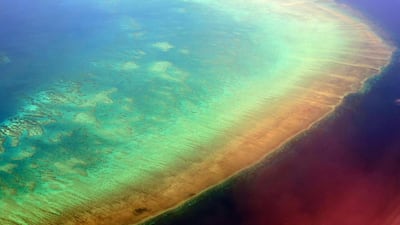
An aerial shot of the Great Barrier Reef in Australia, showing parts of the reef that has been subjected to coral bleaching. -

A house located on land that has been deformed by permafrost thaw at a former airfield in Churapcha, Russia. Reuters -

Native vegetation has been cut down to give space for eucalyptus plantations in the Setubinha region in Brazil. AFP -
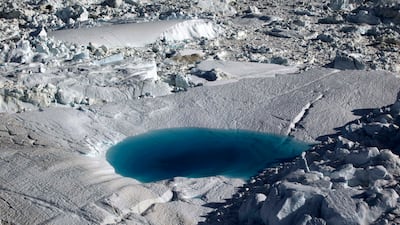
A large melt pool forms in the Ilulissat ice fjord below the Jakobshavn Glacier at the fringe of the Greenland ice sheet. AP -
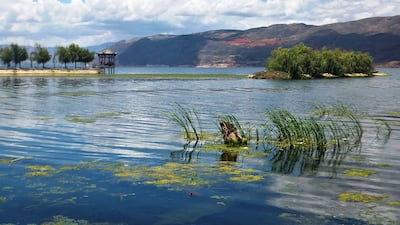
Lake Erhai in China has become eutrophic (where an entire body of water becomes enriched with nutrients and minerals) which caused algal growth that destroyed other life. Photo: Ronan O'Connell -
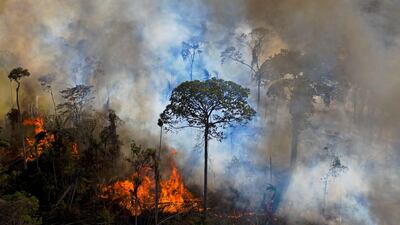
Deforestation in Para state, Brazil. AFP -
Moai statues in Easter Island, Chile, were damaged after a wildfire. Reuters


The IMF on Monday said that while China and other larger emerging economies had the necessary domestic financial resources, many other developing and emerging nations were “missing sufficiently developed financial markets that can deliver large amounts of private finance”.
Attracting international investors is also difficult, as most major emerging market economies and almost all developing countries lack the investment-grade credit ratings that institutional investors often require.
“And few investors have experience in these countries and are able to take the higher risk,” IMF economists said.
Phasing out coal power plants, the single largest source of global greenhouse gases, accounting for about 20 per cent of emissions, is another major challenge.
“Retiring or repurposing them requires large amounts of private investment and public support,” according to the IMF report.
“Some countries are highly dependent on coal and would need to develop alternative sources of energy relatively quickly.”
The climate policies of government and commitments by major banks for climate finance are still not fully aligned with net-zero targets, which is another major challenge that could hinder the climate agenda in developing and emerging markets.
Although a growing number of investment funds are now prioritising sustainability, they have minimal impact on how much money is being provided for large climate needs, the IMF said.
Currently only a “small portion of such funds explicitly aim to create a positive climate impact”. The much larger number of funds that make investment decisions based on environmental, social, and corporate governance factors don’t necessarily focus on climate issues, the fund said.
The IMF called for structural policy reforms aimed at strengthening macroeconomic fundamentals, deepening capital markets, and improving governance in developing and emerging market economies.
Such a policy mix can help improve credit ratings, lower the cost capital and can expand domestic financial resources, as well as pave way for foreign investment.
While many of the policies recommend will take time to put in place, developing and emerging nations should engage in extensive public-private risk sharing to foster climate private investments, the IMF said.
“Multilateral development banks and donors can play an important role in supporting blended finance – including through a more extensive use of guarantees,” it said.

