Opec Fund director general Abdulhamid Alkhalifa and Jordan’s Minister of Planning and International Co-operation Nasser Shraideh during the signing ceremony in Amman. Photo: Opec Fund

Jordan receives $100m from Opec Fund to boost food security and agricultural development


Alvin R Cabral
  • English
  • Arabic

The Opec Fund for International Development has provided a $100 million loan to Jordan to help the kingdom enhance its food security and boost its agricultural development.

The financing is part of an emergency food security project, which aims to address the effects of a recent food supply crisis and stem the rise of commodity prices, the development finance institution of the world's largest oil group said in a statement on Tuesday.

The agreement is part of the fund's wider $1 billion Food Security Action Plan, which was announced in June, and is meant to boost food security in developing countries severely impacted by the conflict in Ukraine.

It was signed in Amman by Abdulhamid Alkhalifa, director-general of the Opec Fund, and Nasser Shraideh, Jordan’s Minister of Planning and International Co-operation.

“Ensuring food security is one of the most pressing global challenges at the moment and the Opec Fund is committed to supporting affected countries," Mr Alkhalifa said.

"We are pleased to extend our support to Jordan, where our financing will help vulnerable households and refugees as well as strengthen the resilience of the food sector.”

Jordan, with a population of almost 11 million, is an upper middle-income country. Still, it is resource-poor, with limited agricultural land, and is classified as a food-deficit nation, according to the World Food Programme.

It is, however, still considered a food secure country, but its food security is challenged by a number of factors, including slow economic growth and increased cost of living, the WFP added.

Jordan is a net importer of food, and its population, among them close to 1.3 million refugees from Syria, have been severely affected by a recent supply crisis, the Opec Fund said.

This week, the US Agency for International Development said it was providing $22 million to help the UN give cash handouts to Syrian refugees to buy food. The WFP last month slashed food stipends for 353,000 primarily Syrian refugees in Jordan by a third.

Global food prices, meanwhile, started to rise in the middle of 2020, when businesses shut down because of the coronavirus pandemic, straining supply chains, Deep Knowledge Analytics said in a recent report.

High food prices have increased world hunger and affected individuals, families and communities, the UN's Food and Agricultural Organisation said. The UN on Tuesday said that around 141 million people in the Middle East face food insecurity.

The loan will allow Jordan to import an additional grain supply totalling 390,000 metric tonnes, the Opec Fund said. New bunkers for the grains will be located in the Al Qatrana, Al Mowakkar and Al Ghabawi areas, with storage capacities that will last for up to four years to be built.

Jordan relies heavily on imports from the Black Sea region to cover its grain consumption, accounting for 98 per cent of wheat imports and 78 per cent of barley imports, the fund added.

  • A Syrian child passes a mural at Al Zaatari refugee camp, which is near the Jordanian city of Mafraq, close to the border with Syria. Reuters
    A Syrian child passes a mural at Al Zaatari refugee camp, which is near the Jordanian city of Mafraq, close to the border with Syria. Reuters
  • Syrian children at Al Zaatari refugee camp, Jordan. EPA
    Syrian children at Al Zaatari refugee camp, Jordan. EPA
  • A Syrian refugee at Al Zaatari refugee camp. EPA
    A Syrian refugee at Al Zaatari refugee camp. EPA
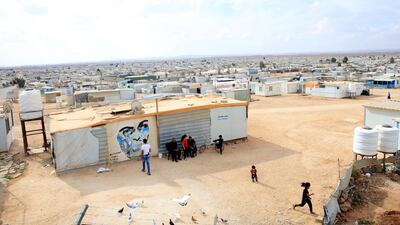
  • Al Zaatari refugee camp. EPA
    Al Zaatari refugee camp. EPA
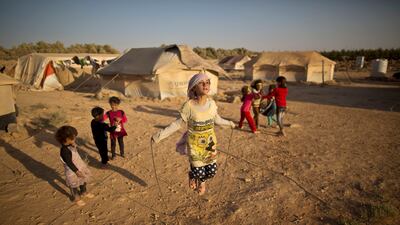
  • Syrian refugee Zubaida Faisal, 10, skipping rope at an informal tented settlement near the Syrian border on the outskirts of Mafraq, Jordan. AP Photo
    Syrian refugee Zubaida Faisal, 10, skipping rope at an informal tented settlement near the Syrian border on the outskirts of Mafraq, Jordan. AP Photo
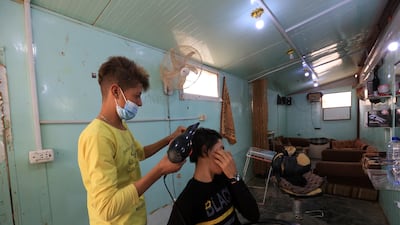
  • A barber shop at the refugee camp. EPA
    A barber shop at the refugee camp. EPA

The country has adopted a food security strategy, which includes short-term emergency response measures and medium-term investment plans and policy reforms as a response to the effects of Russia's military offensive in Ukraine.

The Opec Fund and Jordan have co-operated since 1977 in sectors including agriculture, energy generation, health, industry, education and small and medium enterprises, with more than $500m in loans and grants already provided to Amman.

The Opec Fund's assistance to the kingdom is the latest in a string of financing it has provided to a number of countries in recent months to help them address food security issues.

Last month, the fund provided a $60m loan to the Ivory Coast's Northern Agro-Industrial Pole Project to help finance the development of high-potential geographical areas for agriculture.

In August, the Opec Fund released a $15m loan to Zimbabwe to support an agricultural project aimed at transforming the small-scale farming sector and increasing farmers’ participation in market-oriented value chains.


About Housecall

Date started: July 2020

Founders: Omar and Humaid Alzaabi

Based: Abu Dhabi

Sector: HealthTech

# of staff: 10

Funding to date: Self-funded

Ten tax points to be aware of in 2026

1. Domestic VAT refund amendments: request your refund within five years

If a business does not apply for the refund on time, they lose their credit.

2. E-invoicing in the UAE

Businesses should continue preparing for the implementation of e-invoicing in the UAE, with 2026 a preparation and transition period ahead of phased mandatory adoption. 

3. More tax audits

Tax authorities are increasingly using data already available across multiple filings to identify audit risks. 

4. More beneficial VAT and excise tax penalty regime

Tax disputes are expected to become more frequent and more structured, with clearer administrative objection and appeal processes. The UAE has adopted a new penalty regime for VAT and excise disputes, which now mirrors the penalty regime for corporate tax.

5. Greater emphasis on statutory audit

There is a greater need for the accuracy of financial statements. The International Financial Reporting Standards standards need to be strictly adhered to and, as a result, the quality of the audits will need to increase.

6. Further transfer pricing enforcement

Transfer pricing enforcement, which refers to the practice of establishing prices for internal transactions between related entities, is expected to broaden in scope. The UAE will shortly open the possibility to negotiate advance pricing agreements, or essentially rulings for transfer pricing purposes. 

7. Limited time periods for audits

Recent amendments also introduce a default five-year limitation period for tax audits and assessments, subject to specific statutory exceptions. While the standard audit and assessment period is five years, this may be extended to up to 15 years in cases involving fraud or tax evasion. 

8. Pillar 2 implementation 

Many multinational groups will begin to feel the practical effect of the Domestic Minimum Top-Up Tax (DMTT), the UAE's implementation of the OECD’s global minimum tax under Pillar 2. While the rules apply for financial years starting on or after January 1, 2025, it is 2026 that marks the transition to an operational phase.

9. Reduced compliance obligations for imported goods and services

Businesses that apply the reverse-charge mechanism for VAT purposes in the UAE may benefit from reduced compliance obligations. 

10. Substance and CbC reporting focus

Tax authorities are expected to continue strengthening the enforcement of economic substance and Country-by-Country (CbC) reporting frameworks. In the UAE, these regimes are increasingly being used as risk-assessment tools, providing tax authorities with a comprehensive view of multinational groups’ global footprints and enabling them to assess whether profits are aligned with real economic activity. 

Contributed by Thomas Vanhee and Hend Rashwan, Aurifer

COMPANY%20PROFILE
%3Cp%3E%3Cstrong%3EName%3A%20%3C%2Fstrong%3EKinetic%207%3Cbr%3E%3Cstrong%3EStarted%3A%3C%2Fstrong%3E%202018%3Cbr%3E%3Cstrong%3EFounder%3A%3C%2Fstrong%3E%20Rick%20Parish%3Cbr%3E%3Cstrong%3EBased%3A%3C%2Fstrong%3E%20Abu%20Dhabi%2C%20UAE%3Cbr%3E%3Cstrong%3EIndustry%3A%3C%2Fstrong%3E%20Clean%20cooking%3Cbr%3E%3Cstrong%3EFunding%3A%3C%2Fstrong%3E%20%2410%20million%3Cbr%3E%3Cstrong%3EInvestors%3A%3C%2Fstrong%3E%20Self-funded%3C%2Fp%3E%0A
Citadel: Honey Bunny first episode

Directors: Raj & DK

Stars: Varun Dhawan, Samantha Ruth Prabhu, Kashvi Majmundar, Kay Kay Menon

Rating: 4/5

Key figures in the life of the fort

Sheikh Dhiyab bin Isa (ruled 1761-1793) Built Qasr Al Hosn as a watchtower to guard over the only freshwater well on Abu Dhabi island.

Sheikh Shakhbut bin Dhiyab (ruled 1793-1816) Expanded the tower into a small fort and transferred his ruling place of residence from Liwa Oasis to the fort on the island.

Sheikh Tahnoon bin Shakhbut (ruled 1818-1833) Expanded Qasr Al Hosn further as Abu Dhabi grew from a small village of palm huts to a town of more than 5,000 inhabitants.

Sheikh Khalifa bin Shakhbut (ruled 1833-1845) Repaired and fortified the fort.

Sheikh Saeed bin Tahnoon (ruled 1845-1855) Turned Qasr Al Hosn into a strong two-storied structure.

Sheikh Zayed bin Khalifa (ruled 1855-1909) Expanded Qasr Al Hosn further to reflect the emirate's increasing prominence.

Sheikh Shakhbut bin Sultan (ruled 1928-1966) Renovated and enlarged Qasr Al Hosn, adding a decorative arch and two new villas.

Sheikh Zayed bin Sultan (ruled 1966-2004) Moved the royal residence to Al Manhal palace and kept his diwan at Qasr Al Hosn.

Sources: Jayanti Maitra, www.adach.ae

Our legal consultant

Name: Dr Hassan Mohsen Elhais

Position: legal consultant with Al Rowaad Advocates and Legal Consultants.

Tori Amos
Native Invader
Decca

COMPANY%20PROFILE
%3Cp%3E%3Cstrong%3EName%3A%3C%2Fstrong%3E%20Floward%0D%3Cbr%3E%3Cstrong%3EBased%3A%20%3C%2Fstrong%3ERiyadh%2C%20Saudi%20Arabia%0D%3Cbr%3E%3Cstrong%3EFounders%3A%20%3C%2Fstrong%3EAbdulaziz%20Al%20Loughani%20and%20Mohamed%20Al%20Arifi%0D%3Cbr%3E%3Cstrong%3ESector%3A%20%3C%2Fstrong%3EE-commerce%0D%3Cbr%3E%3Cstrong%3ETotal%20funding%3A%20%3C%2Fstrong%3EAbout%20%24200%20million%0D%3Cbr%3E%3Cstrong%3EInvestors%3A%20%3C%2Fstrong%3EAljazira%20Capital%2C%20Rainwater%20Partners%2C%20STV%20and%20Impact46%0D%3Cbr%3E%3Cstrong%3ENumber%20of%20employees%3A%20%3C%2Fstrong%3E1%2C200%3C%2Fp%3E%0A
Updated: October 04, 2022, 2:54 PM