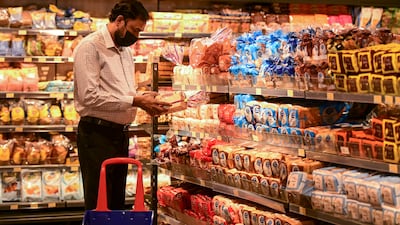
A shopper in a grocery store in Oakland, California. US Labour Department data showed sharply higher food and record gas prices pushed inflation up 8.6 per cent last month from a year earlier. EPA
Stubbornly hot US inflation is fuelling bets that the Federal Reserve will become more aggressive about trying to cool price pressures and perhaps ditch its forward guidance by delivering a jumbo-sized interest rate rise in the coming months.
Fed policymakers had already all but promised half-point interest rate rises at their meeting next week and again in late July, following May's half-point increase and the start of balance sheet reductions this month.
That would be more policy tightening in the space of three months than the Fed did in all of 2018.
On Friday, traders of futures tied to the Fed policy rate began pricing in an even bolder path after US Labour Department data showed sharply higher food and record petrol prices pushed the consumer price index (CPI) up 8.6 per cent last month from a year earlier.
A separate University of Michigan survey showed longer-term inflation expectations rising to their highest since 2008.
Prices of Fed funds futures contracts now reflect better-than-even odds of a 75-basis point rate rise by July, with a one-in-four chance of that occurring next week — up from one-in-20 before the inflation report — and a policy rate in at least the 3.25 per cent to 3.5 per cent range at year end.
Yields on the two-year Treasury note, seen as a proxy for the Fed's policy rate, topped 3 per cent for the first time since 2008.
“We believe that today's inflation data — both the CPI and UMich inflation expectations — are game changers that will force the Fed to switch to a higher gear and front-load policy tightening,” wrote Jefferies' Aneta Markowska, who joined economists at Barclays on Friday in forecasting a 75 basis points rate increase at the Fed's June 14 to 15 meeting.
Most economists still expect a half-point rise next week, and more of the same at subsequent meetings through at least September if not further.
Core CPI, which strips out volatile energy and food prices, rose 6 per cent in May, down slightly from April's 6.2 per cent pace but far from the “clear and convincing” sign of cooling price pressures that Fed chairman Jerome Powell has said he needs to see before slowing rate increases.
“Any hopes that the Fed can ease up on the pace of rate hikes after the June and July meetings now seems to be a long shot,” wrote Bankrate chief financial analyst Greg McBride.
Economists at Deutsche Bank concurred, and said they now forecast rates to rise to 4.125 per cent by mid-2023.
Families hunt for bargains amid rising prices globally — in pictures
Consumers look for budget buys as retailers advertise value offers. All photos: Khushnum Bhandari / The National
A shopper buys vegetables at Lulu Hypermarket in Abu Dhabi. Khushnum Bhandari / The National
Shoppers share information about deals that will help families stay within their weekly shopping budget. Khushnum Bhandari / The National
Families are tightening their belts as they shop for weekly groceries. Khushnum Bhandari / The National
The Lulu Group says it has set up its own sourcing to ensure uninterrupted supplies and keep the prices stable. Khushnum Bhandari / The National
Shoppers look for the best value in cooking oil as prices for edible oil, flour and wheat rise globally. Khushnum Bhandari / The National
The UAE Ministry of Economy has approved a policy to check the prices of basic food such as bread, flour and eggs. Khushnum Bhandari / The National
The UAE will monitor the price of milk among a list of 300 frequently bought essential food supplies. Khushnum Bhandari / The National
Shoppers look for discount buys at Lulu Hypermarket in Abu Dhabi. Khushnum Bhandari / The National
Shoppers look for savings in weekly grocery shopping. Khushnum Bhandari / The National
Fed policymakers at the close of next week's meeting will release their own best guesses of how high they will need to lift short-term rates.
They will also provide forecasts of how much unemployment — now at 3.6 per cent — may need to rise before the economy slows enough to reduce inflation.
In recent weeks, some had expressed the hope that by September their own rate rises, along with easing supply chain pressures and an expected shift in household spending away from scarce goods and towards services, would have started to ease price pressures and allowed them to downshift to smaller rate increases.
Friday's inflation report suggested the opposite.
Used car prices, which had been sinking, reversed course and rose 1.8 per cent from the prior month; airline fares rose by 12.6 per cent from the prior month and 37.8 per cent from a year earlier. Prices for shelter rose 5.5 per cent, the biggest jump in more than 30 years.
The Fed's current policy rate target is now 0.75 per cent to 1 per cent. Fed officials want to get it higher without undermining a historically tight labour market and sending the economy into recession, but accelerating inflation will make that a hard task.
“These are ugly numbers … I’d say we’ll probably be in a recession in the fourth quarter of this year with confirmation in the second quarter of 2023,” said Peter Cardillo, chief market economist at Spartan Capital Securities.

hall of shame
SUNDERLAND 2002-03
No one has ended a Premier League season quite like Sunderland. They lost each of their final 15 games, taking no points after January. They ended up with 19 in total, sacking managers Peter Reid and Howard Wilkinson and losing 3-1 to Charlton when they scored three own goals in eight minutes.
SUNDERLAND 2005-06
Until Derby came along, Sunderland’s total of 15 points was the Premier League’s record low. They made it until May and their final home game before winning at the Stadium of Light while they lost a joint record 29 of their 38 league games.
HUDDERSFIELD 2018-19
Joined Derby as the only team to be relegated in March. No striker scored until January, while only two players got more assists than goalkeeper Jonas Lossl. The mid-season appointment Jan Siewert was to end his time as Huddersfield manager with a 5.3 per cent win rate.
ASTON VILLA 2015-16
Perhaps the most inexplicably bad season, considering they signed Idrissa Gueye and Adama Traore and still only got 17 points. Villa won their first league game, but none of the next 19. They ended an abominable campaign by taking one point from the last 39 available.
FULHAM 2018-19
Terrible in different ways. Fulham’s total of 26 points is not among the lowest ever but they contrived to get relegated after spending over £100 million (Dh457m) in the transfer market. Much of it went on defenders but they only kept two clean sheets in their first 33 games.
LA LIGA: Sporting Gijon, 13 points in 1997-98.
BUNDESLIGA: Tasmania Berlin, 10 points in 1965-66
Porsche Taycan Turbo specs
Engine: Two permanent-magnet synchronous AC motors
T20s 52; Runs 1,456; 100s 1; 50s 7; Avg 31.65; Best 116 not out
The studios taking part (so far)
Punch
Vogue Fitness
Sweat
Bodytree Studio
The Hot House
The Room
Inspire Sports (Ladies Only)
Cryo
Mercer, the investment consulting arm of US services company Marsh & McLennan, expects its wealth division to at least double its assets under management (AUM) in the Middle East as wealth in the region continues to grow despite economic headwinds, a company official said.
Mercer Wealth, which globally has $160 billion in AUM, plans to boost its AUM in the region to $2-$3bn in the next 2-3 years from the present $1bn, said Yasir AbuShaban, a Dubai-based principal with Mercer Wealth.
“Within the next two to three years, we are looking at reaching $2 to $3 billion as a conservative estimate and we do see an opportunity to do so,” said Mr AbuShaban.
Mercer does not directly make investments, but allocates clients’ money they have discretion to, to professional asset managers. They also provide advice to clients.
“We have buying power. We can negotiate on their (client’s) behalf with asset managers to provide them lower fees than they otherwise would have to get on their own,” he added.
Mercer Wealth’s clients include sovereign wealth funds, family offices, and insurance companies among others.
From its office in Dubai, Mercer also looks after Africa, India and Turkey, where they also see opportunity for growth.
Wealth creation in Middle East and Africa (MEA) grew 8.5 per cent to $8.1 trillion last year from $7.5tn in 2015, higher than last year’s global average of 6 per cent and the second-highest growth in a region after Asia-Pacific which grew 9.9 per cent, according to consultancy Boston Consulting Group (BCG). In the region, where wealth grew just 1.9 per cent in 2015 compared with 2014, a pickup in oil prices has helped in wealth generation.
BCG is forecasting MEA wealth will rise to $12tn by 2021, growing at an annual average of 8 per cent.
Drivers of wealth generation in the region will be split evenly between new wealth creation and growth of performance of existing assets, according to BCG.
Another general trend in the region is clients’ looking for a comprehensive approach to investing, according to Mr AbuShaban.
“Institutional investors or some of the families are seeing a slowdown in the available capital they have to invest and in that sense they are looking at optimizing the way they manage their portfolios and making sure they are not investing haphazardly and different parts of their investment are working together,” said Mr AbuShaban.
Some clients also have a higher appetite for risk, given the low interest-rate environment that does not provide enough yield for some institutional investors. These clients are keen to invest in illiquid assets, such as private equity and infrastructure.
“What we have seen is a desire for higher returns in what has been a low-return environment specifically in various fixed income or bonds,” he said.
“In this environment, we have seen a de facto increase in the risk that clients are taking in things like illiquid investments, private equity investments, infrastructure and private debt, those kind of investments were higher illiquidity results in incrementally higher returns.”
The Abu Dhabi Investment Authority, one of the largest sovereign wealth funds, said in its 2016 report that has gradually increased its exposure in direct private equity and private credit transactions, mainly in Asian markets and especially in China and India. The authority’s private equity department focused on structured equities owing to “their defensive characteristics.”
THE BIO
Bio Box
Role Model: Sheikh Zayed, God bless his soul
Favorite book: Zayed Biography of the leader
Favorite quote: To be or not to be, that is the question, from William Shakespeare's Hamlet
Warner 151 not out, Burns 97, Labuschagne 55 not out
Pakistan 240
Shafiq 76, Starc 4-52
Men’s singles
Group A: Son Wan-ho (Kor), Lee Chong Wei (Mas), Ng Long Angus (HK), Chen Long (Chn) Group B: Kidambi Srikanth (Ind), Shi Yugi (Chn), Chou Tien Chen (Tpe), Viktor Axelsen (Den)
Women’s Singles
Group A: Akane Yamaguchi (Jpn), Pusarla Sindhu (Ind), Sayaka Sato (Jpn), He Bingjiao (Chn) Group B: Tai Tzu Ying (Tpe), Sung Hi-hyun (Kor), Ratchanok Intanon (Tha), Chen Yufei (Chn)
Heavily-sugared soft drinks slip through the tax net
Some popular drinks with high levels of sugar and caffeine have slipped through the fizz drink tax loophole, as they are not carbonated or classed as an energy drink.
Arizona Iced Tea with lemon is one of those beverages, with one 240 millilitre serving offering up 23 grams of sugar - about six teaspoons.
A 680ml can of Arizona Iced Tea costs just Dh6.
Most sports drinks sold in supermarkets were found to contain, on average, five teaspoons of sugar in a 500ml bottle.
Engine: 4.0-litre V8 twin-turbocharged and three electric motors
Power: Combined output 920hp
Torque: 730Nm at 4,000-7,000rpm
Transmission: 8-speed dual-clutch automatic
Fuel consumption: 11.2L/100km
On sale: Now, deliveries expected later in 2025
Price: expected to start at Dh1,432,000
Scoreline
Switzerland 5
Motori Profile
Date started: March 2020
Co-founder/CEO: Ahmed Eissa
Based: UAE, Abu Dhabi
Sector: Insurance Sector
Size: 50 full-time employees (Inside and Outside UAE)
Stage: Seed stage and seeking Series A round of financing
Investors: Safe City Group
Dubai Rugby Sevens
November 30, December 1-2
International Vets
Christina Noble Children’s Foundation fixtures
Thursday, November 30:
10.20am, Pitch 3, v 100 World Legends Project
1.20pm, Pitch 4, v Malta Marauders
Friday, December 1:
9am, Pitch 4, v SBA Pirates
AUSTRALIA SQUAD
Aaron Finch (captain), Ashton Agar, Alex Carey, Pat Cummins, Glenn Maxwell, Ben McDermott, Kane Richardson, Steve Smith, Billy Stanlake, Mitchell Starc, Ashton Turner, Andrew Tye, David Warner, Adam Zampa
Ziina users can donate to relief efforts in Beirut
Ziina users will be able to use the app to help relief efforts in Beirut, which has been left reeling after an August blast caused an estimated $15 billion in damage and left thousands homeless. Ziina has partnered with the United Nations High Commissioner for Refugees to raise money for the Lebanese capital, co-founder Faisal Toukan says. “As of October 1, the UNHCR has the first certified badge on Ziina and is automatically part of user's top friends' list during this campaign. Users can now donate any amount to the Beirut relief with two clicks. The money raised will go towards rebuilding houses for the families that were impacted by the explosion.”
Common OCD symptoms and how they manifest
Checking: the obsession or thoughts focus on some harm coming from things not being as they should, which usually centre around the theme of safety. For example, the obsession is “the building will burn down”, therefore the compulsion is checking that the oven is switched off.
Contamination: the obsession is focused on the presence of germs, dirt or harmful bacteria and how this will impact the person and/or their loved ones. For example, the obsession is “the floor is dirty; me and my family will get sick and die”, the compulsion is repetitive cleaning.
Orderliness: the obsession is a fear of sitting with uncomfortable feelings, or to prevent harm coming to oneself or others. Objectively there appears to be no logical link between the obsession and compulsion. For example,” I won’t feel right if the jars aren’t lined up” or “harm will come to my family if I don’t line up all the jars”, so the compulsion is therefore lining up the jars.
Intrusive thoughts: the intrusive thought is usually highly distressing and repetitive. Common examples may include thoughts of perpetrating violence towards others, harming others, or questions over one’s character or deeds, usually in conflict with the person’s true values. An example would be: “I think I might hurt my family”, which in turn leads to the compulsion of avoiding social gatherings.
Hoarding: the intrusive thought is the overvaluing of objects or possessions, while the compulsion is stashing or hoarding these items and refusing to let them go. For example, “this newspaper may come in useful one day”, therefore, the compulsion is hoarding newspapers instead of discarding them the next day.
Source: Dr Robert Chandler, clinical psychologist at Lighthouse Arabia
Our family matters legal consultant
Name: Hassan Mohsen Elhais
Position: legal consultant with Al Rowaad Advocates and Legal Consultants.
Sole survivors
Cecelia Crocker was on board Northwest Airlines Flight 255 in 1987 when it crashed in Detroit, killing 154 people, including her parents and brother. The plane had hit a light pole on take off
George Lamson Jr, from Minnesota, was on a Galaxy Airlines flight that crashed in Reno in 1985, killing 68 people. His entire seat was launched out of the plane
Bahia Bakari, then 12, survived when a Yemenia Airways flight crashed near the Comoros in 2009, killing 152. She was found clinging to wreckage after floating in the ocean for 13 hours.
Jim Polehinke was the co-pilot and sole survivor of a 2006 Comair flight that crashed in Lexington, Kentucky, killing 49.