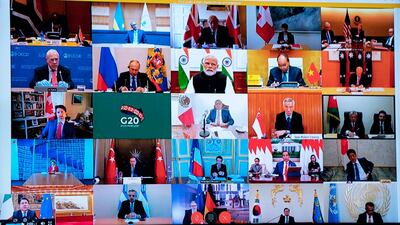
The world appears to have reached the limit of its tolerance for economic disruption. Even as the novel virus continues to put lives at risk, governments around the world are beginning the process of reopening. More than $7 trillion (Dh25.7tn) has been committed to relief efforts just in the past three months, and many more trillions will need to be injected into the global economy in the coming months to help it recover.
With so much at stake, it matters whether governments are getting the most out of their money. The world’s top financial thinkers agree: many of the most effective solutions are also those that reduce carbon emissions.
That conclusion comes from a survey of more than 200 central bankers, G-20 finance minsters, and top academics from across 53 countries, conducted by a group of star economists that includes Nobel Laureate Joseph Stiglitz, among others. The results were released today in the Oxford Review of Economic Policy.
The authors fear that unless policymakers keep carbon emissions in mind, the world risks leaping “from the Covid frying pan into the climate fire".
It's interesting to see that financial minds are turned toward green policies for economic recovery
“We’ve already got enough capital stock to take us to 2° [Celsius of warming],” says Cameron Hepburn, professor of environmental economics at the University of Oxford, referring to the target set under the Paris climate agreement. There’s broad agreement in the scientific community that crossing that temperature threshold would unleash irreversible environmental changes that could lead to massive disasters, millions of deaths, and a poorer world for everyone. “If we load up another $10tn on fossil fuels, we can pretty much kiss Paris goodbye,” Mr Hepburn says.
Most of the money spent so far has gone toward increasing liquidity in global markets, such as direct payment to citizens and loans for businesses, mostly without green strings attached. As governments move beyond providing relief to an economy on pause and begin to set a course for recovery, however, climate objectives may come more into play.
Mr Stiglitz and Mr Hepburn, along with colleagues such as Grantham Research Institute Chairman Nicholas Stern, wanted to gauge the zeitgeist on stimulus among the world’s financial thinkers. Among the respondents to their survey were Laurence Boone, chief economist at the Organisation for Economic Co-operation and Development Sylvie Goulard, deputy governor of France’s central bank, Gus O’Donnell, president of the UK’s Institute for Fiscal Studies, and Sandra Eickmeier, senior economist at Germany’s central bank. Many are in a position to exert direct influence over where stimulus dollars wind up.
Their task was to rank 25 different economic policies—many of which were used to boost recovery after the financial crisis of 2008-09—on four characteristics: how quickly the policy could be deployed, what economic return would it bring for each $1 of public money spent, for how long would it provide returns and how much it would contribute to lowering emissions.
Beyond liquidity measures, the top preferences were for policies with major climate benefits such as clean energy research and infrastructure, disaster preparedness, and zero-carbon transportation. In practice, that might mean funding for things like electric vehicle charging stations and grid modernisation, coastal rehabilitation, and research grants in areas such as energy storage and carbon capture.
“Covid-19 recovery packages ought to take broader priorities in mind, making us more resilient in light of a number of other risks and uncertainty—climate change chief among them,” said Gernot Wagner, associate professor at New York University.
Few governments are considering austerity measures this time around—likely because countries like the UK that followed the deficit-reduction track the last time around have been hit hard during the pandemic as poorly funded healthcare systems have come under pressure.
“It’s interesting to see that financial minds are turned toward green policies for economic recovery,” says Maeva Cousin of Bloomberg Economics. “Much more so than in 2009.” The results of the survey bode well as a prediction for the kinds of economic recovery the world is likely to see. But Ms Cousin also warns that politics could come in the way of green recovery in certain sectors of the economy.
Tourism and aviation, for instance, are likely to get bailed out even without green conditions because of the sheer number of people they employ—even though airline bailouts were ranked lowest by survey respondents from both economic and environmental perspectives. Other policies that received little enthusiasm included income tax cuts, liquidity for large corporations, and non-green infrastructure spending.
Overall, however, Mr Hepburn is pleased that the wisdom of the crowd largely tilted toward economics policies that are inherently green. “If policymakers can be conscious of the potential to solve two problems with one set of actions,” he says, “then there's a reasonable chance that they will.”

The specs: 2018 Nissan 370Z Nismo
Price, base / as tested: Dh182,178
Engine: 3.7-litre V6
Power: 350hp @ 7,400rpm
Torque: 374Nm @ 5,200rpm
Transmission: Seven-speed automatic
Fuel consumption, combined: 10.5L / 100km
The specs
Engine: 4-litre twin-turbo V8
Transmission: eight-speed PDK
Power: 630bhp
Torque: 820Nm
Price: Dh683,200
On sale: now
What%20is%20cystic%20fibrosis%3F
%3Cul%3E%0A%3Cli%3ECystic%20fibrosis%20is%20a%20genetic%20disorder%20that%20affects%20the%20lungs%2C%20pancreas%20and%20other%20organs.%3C%2Fli%3E%0A%3Cli%3EIt%20causes%20the%20production%20of%20thick%2C%20sticky%20mucus%20that%20can%20clog%20the%20airways%20and%20lead%20to%20severe%20respiratory%20and%20digestive%20problems.%3C%2Fli%3E%0A%3Cli%3EPatients%20with%20the%20condition%20are%20prone%20to%20lung%20infections%20and%20often%20suffer%20from%20chronic%20coughing%2C%20wheezing%20and%20shortness%20of%20breath.%3C%2Fli%3E%0A%3Cli%3ELife%20expectancy%20for%20sufferers%20of%20cystic%20fibrosis%20is%20now%20around%2050%20years.%3C%2Fli%3E%0A%3C%2Ful%3E%0A
Mercer, the investment consulting arm of US services company Marsh & McLennan, expects its wealth division to at least double its assets under management (AUM) in the Middle East as wealth in the region continues to grow despite economic headwinds, a company official said.
Mercer Wealth, which globally has $160 billion in AUM, plans to boost its AUM in the region to $2-$3bn in the next 2-3 years from the present $1bn, said Yasir AbuShaban, a Dubai-based principal with Mercer Wealth.
“Within the next two to three years, we are looking at reaching $2 to $3 billion as a conservative estimate and we do see an opportunity to do so,” said Mr AbuShaban.
Mercer does not directly make investments, but allocates clients’ money they have discretion to, to professional asset managers. They also provide advice to clients.
“We have buying power. We can negotiate on their (client’s) behalf with asset managers to provide them lower fees than they otherwise would have to get on their own,” he added.
Mercer Wealth’s clients include sovereign wealth funds, family offices, and insurance companies among others.
From its office in Dubai, Mercer also looks after Africa, India and Turkey, where they also see opportunity for growth.
Wealth creation in Middle East and Africa (MEA) grew 8.5 per cent to $8.1 trillion last year from $7.5tn in 2015, higher than last year’s global average of 6 per cent and the second-highest growth in a region after Asia-Pacific which grew 9.9 per cent, according to consultancy Boston Consulting Group (BCG). In the region, where wealth grew just 1.9 per cent in 2015 compared with 2014, a pickup in oil prices has helped in wealth generation.
BCG is forecasting MEA wealth will rise to $12tn by 2021, growing at an annual average of 8 per cent.
Drivers of wealth generation in the region will be split evenly between new wealth creation and growth of performance of existing assets, according to BCG.
Another general trend in the region is clients’ looking for a comprehensive approach to investing, according to Mr AbuShaban.
“Institutional investors or some of the families are seeing a slowdown in the available capital they have to invest and in that sense they are looking at optimizing the way they manage their portfolios and making sure they are not investing haphazardly and different parts of their investment are working together,” said Mr AbuShaban.
Some clients also have a higher appetite for risk, given the low interest-rate environment that does not provide enough yield for some institutional investors. These clients are keen to invest in illiquid assets, such as private equity and infrastructure.
“What we have seen is a desire for higher returns in what has been a low-return environment specifically in various fixed income or bonds,” he said.
“In this environment, we have seen a de facto increase in the risk that clients are taking in things like illiquid investments, private equity investments, infrastructure and private debt, those kind of investments were higher illiquidity results in incrementally higher returns.”
The Abu Dhabi Investment Authority, one of the largest sovereign wealth funds, said in its 2016 report that has gradually increased its exposure in direct private equity and private credit transactions, mainly in Asian markets and especially in China and India. The authority’s private equity department focused on structured equities owing to “their defensive characteristics.”
Who's who in Yemen conflict
Houthis: Iran-backed rebels who occupy Sanaa and run unrecognised government
Yemeni government: Exiled government in Aden led by eight-member Presidential Leadership Council
Southern Transitional Council: Faction in Yemeni government that seeks autonomy for the south
Habrish 'rebels': Tribal-backed forces feuding with STC over control of oil in government territory
COMPANY%20PROFILE
%3Cp%3E%3Cstrong%3ECompany%20name%3A%3C%2Fstrong%3E%20Alaan%3Cbr%3E%3Cstrong%3EStarted%3A%3C%2Fstrong%3E%202021%3Cbr%3E%3Cstrong%3EBased%3A%3C%2Fstrong%3E%20Dubai%3Cbr%3E%3Cstrong%3EFounders%3A%3C%2Fstrong%3E%20Parthi%20Duraisamy%20and%20Karun%20Kurien%3Cbr%3E%3Cstrong%3ESector%3A%3C%2Fstrong%3E%20FinTech%3Cbr%3E%3Cstrong%3EInvestment%20stage%3A%3C%2Fstrong%3E%20%247%20million%20raised%20in%20total%20%E2%80%94%20%242.5%20million%20in%20a%20seed%20round%20and%20%244.5%20million%20in%20a%20pre-series%20A%20round%3Cbr%3E%3Cbr%3E%3C%2Fp%3E%0A
A list of the animal rescue organisations in the UAE
KILLING OF QASSEM SULEIMANI
Nayanthara: Beyond The Fairy Tale
Starring: Nayanthara, Vignesh Shivan, Radhika Sarathkumar, Nagarjuna Akkineni
Director: Amith Krishnan
Rating: 3.5/5
Ten tax points to be aware of in 2026
1. Domestic VAT refund amendments: request your refund within five years
If a business does not apply for the refund on time, they lose their credit.
2. E-invoicing in the UAE
Businesses should continue preparing for the implementation of e-invoicing in the UAE, with 2026 a preparation and transition period ahead of phased mandatory adoption.
3. More tax audits
Tax authorities are increasingly using data already available across multiple filings to identify audit risks.
4. More beneficial VAT and excise tax penalty regime
Tax disputes are expected to become more frequent and more structured, with clearer administrative objection and appeal processes. The UAE has adopted a new penalty regime for VAT and excise disputes, which now mirrors the penalty regime for corporate tax.
5. Greater emphasis on statutory audit
There is a greater need for the accuracy of financial statements. The International Financial Reporting Standards standards need to be strictly adhered to and, as a result, the quality of the audits will need to increase.
6. Further transfer pricing enforcement
Transfer pricing enforcement, which refers to the practice of establishing prices for internal transactions between related entities, is expected to broaden in scope. The UAE will shortly open the possibility to negotiate advance pricing agreements, or essentially rulings for transfer pricing purposes.
7. Limited time periods for audits
Recent amendments also introduce a default five-year limitation period for tax audits and assessments, subject to specific statutory exceptions. While the standard audit and assessment period is five years, this may be extended to up to 15 years in cases involving fraud or tax evasion.
8. Pillar 2 implementation
Many multinational groups will begin to feel the practical effect of the Domestic Minimum Top-Up Tax (DMTT), the UAE's implementation of the OECD’s global minimum tax under Pillar 2. While the rules apply for financial years starting on or after January 1, 2025, it is 2026 that marks the transition to an operational phase.
9. Reduced compliance obligations for imported goods and services
Businesses that apply the reverse-charge mechanism for VAT purposes in the UAE may benefit from reduced compliance obligations.
10. Substance and CbC reporting focus
Tax authorities are expected to continue strengthening the enforcement of economic substance and Country-by-Country (CbC) reporting frameworks. In the UAE, these regimes are increasingly being used as risk-assessment tools, providing tax authorities with a comprehensive view of multinational groups’ global footprints and enabling them to assess whether profits are aligned with real economic activity.
Contributed by Thomas Vanhee and Hend Rashwan, Aurifer
