Emirates Development Bank, the state-owned lender which provides financing for the UAE's priority sectors, aims to offer at least Dh6 billion ($1.6 billion) in funding this year, its chief executive has said.
The bank, which provided Dh6.1 billion in financing in 2022, will not “do any less than last year” in 2023, Ahmed Al Naqbi told The National in an interview on Wednesday.
“I can definitely say that we will be able to do … no less than Dh6 billion of further support, but hopefully, it will be more than that. And also, the reality of the capacity of the market has to be taken into consideration,” Mr Al Naqbi said.
EDB currently provides direct and indirect financing to UAE-domiciled businesses or projects across its five priority sectors — manufacturing, infrastructure, advanced technology, food security and health care.
It has set aside Dh30 billion for direct and indirect lending to more than 13,500 companies in those sectors by 2025.
“EDB is definitely a leader in the five sectors … But there's a finite universe, a finite market. I wish we could put Dh100 billion out there, but there might not be that [many] number of projects out there. But we do believe that what we did last year is fair to replicate,” Mr Al Naqbi said.
The financing given last year marked an increase of nearly eight times on an annual basis, the bank said.
EDB provided loans to about 180 companies last year, Mr Al Naqbi added, with the bulk of them being small enterprises, including 50 to 70 under the “micro” businesses category.
While Dh1.8 billion in loans was approved for small and medium enterprises last year, the funding approved for large corporates surged to Dh4.3 billion as part of efforts to support the UAE’s “national priority sectors with large projects in key areas”, including data centres, desalination plants, transport, hospitals, manufacturers and specialised logistics, EDB said.
“So there's actually a very large number of small entities, start-ups, that are doing projects in the country, that we are giving loans to. And then above that, we have our mid-caps and large-caps, and they will typically do more large-scale economic projects to support the country. But it [the customer base] is very well diversified,” Mr Al Naqbi said.
“If there is a concentration, it's the concentration in manufacturing, so [we are] looking at as many projects as possible that are greenfield manufacturing projects here in the country.”
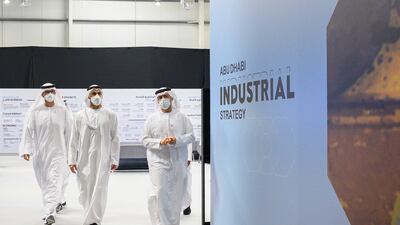
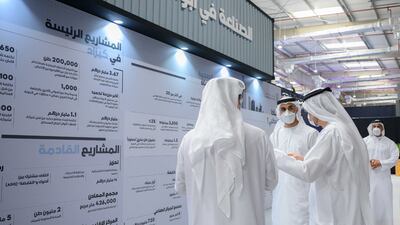
The UAE unveiled its industrial strategy, Operation 300bn, in 2021 to increase the industrial sector’s contribution to gross domestic product to Dh300 billion by 2031, from Dh133 billion in 2021.
It has also launched the Make It in the Emirates initiative, which encourages local and international investors to manufacture and export products from the UAE.
Within manufacturing, EDB is seeing a lot of traction in foodstuff, pharmaceuticals and petrochemical sub-sectors, Mr Al Naqbi said.
Meanwhile, loans disbursed through EDB's microlending platform, which is powered by Beehive, stood at more than Dh100 million last year.
The platform allows SMEs to apply for loans of up to Dh5 million — directly through its business banking app — and receive approval or feedback within five days.
The support provided by the platform will increase this year, Mr Al Naqbi said.
“We're only going to push that even further. Because from our mandate … we really have a focus on the smaller-size companies. And we want them to be the ones that are receiving the support from EDB in the ways that we can support them,” he said.
“They are obviously not necessarily always suitable for financing, because they might be too early stage start-up companies that don't have any income, and a loan might actually be a burden on them and a burden on their growth.
“But we can support them through transactional banking … And we're looking at adding things such as bill payments and wage-protection system to allow them to do the payroll. And all of this is basically free of charge on the application. So it's to support them — we're not looking to make money off of them.”
This year, EDB plans to finance a “much larger number” of renewables projects, in line with the UAE's Year of Sustainability.
“We are hosting Cop28 here in the UAE, our chairman Dr Sultan Al Jaber, is the president-designate of Cop28, so definitely, you will see EDB very much moving into that sector.”
The bank is allocating up to Dh1 billion to support renewable projects this year, Mr Al Naqbi said during a panel discussion at the investment conference Investopia in Abu Dhabi on Thursday.
“The UAE, I don’t see it as a hydrocarbon leader,” Mr Al Naqbi said.
“I see the UAE as a leader in energy space ... we are very much a leader in solar, we are very much a leader in hydrogen, we are very much a leader in many facets of the energy sector and we will continue to be so and continue to invest in that area.”
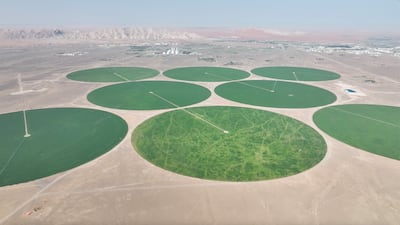
For this year, EDB will also focus on building more tailor-made financing solutions for AgriTech, Mr Al Naqbi said.
“AgriTech and farming require a very specialised kind of financing because of the longer breakeven points of those projects. So we are looking to launch this year a specialised product that is for that sector,” he said.
Wheat farm in Sharjah — in pictures
Your rights as an employee
The government has taken an increasingly tough line against companies that fail to pay employees on time. Three years ago, the Cabinet passed a decree allowing the government to halt the granting of work permits to companies with wage backlogs.
The new measures passed by the Cabinet in 2016 were an update to the Wage Protection System, which is in place to track whether a company pays its employees on time or not.
If wages are 10 days late, the new measures kick in and the company is alerted it is in breach of labour rules. If wages remain unpaid for a total of 16 days, the authorities can cancel work permits, effectively shutting off operations. Fines of up to Dh5,000 per unpaid employee follow after 60 days.
Despite those measures, late payments remain an issue, particularly in the construction sector. Smaller contractors, such as electrical, plumbing and fit-out businesses, often blame the bigger companies that hire them for wages being late.
The authorities have urged employees to report their companies at the labour ministry or Tawafuq service centres — there are 15 in Abu Dhabi.
Mercer, the investment consulting arm of US services company Marsh & McLennan, expects its wealth division to at least double its assets under management (AUM) in the Middle East as wealth in the region continues to grow despite economic headwinds, a company official said.
Mercer Wealth, which globally has $160 billion in AUM, plans to boost its AUM in the region to $2-$3bn in the next 2-3 years from the present $1bn, said Yasir AbuShaban, a Dubai-based principal with Mercer Wealth.
“Within the next two to three years, we are looking at reaching $2 to $3 billion as a conservative estimate and we do see an opportunity to do so,” said Mr AbuShaban.
Mercer does not directly make investments, but allocates clients’ money they have discretion to, to professional asset managers. They also provide advice to clients.
“We have buying power. We can negotiate on their (client’s) behalf with asset managers to provide them lower fees than they otherwise would have to get on their own,” he added.
Mercer Wealth’s clients include sovereign wealth funds, family offices, and insurance companies among others.
From its office in Dubai, Mercer also looks after Africa, India and Turkey, where they also see opportunity for growth.
Wealth creation in Middle East and Africa (MEA) grew 8.5 per cent to $8.1 trillion last year from $7.5tn in 2015, higher than last year’s global average of 6 per cent and the second-highest growth in a region after Asia-Pacific which grew 9.9 per cent, according to consultancy Boston Consulting Group (BCG). In the region, where wealth grew just 1.9 per cent in 2015 compared with 2014, a pickup in oil prices has helped in wealth generation.
BCG is forecasting MEA wealth will rise to $12tn by 2021, growing at an annual average of 8 per cent.
Drivers of wealth generation in the region will be split evenly between new wealth creation and growth of performance of existing assets, according to BCG.
Another general trend in the region is clients’ looking for a comprehensive approach to investing, according to Mr AbuShaban.
“Institutional investors or some of the families are seeing a slowdown in the available capital they have to invest and in that sense they are looking at optimizing the way they manage their portfolios and making sure they are not investing haphazardly and different parts of their investment are working together,” said Mr AbuShaban.
Some clients also have a higher appetite for risk, given the low interest-rate environment that does not provide enough yield for some institutional investors. These clients are keen to invest in illiquid assets, such as private equity and infrastructure.
“What we have seen is a desire for higher returns in what has been a low-return environment specifically in various fixed income or bonds,” he said.
“In this environment, we have seen a de facto increase in the risk that clients are taking in things like illiquid investments, private equity investments, infrastructure and private debt, those kind of investments were higher illiquidity results in incrementally higher returns.”
The Abu Dhabi Investment Authority, one of the largest sovereign wealth funds, said in its 2016 report that has gradually increased its exposure in direct private equity and private credit transactions, mainly in Asian markets and especially in China and India. The authority’s private equity department focused on structured equities owing to “their defensive characteristics.”
UAE currency: the story behind the money in your pockets
The Bloomberg Billionaire Index in full
1 Jeff Bezos $140 billion
2 Bill Gates $98.3 billion
3 Bernard Arnault $83.1 billion
4 Warren Buffett $83 billion
5 Amancio Ortega $67.9 billion
6 Mark Zuckerberg $67.3 billion
7 Larry Page $56.8 billion
8 Larry Ellison $56.1 billion
9 Sergey Brin $55.2 billion
10 Carlos Slim $55.2 billion
The specs
- Engine: 3.9-litre twin-turbo V8
- Power: 640hp
- Torque: 760nm
- On sale: 2026
- Price: Not announced yet
Tearful appearance
Chancellor Rachel Reeves set markets on edge as she appeared visibly distraught in parliament on Wednesday.
Legislative setbacks for the government have blown a new hole in the budgetary calculations at a time when the deficit is stubbornly large and the economy is struggling to grow.
She appeared with Keir Starmer on Thursday and the pair embraced, but he had failed to give her his backing as she cried a day earlier.
A spokesman said her upset demeanour was due to a personal matter.
COMPANY PROFILE
Name: N2 Technology
Founded: 2018
Based: Dubai, UAE
Sector: Startups
Size: 14
Funding: $1.7m from HNIs
Desert Warrior
Starring: Anthony Mackie, Aiysha Hart, Ben Kingsley
Director: Rupert Wyatt
Rating: 3/5
BUNDESLIGA FIXTURES
Friday Stuttgart v Cologne (Kick-off 10.30pm UAE)
Saturday RB Leipzig v Hertha Berlin (5.30pm)
Mainz v Borussia Monchengladbach (5.30pm)
Bayern Munich v Eintracht Frankfurt (5.30pm)
Union Berlin v SC Freiburg (5.30pm)
Borussia Dortmund v Schalke (5.30pm)
Sunday Wolfsburg v Arminia (6.30pm)
Werder Bremen v Hoffenheim (9pm)
Bayer Leverkusen v Augsburg (11.30pm)
LEADERBOARD
%3Cp%3E-19%20T%20Fleetwood%20(Eng)%3B%20-18%20R%20McIlroy%20(NI)%2C%20T%20Lawrence%20(SA)%3B%20-16%20J%20Smith%3B%20-15%20F%20Molinari%20(Ita)%3B%20-14%20Z%20Lombard%20(SA)%2C%20S%20Crocker%20(US)%3C%2Fp%3E%0A%3Cp%3E%3Cstrong%3ESelected%3A%20%3C%2Fstrong%3E-11%20A%20Meronk%20(Pol)%3B%20-10%20E%20Ferguson%20(Sco)%3B%20-8%20R%20Fox%20(NZ)%20-7%20L%20Donald%20(Eng)%3B%20-5%20T%20McKibbin%20(NI)%2C%20N%20Hoejgaard%20(Den)%3C%2Fp%3E%0A
COMPANY PROFILE
Name: Kumulus Water
Started: 2021
Founders: Iheb Triki and Mohamed Ali Abid
Based: Tunisia
Sector: Water technology
Number of staff: 22
Investment raised: $4 million
The%20specs
%3Cp%3E%3Cstrong%3EEngine%3A%3C%2Fstrong%3E%201.8-litre%204-cyl%20turbo%0D%3Cbr%3E%3Cstrong%3EPower%3A%20%3C%2Fstrong%3E190hp%20at%205%2C200rpm%0D%3Cbr%3E%3Cstrong%3ETorque%3A%3C%2Fstrong%3E%20320Nm%20from%201%2C800-5%2C000rpm%0D%3Cbr%3E%3Cstrong%3ETransmission%3A%20%3C%2Fstrong%3ESeven-speed%20dual-clutch%20auto%0D%3Cbr%3E%3Cstrong%3EFuel%20consumption%3A%3C%2Fstrong%3E%206.7L%2F100km%0D%3Cbr%3E%3Cstrong%3EPrice%3A%3C%2Fstrong%3E%20From%20Dh111%2C195%0D%3Cbr%3E%3Cstrong%3EOn%20sale%3A%20%3C%2Fstrong%3ENow%3C%2Fp%3E%0A
RESULTS
6.30pm: Al Maktoum Challenge Round-1 Group 1 (PA) Dh119,373 (Dirt) 1,600m
Winner: Brraq, Adrie de Vries (jockey), Jean-Claude Pecout (trainer)
7.05pm: Handicap (TB) Dh102,500 (D) 1,200m
Winner: Taamol, Connor Beasley, Ali Rashid Al Raihe.
7.40pm: Handicap (TB) Dh105,000 (Turf) 1,800m
Winner: Eqtiraan, Connor Beasley, Ali Rashid Al Raihe.
8.15pm: UAE 1000 Guineas Trial (TB) Dh183,650 (D) 1,400m
Winner: Soft Whisper, Pat Cosgrave, Saeed bin Suroor.
9.50pm: Handicap (TB) Dh105,000 (D) 1,600m
Winner: Hypothetical, Mickael Barzalona, Salem bin Ghadayer.
9.25pm: Handicap (TB) Dh95,000 (T) 1,000m
Winner: Etisalat, Sando Paiva, Ali Rashid Al Raihe
Milestones on the road to union
1970
October 26: Bahrain withdraws from a proposal to create a federation of nine with the seven Trucial States and Qatar.
December: Ahmed Al Suwaidi visits New York to discuss potential UN membership.
1971
March 1: Alex Douglas Hume, Conservative foreign secretary confirms that Britain will leave the Gulf and “strongly supports” the creation of a Union of Arab Emirates.
July 12: Historic meeting at which Sheikh Zayed and Sheikh Rashid make a binding agreement to create what will become the UAE.
July 18: It is announced that the UAE will be formed from six emirates, with a proposed constitution signed. RAK is not yet part of the agreement.
August 6: The fifth anniversary of Sheikh Zayed becoming Ruler of Abu Dhabi, with official celebrations deferred until later in the year.
August 15: Bahrain becomes independent.
September 3: Qatar becomes independent.
November 23-25: Meeting with Sheikh Zayed and Sheikh Rashid and senior British officials to fix December 2 as date of creation of the UAE.
November 29: At 5.30pm Iranian forces seize the Greater and Lesser Tunbs by force.
November 30: Despite a power sharing agreement, Tehran takes full control of Abu Musa.
November 31: UK officials visit all six participating Emirates to formally end the Trucial States treaties
December 2: 11am, Dubai. New Supreme Council formally elects Sheikh Zayed as President. Treaty of Friendship signed with the UK. 11.30am. Flag raising ceremony at Union House and Al Manhal Palace in Abu Dhabi witnessed by Sheikh Khalifa, then Crown Prince of Abu Dhabi.
December 6: Arab League formally admits the UAE. The first British Ambassador presents his credentials to Sheikh Zayed.
December 9: UAE joins the United Nations.
Profile of Bitex UAE
Date of launch: November 2018
Founder: Monark Modi
Based: Business Bay, Dubai
Sector: Financial services
Size: Eight employees
Investors: Self-funded to date with $1m of personal savings
SPEC%20SHEET%3A%20NOTHING%20PHONE%20(2)
%3Cp%3E%3Cstrong%3EDisplay%3A%3C%2Fstrong%3E%206.7%E2%80%9D%20LPTO%20Amoled%2C%202412%20x%201080%2C%20394ppi%2C%20HDR10%2B%2C%20Corning%20Gorilla%20Glass%3C%2Fp%3E%0A%3Cp%3E%3Cstrong%3EProcessor%3A%3C%2Fstrong%3E%20Qualcomm%20Snapdragon%208%2B%20Gen%202%2C%20octa-core%3B%20Adreno%20730%20GPU%3C%2Fp%3E%0A%3Cp%3E%3Cstrong%3EMemory%3A%3C%2Fstrong%3E%208%2F12GB%3C%2Fp%3E%0A%3Cp%3E%3Cstrong%3ECapacity%3A%3C%2Fstrong%3E%20128%2F256%2F512GB%3C%2Fp%3E%0A%3Cp%3E%3Cstrong%3EPlatform%3A%3C%2Fstrong%3E%20Android%2013%2C%20Nothing%20OS%202%3C%2Fp%3E%0A%3Cp%3E%3Cstrong%3EMain%20camera%3A%3C%2Fstrong%3E%20Dual%2050MP%20wide%2C%20f%2F1.9%20%2B%2050MP%20ultrawide%2C%20f%2F2.2%3B%20OIS%2C%20auto-focus%3C%2Fp%3E%0A%3Cp%3E%3Cstrong%3EMain%20camera%20video%3A%3C%2Fstrong%3E%204K%20%40%2030%2F60fps%2C%201080p%20%40%2030%2F60fps%3B%20live%20HDR%2C%20OIS%3C%2Fp%3E%0A%3Cp%3E%3Cstrong%3EFront%20camera%3A%3C%2Fstrong%3E%2032MP%20wide%2C%20f%2F2.5%2C%20HDR%3C%2Fp%3E%0A%3Cp%3E%3Cstrong%3EFront%20camera%20video%3A%3C%2Fstrong%3E%20Full-HD%20%40%2030fps%3C%2Fp%3E%0A%3Cp%3E%3Cstrong%3EBattery%3A%3C%2Fstrong%3E%204700mAh%3B%20full%20charge%20in%2055m%20w%2F%2045w%20charger%3B%20Qi%20wireless%2C%20dual%20charging%3C%2Fp%3E%0A%3Cp%3E%3Cstrong%3EConnectivity%3A%3C%2Fstrong%3E%20Wi-Fi%2C%20Bluetooth%205.3%2C%20NFC%20(Google%20Pay)%3C%2Fp%3E%0A%3Cp%3E%3Cstrong%3EBiometrics%3A%3C%2Fstrong%3E%20Fingerprint%2C%20face%20unlock%3C%2Fp%3E%0A%3Cp%3E%3Cstrong%3EI%2FO%3A%3C%2Fstrong%3E%20USB-C%3C%2Fp%3E%0A%3Cp%3E%3Cstrong%3EDurability%3A%3C%2Fstrong%3E%20IP54%2C%20limited%20protection%3C%2Fp%3E%0A%3Cp%3E%3Cstrong%3ECards%3A%3C%2Fstrong%3E%20Dual-nano%20SIM%3C%2Fp%3E%0A%3Cp%3E%3Cstrong%3EColours%3A%3C%2Fstrong%3E%20Dark%20grey%2C%20white%3C%2Fp%3E%0A%3Cp%3E%3Cstrong%3EIn%20the%20box%3A%3C%2Fstrong%3E%20Nothing%20Phone%20(2)%2C%20USB-C-to-USB-C%20cable%3C%2Fp%3E%0A%3Cp%3E%3Cstrong%3EPrice%20(UAE)%3A%3C%2Fstrong%3E%20Dh2%2C499%20(12GB%2F256GB)%20%2F%20Dh2%2C799%20(12GB%2F512GB)%3C%2Fp%3E%0A
Classification of skills
A worker is categorised as skilled by the MOHRE based on nine levels given in the International Standard Classification of Occupations (ISCO) issued by the International Labour Organisation.
A skilled worker would be someone at a professional level (levels 1 – 5) which includes managers, professionals, technicians and associate professionals, clerical support workers, and service and sales workers.
The worker must also have an attested educational certificate higher than secondary or an equivalent certification, and earn a monthly salary of at least Dh4,000.
More coverage from the Future Forum