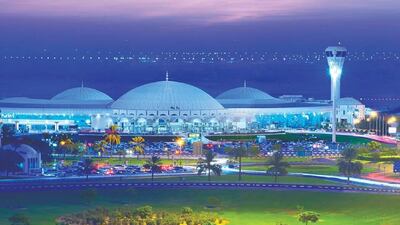
Sharjah International Airport became the only carbon-neutral airport in the Gulf.
The northern emirate hub achieved "Level 3+ Neutrality" accreditation, which is when net carbon dioxide emissions over a full year are zero, from the Airport Carbon Accreditation programme, it said in a statement on Sunday. The programme is backed by the Airports Council International (ACI).
"Sharjah Airport's attainment of the highest level of carbon neutrality reflects the efforts made by the airport in the field of environmental practices," Ali Salim Al Midfa, chairman of Sharjah Airport Authority, said. "The airport has adopted many green initiatives and programmes, in line with the commitment of the UAE towards reducing carbon emissions."
The number of accredited airports around the world surpassed the 300 mark during the peak of the Covid-19 pandemic, according to the Airport Carbon Accreditation programme, which was first launched in 2009. The global total now stands at 312.
"Underpinning the sustainability ambitions of the airport sector, during the height of the Covid-19 crisis a number of airports joined Airport Carbon Accreditation for the first time, and several more progressed further through the accreditation levels," it said in a July 29 statement.
The airport industry's work towards sustainability goals comes as the coronavirus crisis severely affects the global aviation industry. A recovery to 2019 passenger traffic levels is unlikely before 2024, according to industry bodies and analysts.
Airports that have joined the accreditation programme for the first time since the pandemic was declared in March include South Africa's Bram Fischer International Airport, Nigeria's Lagos Murtala Muhammed Airport and Mexico's Queretaro Airport.
Airports that have been upgraded since the pandemic include Tunisia's Enfidha-Hammamet Airport, China's Guangzhou Baiyun International Airport and Sharjah International Airport.
"Sharjah Airport has joined the highest rank of the global carbon management programme for airports," the ACA programme said in a separate statement. "At level 3+ 'Neutrality', the airport has reduced emissions from sources under its control to a maximum and compensated for residual emissions with the purchase of responsible carbon credits."
Sharjah Airport's accreditation brought the total number of carbon-neutral airports in the ACI's Asia-Pacific region to seven hubs, it said.
Sharjah Airport has implemented various environmental and sustainability projects, including energy conservation initiatives and clean energy projects. It also monitored electricity and water consumption in the airport and introduced an integrated waste management system targeted at sending zero waste to landfill.
“By reaching carbon-neutral status, the highest status currently, in the internationally-recognised Airport Carbon Accreditation programme, Sharjah Airport is firmly positioning itself as an environmental leader in the region and beyond,” Stefano Baronci, director general of ACI Asia-Pacific, said.

Company Profile
Company name: Fine Diner
Started: March, 2020
Co-founders: Sami Elayan, Saed Elayan and Zaid Azzouka
Based: Dubai
Industry: Technology and food delivery
Initial investment: Dh75,000
Investor: Dtec Startupbootcamp
Future plan: Looking to raise $400,000
Total sales: Over 1,000 deliveries in three months
Cryopreservation: A timeline
- Keyhole surgery under general anaesthetic
- Ovarian tissue surgically removed
- Tissue processed in a high-tech facility
- Tissue re-implanted at a time of the patient’s choosing
- Full hormone production regained within 4-6 months
Panipat
Director Ashutosh Gowariker
Produced Ashutosh Gowariker, Rohit Shelatkar, Reliance Entertainment
Cast Arjun Kapoor, Sanjay Dutt, Kriti Sanon, Mohnish Behl, Padmini Kolhapure, Zeenat Aman
Rating 3 /5 stars
21 Lessons for the 21st Century
Yuval Noah Harari, Jonathan Cape
Ten tax points to be aware of in 2026
1. Domestic VAT refund amendments: request your refund within five years
If a business does not apply for the refund on time, they lose their credit.
2. E-invoicing in the UAE
Businesses should continue preparing for the implementation of e-invoicing in the UAE, with 2026 a preparation and transition period ahead of phased mandatory adoption.
3. More tax audits
Tax authorities are increasingly using data already available across multiple filings to identify audit risks.
4. More beneficial VAT and excise tax penalty regime
Tax disputes are expected to become more frequent and more structured, with clearer administrative objection and appeal processes. The UAE has adopted a new penalty regime for VAT and excise disputes, which now mirrors the penalty regime for corporate tax.
5. Greater emphasis on statutory audit
There is a greater need for the accuracy of financial statements. The International Financial Reporting Standards standards need to be strictly adhered to and, as a result, the quality of the audits will need to increase.
6. Further transfer pricing enforcement
Transfer pricing enforcement, which refers to the practice of establishing prices for internal transactions between related entities, is expected to broaden in scope. The UAE will shortly open the possibility to negotiate advance pricing agreements, or essentially rulings for transfer pricing purposes.
7. Limited time periods for audits
Recent amendments also introduce a default five-year limitation period for tax audits and assessments, subject to specific statutory exceptions. While the standard audit and assessment period is five years, this may be extended to up to 15 years in cases involving fraud or tax evasion.
8. Pillar 2 implementation
Many multinational groups will begin to feel the practical effect of the Domestic Minimum Top-Up Tax (DMTT), the UAE's implementation of the OECD’s global minimum tax under Pillar 2. While the rules apply for financial years starting on or after January 1, 2025, it is 2026 that marks the transition to an operational phase.
9. Reduced compliance obligations for imported goods and services
Businesses that apply the reverse-charge mechanism for VAT purposes in the UAE may benefit from reduced compliance obligations.
10. Substance and CbC reporting focus
Tax authorities are expected to continue strengthening the enforcement of economic substance and Country-by-Country (CbC) reporting frameworks. In the UAE, these regimes are increasingly being used as risk-assessment tools, providing tax authorities with a comprehensive view of multinational groups’ global footprints and enabling them to assess whether profits are aligned with real economic activity.
Contributed by Thomas Vanhee and Hend Rashwan, Aurifer
Dunki
%3Cp%3E%3Cstrong%3EDirector%3A%3C%2Fstrong%3E%20Rajkumar%20Hirani%C2%A0%3C%2Fp%3E%0A%3Cp%3E%3Cstrong%3EStarring%3A%3C%2Fstrong%3E%20Shah%20Rukh%20Khan%2C%20Taapsee%20Pannu%2C%20Vikram%20Kochhar%20and%20Anil%20Grover%3C%2Fp%3E%0A%3Cp%3E%3Cstrong%3ERating%3A%3C%2Fstrong%3E%204%2F5%3C%2Fp%3E%0A
The specs: 2019 BMW X4
Price, base / as tested: Dh276,675 / Dh346,800
Engine: 3.0-litre turbocharged in-line six-cylinder
Transmission: Eight-speed automatic
Power: 354hp @ 5,500rpm
Torque: 500Nm @ 1,550rpm
Fuel economy, combined: 9.0L / 100km
The Sand Castle
Director: Matty Brown
Stars: Nadine Labaki, Ziad Bakri, Zain Al Rafeea, Riman Al Rafeea
Rating: 2.5/5
Read more about the coronavirus
The five pillars of Islam
MOUNTAINHEAD REVIEW
Starring: Ramy Youssef, Steve Carell, Jason Schwartzman
Director: Jesse Armstrong
Rating: 3.5/5
Ferrari 12Cilindri specs
Engine: naturally aspirated 6.5-liter V12
Power: 819hp
Torque: 678Nm at 7,250rpm
Price: From Dh1,700,000
Available: Now
Lexus LX700h specs
Engine: 3.4-litre twin-turbo V6 plus supplementary electric motor
Power: 464hp at 5,200rpm
Torque: 790Nm from 2,000-3,600rpm
Transmission: 10-speed auto
Fuel consumption: 11.7L/100km
On sale: Now
Price: From Dh590,000
Zodi%20%26%20Tehu%3A%20Princes%20Of%20The%20Desert
%3Cp%3E%3Cstrong%3EDirector%3A%20%3C%2Fstrong%3EEric%20Barbier%26nbsp%3B%3C%2Fp%3E%0A%3Cp%3E%3Cstrong%3EStarring%3A%20%3C%2Fstrong%3EYoussef%20Hajdi%2C%20Nadia%20Benzakour%2C%20Yasser%20Drief%3C%2Fp%3E%0A%3Cp%3E%3Cstrong%3ERating%3A%3C%2Fstrong%3E%204%2F5%3C%2Fp%3E%0A
The specs
Engine: 4.0-litre V8 twin-turbocharged and three electric motors
Power: Combined output 920hp
Torque: 730Nm at 4,000-7,000rpm
Transmission: 8-speed dual-clutch automatic
Fuel consumption: 11.2L/100km
On sale: Now, deliveries expected later in 2025
Price: expected to start at Dh1,432,000
