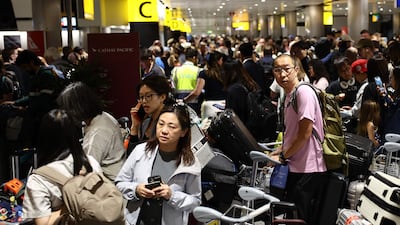

Days of disruption are expected for travellers using UK airports after a technical issue in the air traffic control system grounded hundreds of flights.
The issue, which emerged on Tuesday afternoon, has been resolved but the knock-on effect means further flights were delayed or cancelled today. Heathrow, Gatwick and other major airports experienced problems, with more than 1,000 flights affected by the four-hour disruption.
The boss of the National Air Traffic Services, Martin Rolfe, apologised, but faced calls to resign after the third major breakdown of the system during his decade-long tenure.

He was summoned by Transport Secretary Heidi Alexander to explain the situation amid concerns that the infrastructure and technology are not up to scratch. “I am seeking assurances that lessons will be learnt and systems that support aviation are up to the job,” Ms Alexander said on X.
A Downing Street spokesman later said Mr Rolfe has the confidence of the government. He has been given a week's deadline by Ms Alexander to carry out a full investigation into what happened to make sure that lessons are learned.
Mr Rolfe said on Wednesday that a cyber attack had been ruled out, but it was too early to say what the true cause was. He said it would not be a repeat of previous problems, but “something we’ve never seen in 50 years of operation”.
“We will be doing a very thorough and full investigation,” Mr Rolfe told BBC Radio 4’s Today programme. “Not to take away any of the frustrations and disappointments from the people who haven’t been able to travel, but we do have one of the best systems and one of the best services in the world.”
So far on Wednesday morning, 153 flights have been cancelled, including 55 departures and 98 arrivals, according to data compiled by Cirium. That compares with more than 1,750 aborted services on Tuesday, the data shows.
The spillover into Wednesday shows the complexity involved in restarting operations, with about 8,000 flights using the UK air space each day. Heavy disruptions mean that aircraft and crew are out of position and extra flights are needed to clear the backlog of stranded passengers.

Heathrow, the UK’s busiest airport, said that while operations were recovering, travellers should expect delays as aircraft and crew reposition. The airport said it has additional staff across Heathrow’s terminals.
Gatwick Airport, the other main hub in London, said in a statement that “it will take time for our operations to fully return to normal”.
Ryanair said about 150,000 of its passengers had been affected on Tuesday and that it cancelled more than 200 flights, while British Airways said it had cancelled or diverted 100 flights with tens of thousands impacted.
Tuesday’s problem was related to a technical issue at Nats, a public-private company based in Swanwick, Hampshire, that oversees air traffic control in the UK. The UK government holds a 49 per cent stake plus a blocking share in Nats, while airlines, airport operator LHR Airports Limited and Nats staff fund the rest.
“This has been a very complex recovery and has created difficulties for the whole aviation network, from which it will take time to recover,” Nats said.
Airport system problems have become routine in the UK. Last summer, an unspecified radar-related issue shut down the country’s airspace. Another Nats glitch three years ago halted air traffic in the country and left planes, crews and passengers stranded on one of the busiest travel days of the year.
That shutdown cost airlines £100 million ($135 million). An engineer took three hours to get to the office after being unable to fix the problem from home.
A radar-related technical issue also disrupted flights in July 2025.
Ryanair Holdings Plc and Wizz Air Holdings Plc have repeatedly called for Mr Rolfe to resign.
Yvonne Moynihan, managing director of Wizz Air, asked what reassurance there could be that there would not be another such event. “This is the third incident. Major questions need to be asked about the resilience of the system,” she said.
“In any industry when you’ve had three failures, you have to consider three strikes and you’re out.”

The Nats Swanwick operations room manages the en route airspace over England and Wales up to the Scottish border, as well as lower-altitude traffic to and from London’s airports, equal to about 2.5 million flights or 250 million passengers in the UK airspace.
Heathrow suffered its worst disruption in decades early last year after a nearby fire cut power to the hub and brought travel to a standstill for hundreds of thousands of passengers. The airport in the south-west of London, handles roughly 1,400 flights and 200,000 passengers every day, and about 40 aircraft take off every hour at peak times on average.
The disruption adds to complex operations particularly for Middle East carriers like Emirates or Qatar Airways that have seen their services come under strain in recent months because of the Iran war. Heathrow is among the busiest hubs for carriers from the Gulf, with Emirates alone operating about a dozen flights to London airports a day, many on its mammoth Airbus SE A380 aircraft.