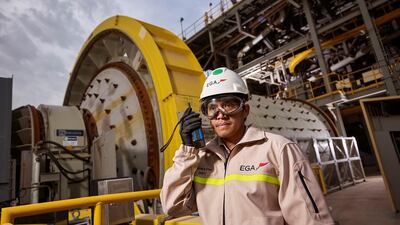
An Emirates Global Aluminium employee at the company's Taweelah refinery. Aluminium production is one of the core sectors of the economy that will come under focus as part of Abu Dhabi Department of Economic Development's Basic Industries Project. Image courtesy of EGA
An Emirates Global Aluminium employee at the company's Taweelah refinery. Aluminium production is one of the core sectors of the economy that will come under focus as part of Abu Dhabi Department of E

Abu Dhabi offers investment incentives under new Basic Industries Project in push for self-sufficiency


Deena Kamel
  • English
  • Arabic

Abu Dhabi’s Department of Economic Development outlined investment opportunities in 27 fields to boost local manufacturing of basic consumer and industrial products in a push towards self-sufficiency.

The government is aiming to attract private sector investment in four key basic industries of food production, medical supplies, power generation and important materials such as iron, aluminium and cement, the department told reporters during a virtual press conference on Wednesday.

The government agency highlighted 14 new investment opportunities in medical supplies, including gloves and face shields. Another eight areas in food production targeted range from manufacturing dates to baby foods,turning food waste into animal feed and seed production.

Opportunities in power generation include the manufacture of solar panels and batteries needed for clean energy production and machines for electronic surveillance of power plants.

"Selecting these targetted industries came after detailed analysis in co-ordination with government partner entities based on the amount of consumption of these products and their production rate," said Nabil Saleh Al Awlaqi, the department's environment, health and safety director.

The investment opportunities were identified after studying gaps in the supply chain.

"Through these basic industries we talk about the value chain: how can we complete the value chain with our existing industries, where's our competencies to achieve self-sufficiency?" Khaled Mubarak Banizama, the department's industrial development director, said. "We need to define these gaps and through that we consider the opportunities."

To implement its plan, the government is identifying and engaging key local and global manufacturers to boost production of these goods domestically, Mohamed Ebrahim Al Hosani, Adio's domestic investment director, said.

To attract investors, Abu Dhabi is offering various incentives to manufacturers to stimulate more local production.

This includes a reduction of 10 per cent to more than 30 per cent on electricity tariffs to industrial companies to reduce operational costs, Mr Banizama said.

Details of the investment opportunities emerged after the department said on July 19 it is rolling out a basic industries project aimed at making the emirate "self-sufficient in the production of basic and consumer commodities".

The aim is to increase the private sector's contribution in meeting local demand and encourage exports.

"We hope to attract companies that lead us to a knowledge economy, with the ability for innovation in different sectors," Mr Al Hosani said. "We also want to increase Emiratisation in the private sector."

The project, undertaken by the department’s Industrial Development Bureau, is in partnership with several government entities.

They include the emirate's departments of health and energy, the Agriculture and Food Safety Authority, Abu Dhabi Investment Office, Senaat General Holding and Emirates Global Aluminium.

Food production has become a key focus for the UAE in recent years as it looks to improve its security by encouraging local production and reducing its reliance on exports.

Demand for medical supplies has also skyrocketed during the Covid-19 pandemic and some local manufacturing capacity in the UAE has been converted to meet this need.

Strata, Mubadala Investment Company’s aerospace manufacturing unit, is looking to further diversify into the health technology sector, after producing N95 masks in partnership with Honeywell in May.


The story of Edge

Sheikh Mohamed bin Zayed, Crown Prince of Abu Dhabi and Deputy Supreme Commander of the Armed Forces, established Edge in 2019.

It brought together 25 state-owned and independent companies specialising in weapons systems, cyber protection and electronic warfare.

Edge has an annual revenue of $5 billion and employs more than 12,000 people.

Some of the companies include Nimr, a maker of armoured vehicles, Caracal, which manufactures guns and ammunitions company, Lahab


How Apple's credit card works

The Apple Card looks different from a traditional credit card — there's no number on the front and the users' name is etched in metal. The card expands the company's digital Apple Pay services, marrying the physical card to a virtual one and integrating both with the iPhone. Its attributes include quick sign-up, elimination of most fees, strong security protections and cash back.

What does it cost?

Apple says there are no fees associated with the card. That means no late fee, no annual fee, no international fee and no over-the-limit fees. It also said it aims to have among the lowest interest rates in the industry. Users must have an iPhone to use the card, which comes at a cost. But they will earn cash back on their purchases — 3 per cent on Apple purchases, 2 per cent on those with the virtual card and 1 per cent with the physical card. Apple says it is the only card to provide those rewards in real time, so that cash earned can be used immediately.

What will the interest rate be?

The card doesn't come out until summer but Apple has said that as of March, the variable annual percentage rate on the card could be anywhere from 13.24 per cent to 24.24 per cent based on creditworthiness. That's in line with the rest of the market, according to analysts

What about security? 

The physical card has no numbers so purchases are made with the embedded chip and the digital version lives in your Apple Wallet on your phone, where it's protected by fingerprints or facial recognition. That means that even if someone steals your phone, they won't be able to use the card to buy things.

Is it easy to use?

Apple says users will be able to sign up for the card in the Wallet app on their iPhone and begin using it almost immediately. It also tracks spending on the phone in a more user-friendly format, eliminating some of the gibberish that fills a traditional credit card statement. Plus it includes some budgeting tools, such as tracking spending and providing estimates of how much interest could be charged on a purchase to help people make an informed decision. 

* Associated Press 

Small Victories: The True Story of Faith No More by Adrian Harte
Jawbone Press

French business

France has organised a delegation of leading businesses to travel to Syria. The group was led by French shipping giant CMA CGM, which struck a 30-year contract in May with the Syrian government to develop and run Latakia port. Also present were water and waste management company Suez, defence multinational Thales, and Ellipse Group, which is currently looking into rehabilitating Syrian hospitals.