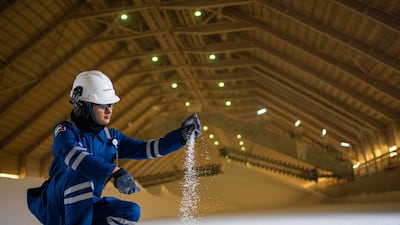

Fertiglobe, the world’s largest seaborne exporter of urea and ammonia, said it has restored UAE exports to 95 per cent of production in the third quarter, despite continuing disruption at the Strait of Hormuz.
That is up from 56 per cent in the second quarter, it said in a statement on Thursday to the Abu Dhabi Securities Exchange, where its shares trade.
Reaching that figure involved extensive efforts by Fertiglobe's production and supply-chain teams as well as working with majority shareholders XRG and Adnoc, and even the government, Ahmed El Hoshy, chief executive of Fertiglobe, told The National, without disclosing the specifics on how it was achieved.
The company, however, said UAE exports were supported by active inventory, logistics management and a “focused commercial approach”.
The effective closure of Hormuz, through which about one third of global seaborne fertiliser passed before the Iran war began on February 28, has significantly affected the supply chain.
While Fertiglobe has been transporting the stocks it had stored during the peak of the war, “we still have inventory left over, so I'd even like to export more than we've produced”, Mr El Hoshy said.
However, higher freight and logistical costs have affected earnings.
Net profit attributable to the owners of the company for the third quarter dropped by 90 per cent to $22.7 million. Revenue for the period, however, rose by 19 per cent to $904.5 million, driven by higher ammonia prices and sales volumes.
Along with the higher logistics costs, “sometimes the logistics to get product out also made it a little bit challenging to know the timing of exports”, Mr El Hoshy said.
The company also carried out a turnaround at its EBIC plant in Egypt, and during that process had to use inventories to continue selling products.
“When you use inventory to sell in Q3 instead of actual production, you end up getting charged with the fixed cost for the product … [and] you end up paying a larger amount,” he said.
And while ammonia prices were higher, the lower cost of urea also brought down margins, he added.
Urea, the most commonly used chemical for fertiliser, recorded a significant price increase to about $720 a tonne in mid-April from about $465 a tonne on the eve of the war, according to Trading Economics. Prices have now cooled to about $430 a tonne.
Fertiglobe is the largest producer of nitrogen fertilisers in the region, with a production capacity about of 6.6 million tonnes of urea and ammonia through subsidiaries in the UAE, Egypt and Algeria. Last year, it also established Fertiglobe Australia to operate assets it acquired from Chinese-based company Wengfu.
Gas price impact
While Fertiglobe uses long-term contracts for gas that are not linked to European gas prices, the benchmark acts as a bellwether for the industry, Mr El Hoshy said.
High European gas prices have caused about 35 per cent of European ammonia capacity to remain offline, he said.
Dutch front-month futures, which tracks European gas prices, was at about €90 ($100) per megawatt-hour on Thursday, more than double annually.
“There's 19 million tonnes of ammonia capacity that sits in Europe today,” Mr El Hoshy said. “Their cash cost today to produce ammonia is $1,000 a tonne, and the price that is in Europe today is $750 a tonne. So there's some mismatch. Either their cost needs to come down, or the price of ammonia needs to go up to justify them restarting their plant.”

Given the current situation and how low the inventories are, “we continue to be relatively constructive on the outlook for the market for ammonia and urea because the Europeans are now operating at a rate where they're not able to make money unless the price of ammonia goes up”, he said.
Robots cleaning up
Fertiglobe, which has implemented its initial $55 million cost optimisation target, has launched FIT3, a new programme aimed at achieving a further $30 million of annual non-gas cost savings by the end of 2028.
“Together with maintenance capex normalising from 2027, this will strengthen our competitiveness and cash generation through the cycle,” the company said.
The turnaround programme in Egypt and the UAE is expected to deliver strong results, Mr El Hoshy said. At the EBIC plant, production has increased by more than 20 per cent on a run rate basis.
Outside of regular maintenance, the programme in Egypt used artificial intelligence to go through data from every single interruption the plant has had since it started in 2009 and it came up with a list of things needed to be done.
“We discovered things and took care of it. We also used robotics for the first time to clean areas in the plant that humans couldn't get to, never been touched in 17 years, and that has allowed us to remove dust and debris,” Mr El Hoshy said.
“Since we started up in September for our plant in Egypt, we have achieved rates not achieved ever in these plants, so record daily production.”
Outlook
The company is preparing for different scenarios and aiming to see how it can reduce costs when faced with issues such as higher temporary logistics costs.
“What we've done internally is looked at … how we procure things, how we do things logistically, how we load product, where it's basically across all functional groups, [we are looking for] ways that we can reduce costs using simplified processes,” he said.
Looking ahead, if the war continues, “I still think that we're in a very tough position having the Strait of Hormuz compromised for exports of sulphur, which is a which is a very important input for fertiliser, urea, ammonia and natural gas”, Mr El Hoshy added.
The products must get to global markets because it's in a “very vulnerable position”.
Any impact will be felt mainly in low to medium-income countries in terms of not being able to secure the adequate fertilisers they need to increase the crop yields to feed their populations, he said.

