Saudi Arabia's Minister of Investment, Khalid Al Falih, has told an event in London that the kingdom's development plan is on its way to implementation and ahead of schedule.
“We're more than halfway through the implementation of Vision 2030, and I'm glad to report that we're ahead of schedule on all aspects of the implementation,” he told the UK-Saudi Sustainable Infrastructure Forum.
Vision 2030, Saudi Arabia's plan to transform the country from heavy reliance on oil and gas revenue to a technologically-advanced economy powered by renewable energy through a series of giga-projects involving trillions of dollars.
Saudi leaders, including Finance Minister Mohammed Al Jadaan, have recently hinted that some parts of the plan have been scaled back.
Nonetheless, the mood at the summit, which was convened by the City of London Corporation and the Saudi-British Joint Business Council, was distinctly upbeat and served as a further opportunity to expand the trade relationship between the kingdoms.
Mr Al Falih told the conference that Vision 2030 has been a boon for the Saudi economy, as the country uses it as a pathway to build a future beyond oil and gas.
“Our GDP has grown by some 70 per cent since we launched Vision 2030. We have moved from number 20 on the rankings of the G20 countries to number 16.
“We are the second-fastest growing economy within the G20 at close to 7 per cent annualised GDP growth since launching Vision 2030.
'The land of the future'
Emphasising that the kingdom is open for business, Mr Al Falih added that foreign direct investment by some measures has quadrupled in the past seven years and the number of foreign licences granted has increased by a factor of 10.
Using the tourism sector to illustrate how much progress Saudi Arabia has made towards its Vision 2030 goals, Mr Al Falih said the original target to attract 100 million visitors by 2030 was achieved last year and “the target has moved to 150 million visitors”.
“Projects that were only perceived as dreams are well under construction.”
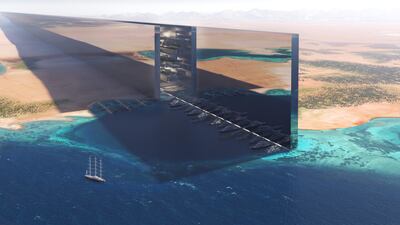
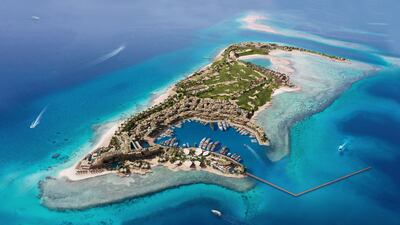
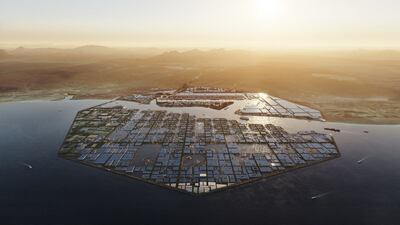
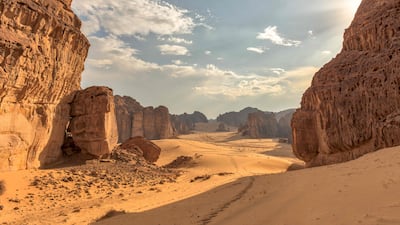
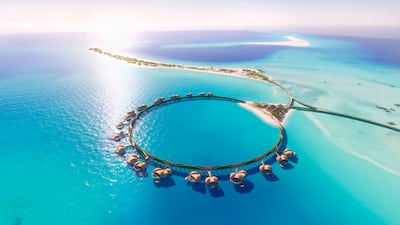
One of those projects is, of course, Neom in the north-west of Saudi Arabia. Neom has been singled out to be the “land of the future”, a $500 billion scheme to build 10 cities that have ultra-modern urbanisation technology, a thriving and sustainable economy with a conservation element that denotes that “nature comes first”.
One of the most high-profile and ambitious projects is The Line, a “cognitive” city stretching for 274km across the Neom region, with no cars and no emissions, because it will run on 100 per cent renewable power.
Although, some of the plans for Neom's projects like The Line have been scaled back of late, the enthusiasm for them among the summit delegates is undiminished.
“Neom is the world's largest sustainable region currently under development on earth,” said Nadhmi Al Nasr, chief executive of Neom.
“We have the unique advantage of incorporating the latest innovations and technology into everything we do from the start.
“Ninety-five per cent of Neom will remain conserved for nature and untouchable,” he added.
In order for Neom and the 13 other giga infrastructure projects within Vision 2030 to blossom from dreams to reality, private sector involvement is crucial at almost every level, according to Dr Manar Al Moneef, chief investment officer at Neom.
“The private sector plays a significant role, will join us and be part of this journey,” she said.
“Our aim is work with them hand-in-hand to actually structure opportunities in a way that makes sense.
“Today, we have more than 150 initiatives identified across various sectors and regions. Each of these initiatives have multiple opportunities that we're open to discuss with the private sector.”
'A hub for global finance'
It is hoped that many of those discussions will take place with British companies, and delegates at the summit emphasised the importance of London to Saudi Arabia in terms of the business and economic relationship.
“London has become, in my opinion, the world's financial centre,” Mr Al Falih told the summit.
“We look at London as a hub for global finance,” he said, adding that Brexit has afforded London an opportunity to act as a conduit for capital flowing into growing markets like Saudi Arabia.
“There is already strong collaboration between the London Stock Exchange and many actors in the Saudi market.”
Jane Goodland, group head of sustainability at London Stock Exchange Group, agreed, saying that London's capital market has got “huge potential to partner with Saudi in their Vision 2030".
“When think about green bonds, and sustainable bonds specifically, we believe that there is a very bright future for these types of instruments to meet some of the capital needs, which we know are going to be quite significant, not just in Saudi Arabia but globally as we all try to tackle climate change and transition into a low carbon economy that we need to do.”
Illustrating this point in the Saudi context are the inaugural green bonds issued by PIF (Public Investment Fund) of Saudi Arabia, which were eight times oversubscribed when launched on the London Stock Exchange.
“That's just going to grow and grow,” said Ms Goodland, “as we see more case studies and more examples of how these projects get financed.”
That said, for Dr Al Moneef, investing in Neom is so much more than just bottom-line profit.
“Neom is a once-in-a-lifetime opportunity,” she said.
“If you really care about making a difference; if you really care about introducing something new; if you really care about green and sustainability, that [Neom] is the place to be.”
“We have every opportunity available to you – the size you want and the scale you want. If you're talking about $100 million or $1 billion, everything is available at a structure that makes you comfortable as well as the banks. So, if you want to make that is the place to be,” she added.
The general message to the British company executives and entrepreneurs in the summit's audience about doing business in Saudi Arabia was largely summed up by Prince Khalid bin Bandar Al Saud, Saudi ambassador to the UK.
“Everything is there to provide the opportunity,” he said.
“All that's missing is more people coming across, and I think that it won't take long for anyone going to Saudi to find an opportunity and if they can't find it, they're probably doing the wrong thing.”

Stamp duty timeline
December 2014: Former UK finance minister George Osbourne reforms stamp duty, replacing the slab system with a blended rate scheme, with the top rate increasing to 12 per cent from 10 per cent:
Up to £125,000 - 0%; £125,000 to £250,000 – 2%; £250,000 to £925,000 – 5%; £925,000 to £1.5m: 10%; Over £1.5m – 12%
April 2016: New 3% surcharge applied to any buy-to-let properties or additional homes purchased.
July 2020: Rishi Sunak unveils SDLT holiday, with no tax to pay on the first £500,000, with buyers saving up to £15,000.
March 2021: Mr Sunak decides the fate of SDLT holiday at his March 3 budget, with expectations he will extend the perk unti June.
April 2021: 2% SDLT surcharge added to property transactions made by overseas buyers.
More coverage from the Future Forum
The five pillars of Islam
WHAT ARE NFTs?
Non-fungible tokens (NFTs) are tokens that represent ownership of unique items. They allow the tokenisation of things such as art, collectibles and even real estate.
An NFT can have only one official owner at one time. And since they're minted and secured on the Ethereum blockchain, no one can modify the record of ownership, not even copy-paste it into a new one.
This means NFTs are not interchangeable and cannot be exchanged with other items. In contrast, fungible items, such as fiat currencies, can be exchanged because their value defines them rather than their unique properties.
Key findings of Jenkins report
- Founder of the Muslim Brotherhood, Hassan al Banna, "accepted the political utility of violence"
- Views of key Muslim Brotherhood ideologue, Sayyid Qutb, have “consistently been understood” as permitting “the use of extreme violence in the pursuit of the perfect Islamic society” and “never been institutionally disowned” by the movement.
- Muslim Brotherhood at all levels has repeatedly defended Hamas attacks against Israel, including the use of suicide bombers and the killing of civilians.
- Laying out the report in the House of Commons, David Cameron told MPs: "The main findings of the review support the conclusion that membership of, association with, or influence by the Muslim Brotherhood should be considered as a possible indicator of extremism."
Who has lived at The Bishops Avenue?
- George Sainsbury of the supermarket dynasty, sugar magnate William Park Lyle and actress Dame Gracie Fields were residents in the 1930s when the street was only known as ‘Millionaires’ Row’.
- Then came the international super rich, including the last king of Greece, Constantine II, the Sultan of Brunei and Indian steel magnate Lakshmi Mittal who was at one point ranked the third richest person in the world.
- Turkish tycoon Halis Torprak sold his mansion for £50m in 2008 after spending just two days there. The House of Saud sold 10 properties on the road in 2013 for almost £80m.
- Other residents have included Iraqi businessman Nemir Kirdar, singer Ariana Grande, holiday camp impresario Sir Billy Butlin, businessman Asil Nadir, Paul McCartney’s former wife Heather Mills.
Hunting park to luxury living
- Land was originally the Bishop of London's hunting park, hence the name
- The road was laid out in the mid 19th Century, meandering through woodland and farmland
- Its earliest houses at the turn of the 20th Century were substantial detached properties with extensive grounds
The%20specs
%3Cp%3E%3Cstrong%3EEngine%3A%3C%2Fstrong%3E%206.5-litre%20V12%20and%20three%20electric%20motors%0D%3Cbr%3E%3Cstrong%3EPower%3A%20%3C%2Fstrong%3E1%2C015hp%0D%3Cbr%3E%3Cstrong%3ETorque%3A%20%3C%2Fstrong%3E1%2C500Nm%20(estimate)%0D%3Cbr%3E%3Cstrong%3ETransmission%3A%3C%2Fstrong%3E%20Eight-speed%20dual-clutch%20auto%0D%3Cbr%3E%3Cstrong%3EOn%20sale%3A%3C%2Fstrong%3E%20Early%202024%0D%3Cbr%3E%3Cstrong%3EPrice%3A%20%3C%2Fstrong%3EFrom%20Dh2%20million%20(estimate)%3C%2Fp%3E%0A
APPLE IPAD MINI (A17 PRO)
Display: 21cm Liquid Retina Display, 2266 x 1488, 326ppi, 500 nits
Chip: Apple A17 Pro, 6-core CPU, 5-core GPU, 16-core Neural Engine
Storage: 128/256/512GB
Main camera: 12MP wide, f/1.8, digital zoom up to 5x, Smart HDR 4
Front camera: 12MP ultra-wide, f/2.4, Smart HDR 4, full-HD @ 25/30/60fps
Biometrics: Touch ID, Face ID
Colours: Blue, purple, space grey, starlight
In the box: iPad mini, USB-C cable, 20W USB-C power adapter
Price: From Dh2,099
Company profile
Name: Infinite8
Based: Dubai
Launch year: 2017
Number of employees: 90
Sector: Online gaming industry
Funding: $1.2m from a UAE angel investor
HEADLINE HERE
- I would recommend writing out the text in the body
- And then copy into this box
- It can be as long as you link
- But I recommend you use the bullet point function (see red square)
- Or try to keep the word count down
- Be wary of other embeds lengthy fact boxes could crash into
- That's about it
Fixtures and results:
Wed, Aug 29:
- Malaysia bt Hong Kong by 3 wickets
- Oman bt Nepal by 7 wickets
- UAE bt Singapore by 215 runs
Thu, Aug 30: UAE v Nepal; Hong Kong v Singapore; Malaysia v Oman
Sat, Sep 1: UAE v Hong Kong; Oman v Singapore; Malaysia v Nepal
Sun, Sep 2: Hong Kong v Oman; Malaysia v UAE; Nepal v Singapore
Tue, Sep 4: Malaysia v Singapore; UAE v Oman; Nepal v Hong Kong
Thu, Sep 6: Final
Ten tax points to be aware of in 2026
1. Domestic VAT refund amendments: request your refund within five years
If a business does not apply for the refund on time, they lose their credit.
2. E-invoicing in the UAE
Businesses should continue preparing for the implementation of e-invoicing in the UAE, with 2026 a preparation and transition period ahead of phased mandatory adoption.
3. More tax audits
Tax authorities are increasingly using data already available across multiple filings to identify audit risks.
4. More beneficial VAT and excise tax penalty regime
Tax disputes are expected to become more frequent and more structured, with clearer administrative objection and appeal processes. The UAE has adopted a new penalty regime for VAT and excise disputes, which now mirrors the penalty regime for corporate tax.
5. Greater emphasis on statutory audit
There is a greater need for the accuracy of financial statements. The International Financial Reporting Standards standards need to be strictly adhered to and, as a result, the quality of the audits will need to increase.
6. Further transfer pricing enforcement
Transfer pricing enforcement, which refers to the practice of establishing prices for internal transactions between related entities, is expected to broaden in scope. The UAE will shortly open the possibility to negotiate advance pricing agreements, or essentially rulings for transfer pricing purposes.
7. Limited time periods for audits
Recent amendments also introduce a default five-year limitation period for tax audits and assessments, subject to specific statutory exceptions. While the standard audit and assessment period is five years, this may be extended to up to 15 years in cases involving fraud or tax evasion.
8. Pillar 2 implementation
Many multinational groups will begin to feel the practical effect of the Domestic Minimum Top-Up Tax (DMTT), the UAE's implementation of the OECD’s global minimum tax under Pillar 2. While the rules apply for financial years starting on or after January 1, 2025, it is 2026 that marks the transition to an operational phase.
9. Reduced compliance obligations for imported goods and services
Businesses that apply the reverse-charge mechanism for VAT purposes in the UAE may benefit from reduced compliance obligations.
10. Substance and CbC reporting focus
Tax authorities are expected to continue strengthening the enforcement of economic substance and Country-by-Country (CbC) reporting frameworks. In the UAE, these regimes are increasingly being used as risk-assessment tools, providing tax authorities with a comprehensive view of multinational groups’ global footprints and enabling them to assess whether profits are aligned with real economic activity.
Contributed by Thomas Vanhee and Hend Rashwan, Aurifer
World record transfers
1. Kylian Mbappe - to Real Madrid in 2017/18 - €180 million (Dh770.4m - if a deal goes through)
2. Paul Pogba - to Manchester United in 2016/17 - €105m
3. Gareth Bale - to Real Madrid in 2013/14 - €101m
4. Cristiano Ronaldo - to Real Madrid in 2009/10 - €94m
5. Gonzalo Higuain - to Juventus in 2016/17 - €90m
6. Neymar - to Barcelona in 2013/14 - €88.2m
7. Romelu Lukaku - to Manchester United in 2017/18 - €84.7m
8. Luis Suarez - to Barcelona in 2014/15 - €81.72m
9. Angel di Maria - to Manchester United in 2014/15 - €75m
10. James Rodriguez - to Real Madrid in 2014/15 - €75m
Killing of Qassem Suleimani
Mohammed bin Zayed Majlis
Checks continue
A High Court judge issued an interim order on Friday suspending a decision by Agriculture Minister Edwin Poots to direct a stop to Brexit agri-food checks at Northern Ireland ports.
Mr Justice Colton said he was making the temporary direction until a judicial review of the minister's unilateral action this week to order a halt to port checks that are required under the Northern Ireland Protocol.
Civil servants have yet to implement the instruction, pending legal clarity on their obligations, and checks are continuing.
Guide to intelligent investing
Investing success often hinges on discipline and perspective. As markets fluctuate, remember these guiding principles:
- Stay invested: Time in the market, not timing the market, is critical to long-term gains.
- Rational thinking: Breathe and avoid emotional decision-making; let logic and planning guide your actions.
- Strategic patience: Understand why you’re investing and allow time for your strategies to unfold.
Key figures in the life of the fort
Sheikh Dhiyab bin Isa (ruled 1761-1793) Built Qasr Al Hosn as a watchtower to guard over the only freshwater well on Abu Dhabi island.
Sheikh Shakhbut bin Dhiyab (ruled 1793-1816) Expanded the tower into a small fort and transferred his ruling place of residence from Liwa Oasis to the fort on the island.
Sheikh Tahnoon bin Shakhbut (ruled 1818-1833) Expanded Qasr Al Hosn further as Abu Dhabi grew from a small village of palm huts to a town of more than 5,000 inhabitants.
Sheikh Khalifa bin Shakhbut (ruled 1833-1845) Repaired and fortified the fort.
Sheikh Saeed bin Tahnoon (ruled 1845-1855) Turned Qasr Al Hosn into a strong two-storied structure.
Sheikh Zayed bin Khalifa (ruled 1855-1909) Expanded Qasr Al Hosn further to reflect the emirate's increasing prominence.
Sheikh Shakhbut bin Sultan (ruled 1928-1966) Renovated and enlarged Qasr Al Hosn, adding a decorative arch and two new villas.
Sheikh Zayed bin Sultan (ruled 1966-2004) Moved the royal residence to Al Manhal palace and kept his diwan at Qasr Al Hosn.
Sources: Jayanti Maitra, www.adach.ae