

Artificial intelligence is transforming India's economy and the way companies do business.
As the technology expands, India — already famed for its IT industry — has the potential to play a much larger role in providing AI solutions to the rest of the world, industry experts say.
“In the coming years, the contribution from AI to the Indian economy is going to be extremely significant,” says Ganesh Gopalan, chief executive of Gnani.ai, a Bengaluru-based company that provides conversational AI voice bots for customer service automation.
AI is increasingly being used across industries in India — from banking and health care to farming and manufacturing — to improve efficiency by using the intelligence of technology and machines to perform tasks.
AI is expected to add up to $500 billion to India's gross domestic product by 2025 and $967 billion by 2035, according to a new report by TeamLease Digital.
AI has become more prevalent in the post-pandemic era where traction to move digital has become the need for most businesses today, says Gyan Pandey, head of digital at Voltas, which is part of the Tata Group.
“We have observed a strong demand for premium AI-based products not only from the developed metro markets, but also from smaller towns.”
AI has the potential to significantly boost the Indian economy by improving productivity, reducing costs and creating opportunities for innovation and growth, says Anurag Sanghai, principal solutions architect at Intellicus Technologies.
“The country is poised for realising tremendous gains through investment in developing AI skills and infrastructure, and by ensuring that the benefits are shared across all the socioeconomic strata,” he says.
To date, most AI development and investment has taken place in the West, but India's AI software segment is expected to grow annually by 18 per cent to the end of 2025, according to the TeamLease report.
India's investments in AI are growing by 30.8 per cent annually and will reach $881 million this year.
“Currently, most AI-based technology is being developed overseas,” says Vishal Jain, co-founder of Roadcast Tech Solutions.
“In India, it is at a very nascent stage. Therefore, it will take some time to mature. Besides this, AI as a sector requires substantial research and development (R&D). Therefore, to build large-scale products and support constant innovation in AI, players in India need to look at massive investments.”
Meanwhile, India has a lot to offer the world when it comes to AI and Indian companies are already leading this effort, says Mr Gopalan of Gnani.ai.
“In the coming years, we are fairly confident that India as a country will continue to invest and soon enough be a very significant part of the whole AI economy.”
Gnani.ai started out by solving problems for the Indian market, before expanding to work with customers in the Middle East, the US and other Asian countries, Mr Gopalan adds.
Also based in the country's IT hub of Bengaluru, SwitchOn is a company that uses AI to automate inspections in the manufacturing industry.
The technology is used to identify defective products in high-speed manufacturing lines making more than 10 products a second, including consumer goods and automotive components.
Artificial intelligence in the UAE — in pictures
-
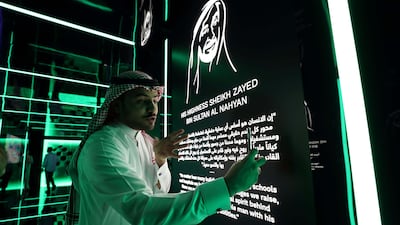
An official at the launch of Mohamed bin Zayed University of Artificial intelligence in Masdar City, Abu Dhabi. AI is central to the UAE's economic growth agenda. Chris Whiteoak / The National -
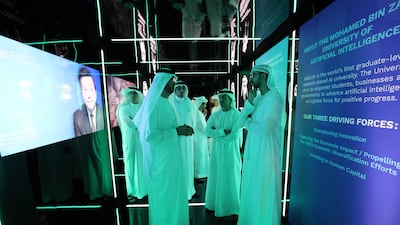
From left, Dr Sultan Al Jaber, Dr Ahmad Al Falasi and Omar Al Olama at the launch of the university. Chris Whiteoak / The National -

The university has teamed up with IBM to open a research centre at its Masdar City campus. Chris Whiteoak / The National -
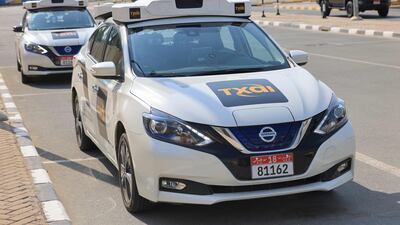
Self-driving taxis in Abu Dhabi. The UAE intends to become one of the leading AI nations by 2031. AFP -
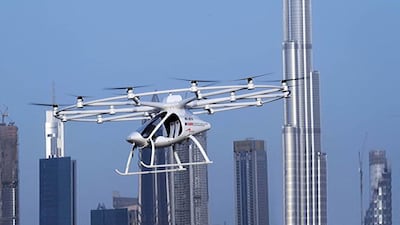
MBZUAI has developed a curriculum and programmes that support academic research to contribute to tackling real-world challenges. AFP -

A robot outside the Dutch pavilion at the Expo 2020 Dubai. New districts are being built in the UAE, with artificial intelligence at their core. AFP -

Ajman's first self-driving bus goes on its first official drive with Sheikh Rashid bin Humaid, director of the Ajman Municipality and Planning Department, and Mr Al Olama onboard. -

MBZUAI is the only graduate-level university in the world singularly focused on developing AI tools. Photo: MBZUAI -

Through the IBM Skills Academy programme, MBZUAI will have access to lectures, labs, industry use cases and design-thinking sessions. Photo: MBZUAI -

Dr Al Jaber, Minister of Industry and Advanced Technology and chairman of the MBZUAI board of trustees, has in the past emphasised the UAE's plans to use AI as a transformative tool to support its development. Chris Whiteoak / The National -

MBZUAI offers an executive programme to equip UAE government and business leaders with practical skills to tap into the benefits of cutting-edge technology. AFP


AI can play a key role in boosting India's manufacturing sector, which is a critical part of India's economic growth plans.
When manufacturers use manual inspections, they would typically only inspect one out of several thousand products, says Aniruddha Banerjee, co-founder of SwitchOn.
This means that a number of defective products end up in the hands of consumers. However, AI allows each and every item to be inspected, he adds.
“By eliminating defective products, we are able to reduce supply chain costs and drastically reduce wastage for these companies,” says Mr Banerjee.
His company is also working with global companies to deploy its solutions worldwide, he says.
Along with manufacturing, AI is also playing a growing role in India's agriculture sector, which makes up about 20 per cent of the economy and is still dominated by small farmers using traditional methods.
“India has witnessed an exponential increase in AgriTech businesses that are developing and implementing AI for enhanced solution for the agricultural industry,” says Pushkar Limaye, co-founder and chief technology officer at Carnot Technologies, an Indian agricultural technology company that was acquired by conglomerate Mahindra & Mahindra.
“AI-based solutions in India are looking to help achieve healthier crops, analysing weather-related data, analysing yield as per seasons, monitoring soil and growing conditions, supply chain management.”
co-founder and chief growth officer at Exotel
As more such start-ups emerge in the country, there is an enormous opportunity for India to build on its expertise and reputation in the IT sector to boost its presence in the global AI industry.
“Anytime a disruption happens, that's an opportunity to take the leadership position and become the provider of technology,” says Sachin Bhatia, co-founder and chief growth officer at Exotel, a cloud-based communication engagement company that offers conversational AI products to businesses.
“So here, India has a very large pool of engineers, technology graduates. We believe that India would be providing a very large pool of AI-talented engineers. And there has been a huge wave of companies which are making software in India for the global market.”
One concern that is frequently raised about the greater use of AI, however, is the impact that it will have on jobs.
With a population of more than 1.4 billion, more than half of whom are under the age of 30, it is vital for India to generate employment to lift people out of poverty.
Ultimately, however, AI “is going to lead to more productivity and is going to lead to more businesses doing better”, which will generate different kinds of jobs, says Mr Gopalan.
The Indian government is also working to boost the country's AI sector. In this year's budget, the government announced plans to set up three centres of excellence for artificial intelligence.
These initiatives aim to create a conducive ecosystem for AI development, promote R&D, and foster innovation, says Naren Vijay, executive vice president of growth at Lumenore, which uses AI to conduct predictive data analytics.
Watch: UAE-built robot barista can make coffee in three minutes
But he also acknowledges that there are several challenges associated with the use of AI in India.
These include data privacy and security, particularly when it comes to AI being deployed in finance and health care.
Many parts of India also do not have the infrastructure needed for AI, including high-speed internet, computing power and cloud services.
There are also ethical considerations, such as AI systems possibly being trained on biased data, which can lead to discriminatory outcomes, says Mr Vijay.
“It can be a significant ethical concern when AI is used in decision-making processes such as hiring, lending and criminal justice.”
India is still awaiting its data protection legislation, which means there is still a regulatory vacuum around data security, says Rajat Deshpande, chief executive and co-founder of FinBox, which uses AI to analyse data and assess risk.
“Since AI models rely so heavily on user data, there is often apprehension around their use.”
There is also a hurdle when its comes to human resources. While India has many skilled IT workers, far more talent will be needed to fulfil its potential in AI, experts say.
“The dearth of qualified talent in India represents another important potential and challenge,” says Kunal Bhatt, head of automation at Mumbai-based CMS IT Services.
“This can be solved by funding AI-led education and training programmes to upgrade the skills of current experts.”
If these issues can be successfully addressed, India is in a prime position to benefit from the rise of AI globally.
“India’s artificial intelligence moment is truly here and now,” says Mr Bhatt.

