


Greater funding for solutions to help to mitigate the effects of climate change — especially in developing economies — could be sourced if more philanthropic money was directed towards it, according to the Cop28 representative for business and philanthropy.
Badr Jafar, who is also chief executive of Crescent Enterprises, was in Davos last week to help build on the idea of creating a global philanthropy alliance in the build-up to the Cop28 summit, being held in the UAE this year, to support efforts to ease the effects of climate change.
“I am a true believer in the catalytic potential for philanthropy to move all of our global systems to address issues related to humanity and habitat,” he told The National.
“The big opportunity is going to come [when] we're able to create platforms for cross fertilisation, not just partnering capital, but also ideas and learning. And that is what this new platform that we hope to launch at Cop28 will be, a global alliance.”
Climate philanthropy is a growing but under-represented area of giving and investment. The World Economic Forum organised several discussions on the subject at its annual meeting in Davos last week.
According to the WEF, the share of total global philanthropy dedicated to climate mitigation is less than 2 per cent a year. Of the approximately $810 billion of total philanthropic giving in 2021, only about $7.5 billion to $12.5 billion was earmarked for climate mitigation.
In Davos, the forum launched, with US climate envoy John Kerry, the Giving to Amplify Earth Action initiative to help unlock the $3 trillion of financing needed each year to reach net zero, reverse nature loss and restore biodiversity by 2050.

Mr Jafar said the global climate philanthropy alliance he wants to help create would focus on supporting developing economies as well as increasing the size of the sector.
“There are positive trend lines to the extent that in the last five years the [climate philanthropy] amount has tripled. So, it is going in the right direction, for a number of reasons,” he said.
“The vast majority of that money is invested in adaptation financing in North America and Europe. Less than 10 per cent of all adaptation financing goes to Africa and Latin America combined. So there is also an imbalance within the 2 per cent, which is already very low.”
In Davos, Mr Jafar, with the Prince Albert II of Monaco Foundation, co-hosted a high-level event on climate and nature philanthropy.
Cop28 representative for business and philanthropy
This brought together a diverse group including Majid Al Suwaidi, director general of Cop28, Cherie Blair, founder of the Cherie Blair Foundation for Women, Andre Hoffmann, vice-chairman of Roche, and Rohini Nilekani, chair of Rohini Nilekani Philanthropies.
“Philanthropy, when deployed strategically, can be nimble, can be flexible, can be risk tolerant, and can be a lot more equitable in the way in which it's dispersed,” Mr Jafar said.
“And this is why it has a unique characteristic and the potential to create a multiplier effect, in partnership with blended finance, in partnership with business capital, and government capital.”
Mr Jafar is also the founding patron of the Centre for Strategic Philanthropy at the University of Cambridge and the Strategic Philanthropy Initiative at NYU Abu Dhabi.
The global climate crises over the years - in pictures
-
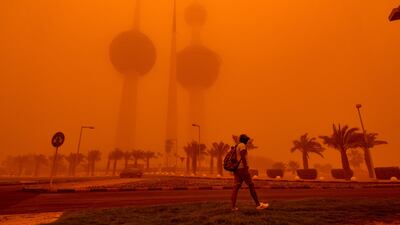
The Kuwait Towers are shrouded amid a sandstorm. The world has seen more extreme weather in the past decade, with the Gulf witnessing cyclones, flooding and extreme heat. EPA -
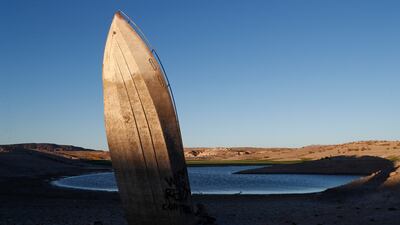
A formerly sunken boat sits upright on the shore of Lake Mead, Nevada, where water levels have dropped. EPA -
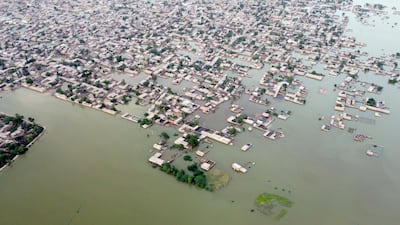
Homes surrounded by floodwater in Pakistan's south-western Baluchistan province earlier this year. AP Photo -
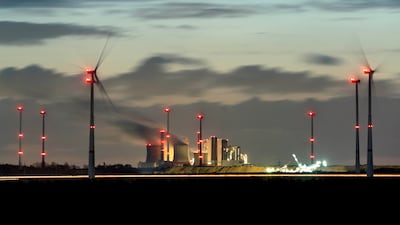
Steam rises from a coal-fired power plant near Grevenbroich, Germany. AP Photo -
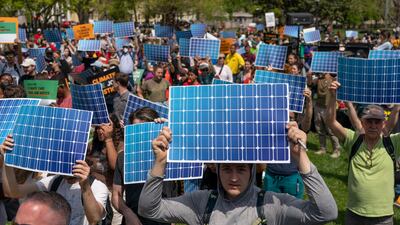
Activists display prints replicating solar panels during a rally to mark Earth Day in Washington. AP Photo -
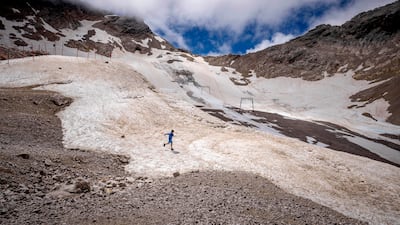
A glacier, which has lost most of its ice in the past few years, on Mount Zugspitze, Germany. AP Photo -
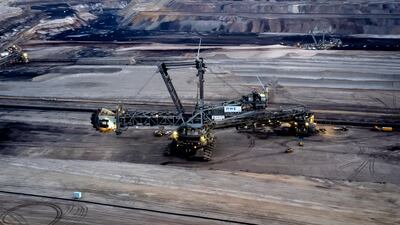
A bucket wheel excavator mining coal at an open-cast mine in Luetzerath, Germany. AP Photo -
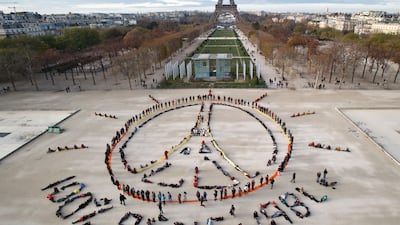
Climate activists form a human chain spelling out '100% renewable', at Cop21 in Paris in 2015. AP -
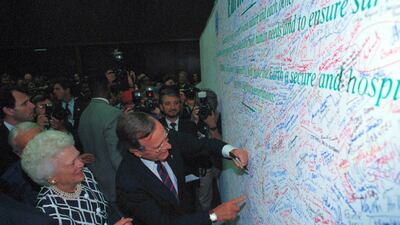
US president George W Bush and first lady Barbara Bush sign a pledge to protect the Earth in Rio de Janeiro in 1992. AP Photo -
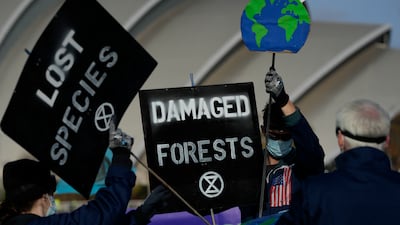
Extinction Rebellion activists holds placards at Cop26 last year in Glasgow, Scotland. AP Photo -

Demonstrators hold banners calling for a reduction in greenhouse gas emissions in Kyoto, Japan, in 1997. AP Photo -
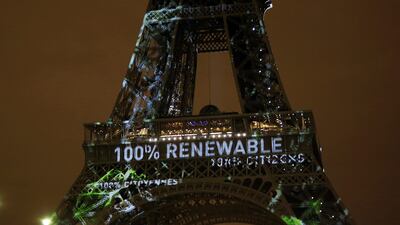
An artwork entitled 'One Heart One Tree' by Naziha Mestaoui is displayed on the Eiffel Tower before the 2015 Paris climate conference. AP Photo -
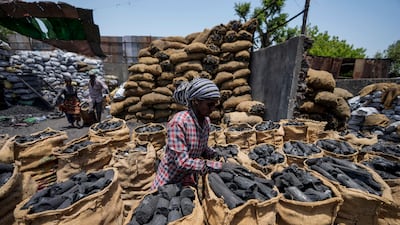
A woman works at a coal depot in Ahmedabad, India, in May. AP Photo -
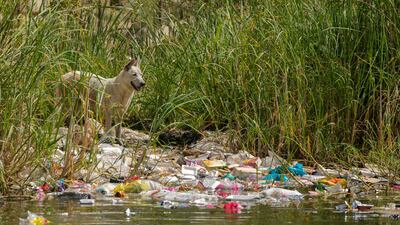
Plastic waste on the banks of the Nile in Cairo in September. AP Photo -
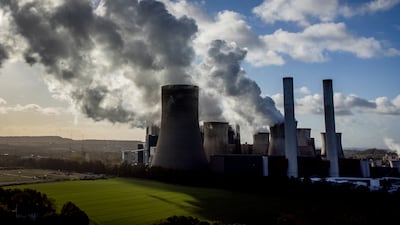
Steam rises from a coal-fired power plant Niederaussem, Germany. AP Photo -

Lake Poopo, home to the Uru Murato indigenous community in Bolivia, has largely become a desert. AFP -
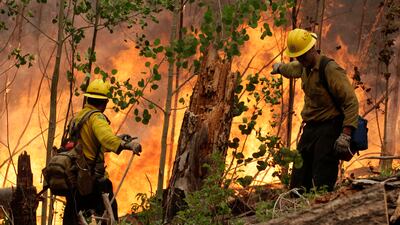
US firefighters battle a blaze near Los Alamos, New Mexico, in 2011. AP Photo -
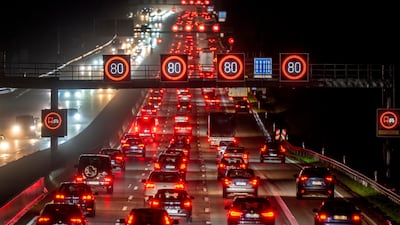
Cars on motorway in Frankfurt, Germany. Vehicle emissions are a contributor to climate change. AP Photo -
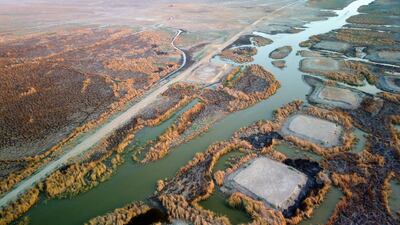
The rapidly drying marshes of Chibayish in Iraq's southern Dhi Qar province. AFP


A key opportunity lies in being able to use philanthropic money to leverage other forms of capital, he said.
“Some of the data that the centres have been putting together, have [highlighted] ... a couple of great case studies that show that like in venture capital … some of the first money in might not be a huge amount of money, but you look and see what over time that money has been able to achieve in terms of transformational process of innovation within that company, business or sector.”
This is also a unique moment to take advantage of trillions of dollars that are part of an epic intergenerational wealth transfer.
“This new generation is much more in tune with the interconnectedness of the [climate related] challenges but also to the impact on their own business,” he said.

