


Lebanon's private sector activity improved in August to the highest levels in more than nine years as output and new orders picked up.
The Blom Lebanon Purchasing Managers' Index rose to 50.1 last month, from 49.9 in July, its highest reading since June 2013.
A reading above the neutral level of 50 indicates growth, while one below it points to a contraction.
The higher reading is an "important achievement, even a milestone in the recent life of the Lebanese economy", said Aline Azzi, research analyst at Blominvest Bank.
The improvement was driven by strong tourist and expatriate spending, as well as possible deferred and pent-up spending by resident Lebanese, Ms Azzi said.
"This result should be put in context, as it reflects adjustment of the Lebanese economy towards a 'new normal', which is not surprisingly much lower than the 'old normal' prior to October 2019," she said.
"Only determined implementation of an economic and governance reform and recovery programme" in line with the International Monetary Fund proposed bailout package can "pull the economy from its lower new normal to a better and higher standing".
Despite business activity stabilising and backlogs of work, employment fell slightly and inflation persisted in the third quarter, as the US dollar strengthened and pushed up operating conditions, according to the survey.
To protect margins, private sector firms in Lebanon raised their prices.
Lebanon recorded its 25th consecutive month of triple-digit inflation in July with the Central Administration of Statistics' Consumer Price Index rising to 168 per cent from the same month a year earlier. The index increased 7.4 per cent from June 2022.
Lebanon is expected to post the second-highest inflation rate in the world this year, trailing Sudan, according to Fitch Solutions.
Inflation in the country will average 178 per cent in 2022, up from about 155 per cent last year, Fitch said.
-

People queue outside a closed bakery, waiting for it to open, in Chiyah, Lebanon. Reuters -
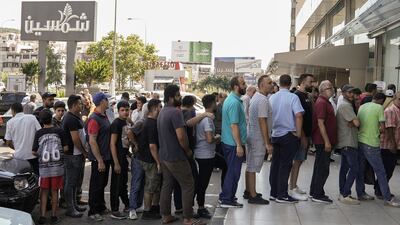
Another queue at a bakery in Khaldeh. The Lebanese Parliament has approved a $150m World Bank loan for wheat imports to address shortages in the country. Reuters -

The loan will finance wheat imports for at least six months, alleviating acute bread shortages. Reuters -

Lebanon has suffered from chronic scarcity of wheat and flour since its economic crisis began in 2019. Reuters -

A man holds stacks of bread as he makes his way through a crowd of people queuing for bread outside a bakery in Beirut. Reuters -
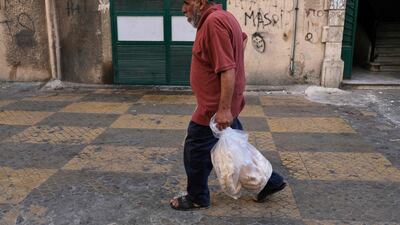
Subsidised Arabic bread consumed in most Lebanese households has become scarce. AFP -
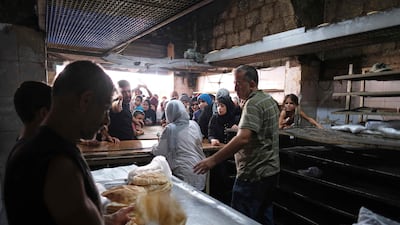
About 22 per cent of Lebanese households are food insecure, according to the World Food Programme, with that number likely to rise. AFP -
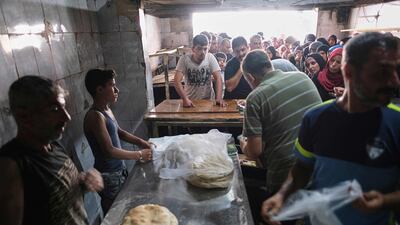
Soaring inflation, paired with a plunge in the value of the local currency, has badly affected the purchasing power of Lebanon's citizens. AFP -

Long early-morning queues often form in front of bakeries and shops as customers race to purchase limited quantities of subsidised bread. AFP -
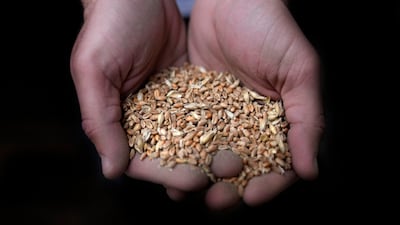
The limited availability of bread has caused tensions to frequently boil over in queues. Two people were wounded in Tripoli in mid-July after a gunfight over who was ahead in a bread queue. AP -
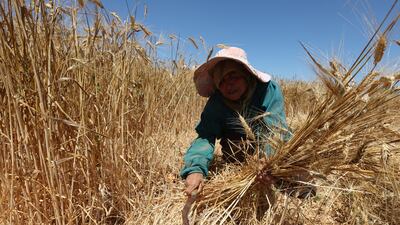
A woman uses a sickle to harvest wheat at a field in Houla village, near the border with Israel, southern Lebanon. Reuters -
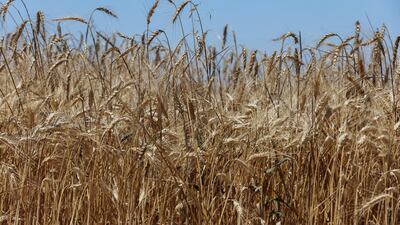
Russia’s invasion of Ukraine in February has also been detrimental, with the war there hindering the country’s ability to export wheat. About 80 per cent of Lebanon’s wheat came from Ukraine prior to the invasion. Reuters -
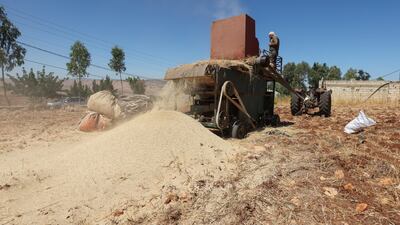
The Beirut port explosion in August 2020 destroyed the country’s grain silos and with it most of Lebanon’s wheat reserves. Reuters


The country's economy collapsed after it defaulted on about $31 billion of Eurobonds in March 2020, with its currency sinking more than 90 per cent against the dollar on the black market.
"Looking ahead, businesses remained downbeat as concerns towards the domestic political environment clouded the economic outlook," the survey said.
Lebanon faces political deadlock over the formation of a new Cabinet nearly four months after parliamentary elections amid its worst economic crisis in decades.
Failure by politicians to agree on the formation of a new government will make the economic crisis worse and delay a $3bn IMF bailout programme that is contingent on a slew of reforms.
The fund's reform programme mandates the restructuring of the country's financial sector, implementing fiscal consolidation as well as restructuring of external public debt.
Reforming state-owned enterprises, particularly in the energy sector and strengthening governance as well as modernising the central bank legal framework and governance and accountability arrangements are other requirements.
The government also needs to establish a credible and transparent monetary and exchange rate system.
Securing IMF backing will help to unlock a further $11bn of assistance that was pledged at a Paris donor conference in 2018.

