


David Clark, the executive responsible for transforming Amazon into a global delivery force, is leaving his role as chief executive of its consumer business after 23 years at the world's biggest e-commerce company.
The Seattle-based company, one of the most valuable in the world, made the announcement in a regulatory filing to the US Securities and Exchange Commission on Friday. Amazon said the resignation is effective from July 1, but did not elaborate.
Mr Clark, in an e-mail to his team he posted on his Twitter and LinkedIn accounts, said he had thought over leaving “for some time” and wanted to return to building, acknowledging that he was able to “hone those skills” while at Amazon.
“Success is rarely achieved alone and this was absolutely true for me at Amazon. The successes we enjoyed over the years were a direct result of Amazonians coming together from across the company to deliver the best experience possible to our customers,” wrote Mr Clark, who was responsible for building a delivery operation that rivalled FedEx and United Parcel Service.
“I have discussed my intent to transition out of Amazon with my family and others close to me, but I wanted to ensure the teams were set up for success.”
Mr Clark's departure is the latest in a number at Amazon, which had for years been under the stewardship of veteran leaders. Those who have left included vice presidents and even its founder, billionaire Jeff Bezos.
It is also the second high-profile exit by an executive at a major technology company this week. Sheryl Sandberg, the No 2 at Facebook owner Meta Platforms who helped grow the company into the world's largest social media platform, on Wednesday announced that she was stepping down after 14 years of service.
Andy Jassy, who replaced Mr Bezos as chief executive last year, is expected to appoint Mr Clark's replacement in the next few weeks.
Mr Clark said in his statement that he was confident of his timing to leave now.
“We have a great leadership team across the consumer business that is ready to take on more as the company evolves past the customer experience challenges we took on during the Covid-19 pandemic,” he said.
Mr Clark was instrumental in guiding Amazon during the Covid-19 pandemic, in which he implemented several changes — reportedly at around 150 — from social distancing to installing temperature scanners at Amazon warehouses.
He also had to deal with a number of challenges, including scrutiny of Amazon's safe working conditions and fending off the increase in the organising of labour unions. He was never shy in his defence of Amazon, at times even talking directly to critics.
More recently, Mr Clark had to deal with worker shortage and higher fuel prices, which led to Amazon's first fuel and inflation surcharge on merchants, who pay the company to fulfill their products in the US, among other measures to address rising inflation and costs.
Mr Clark said, however, that Amazon has a “solid multi-year plan to fight the inflationary challenges we are facing in 2022".
Michael Indresano, a former Amazon logistics vice president who was under Mr Clark, said Mr Clark came up with the idea of acquiring planes to give the company more control over shipping, promoted the use of robots and “took risks that others wouldn't consider”.
Mr Clark joined Amazon in May 1999, a day after graduating from business school. His role was an operations manager in Kentucky then he quickly ascended the ranks, eventually running all of Amazon's retail, logistics and other consumer-facing businesses.
-

Michael Foster of the Retail, Wholesale and Department Store Union holds a sign outside an Amazon facility before the unionisation vote last year. AP -
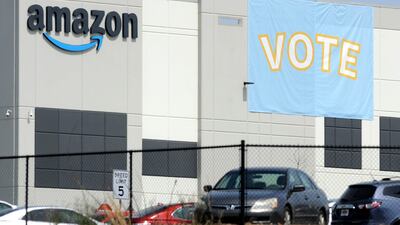
Amazon warehouse in Bessemer, Alabama. AP -

A message placed by Amazon is seen at a warehouse breakroom in Bessemer, Alabama. Reuters -
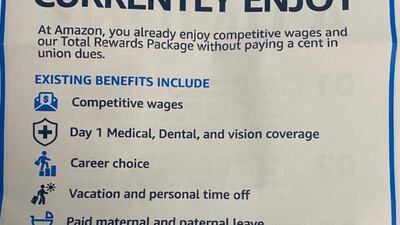
A pamphlet distributed by Amazon to workers in Bessemer, Alabama, before another potential union vote. Amazon Union/ Handout via Reuters -

In this file photo taken on March 26, 2021 people hold pro-union signs during a rally at the Amazon Spheres and headquarters in Seattle in solidarity with Amazon workers hoping to unionise in Bessemer, Alabama. AFP -
The Amazon fulfilment centre in Bessemer, Alabama. AFP -
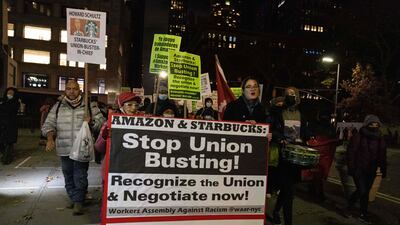
In this file photo taken on November 26, 2021, people march during a protest in support of Amazon and Starbucks workers in New York City. AFP -
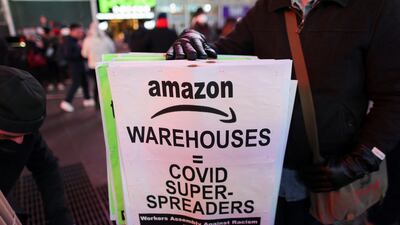
Staten Island Amazon workers protest in Times Square as they demand union rights in New York City. Reuters


Reuters contributed to this report

