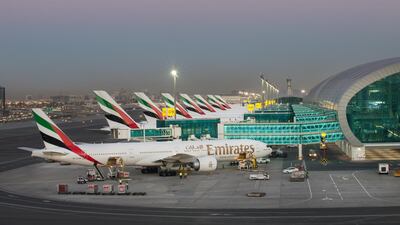
Dubai International Airport handled 13.6 million passengers in the first three months of 2022. Photo: Dubai Airports

Dubai International Airport raises 2022 passenger traffic forecast to 58.3 million


Deena Kamel
  • English
  • Arabic

Dubai International Airport has raised its annual passenger traffic forecast for 2022 to 58.3 million, from an earlier projection of 57 million.

The world’s busiest international airport recorded its busiest quarter since 2020 in the first three months of this year.

Passenger traffic more than doubled during the reporting period to 13.6 million travellers, from 5.7 million in the same quarter a year ago, state-owned operator Dubai Airports said on Thursday.

The recovery recorded over the past consecutive quarters was initially led by point-to-point traffic, which continues to exceed pre-coronavirus levels, said Paul Griffiths, chief executive of Dubai Airports.

However, the opening of borders in many key markets resulted in transfer traffic rebounding to 60 per cent of 2019 levels, he said.

The airport's performance is a “direct outcome of Dubai's clear strategy and efforts to restore international air connectivity and mobility, and lead the global aviation industry out of an unprecedented crisis”, Mr Griffiths said.

Dubai International Airport currently serves 193 destinations across 92 countries through 73 scheduled international airlines.

The emirate hosted about four million visitors in the first quarter of this year, a more than fourfold increase from the same period last year, Sheikh Hamdan bin Mohammed, Crown Prince of Dubai, said on Tuesday.

The emirate was also ranked first in the world in terms of hotel occupancy rates, with hospitality establishments 82 per cent full on average in the first three months of 2022, he said.

Flight movements at Dubai International Airport during the first quarter increased by 5.8 per cent a year to 81,966, the airport operator said.

India held its long-standing position as the airport’s top destination country, with passenger traffic reaching 1.6 million, followed by Saudi Arabia (1.1 million), Pakistan (997,000) and the UK (934,000).

The top three cities in terms of passenger numbers were London (617,000 passengers), Riyadh (517,000) and Jeddah (337,000).

The airport handled a total of 519,555 tonnes of cargo during the first three months of 2022, down from 550,811 tonnes in the same period a year ago.

Dubai International Airport through the years

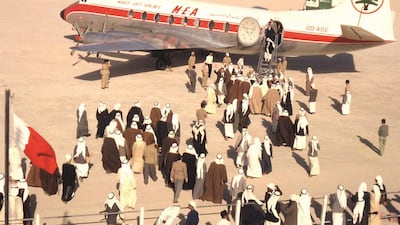
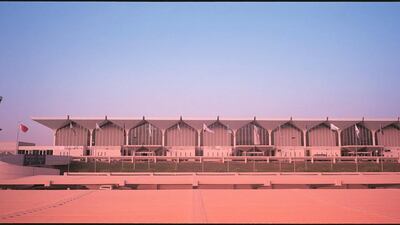
  • Dubai International Airport celebrated its 60th anniversary in 2020. Here passengers board a plane parked on a sand compacted runway in the 1960s. All photos: Dubai Airports
    Dubai International Airport celebrated its 60th anniversary in 2020. Here passengers board a plane parked on a sand compacted runway in the 1960s. All photos: Dubai Airports
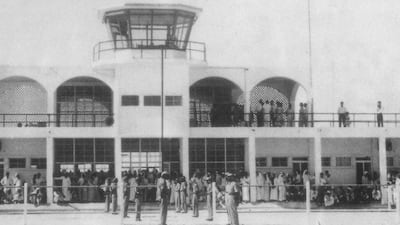
  • Dubai airport in the 1960s. By 1968 the airport was served by nine international airlines flying to 20 destinations
    Dubai airport in the 1960s. By 1968 the airport was served by nine international airlines flying to 20 destinations
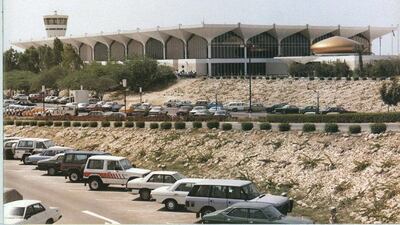
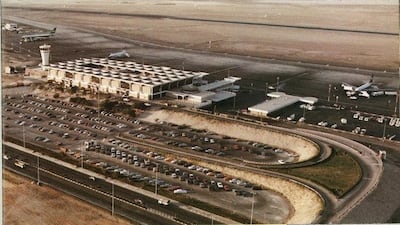
  • Developments in the 1970s included a new three-storey terminal building, control tower, additional taxiways and longer runways
    Developments in the 1970s included a new three-storey terminal building, control tower, additional taxiways and longer runways
  • The airport's second runway, equipped with the latest technology, was opened in 1984
    The airport's second runway, equipped with the latest technology, was opened in 1984
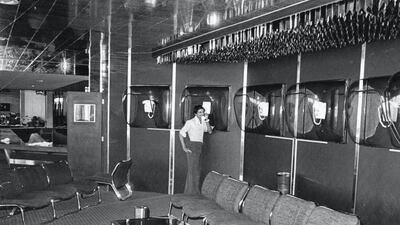
  • The transit lounge at Dubai International airport in the 1970s
    The transit lounge at Dubai International airport in the 1970s
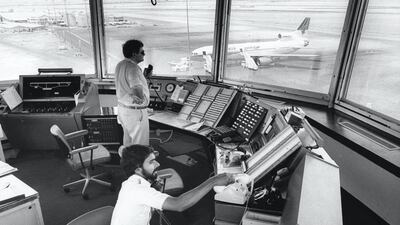
  • The air traffic control tower at Dubai International airport in the 1970s
    The air traffic control tower at Dubai International airport in the 1970s
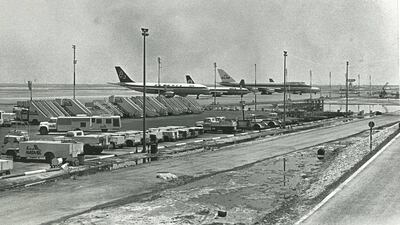
  • The airport in the 1970s
    The airport in the 1970s
  • Dubai Duty Free began operations in 1983 and had an annual turnover of $20 million in its first year
    Dubai Duty Free began operations in 1983 and had an annual turnover of $20 million in its first year
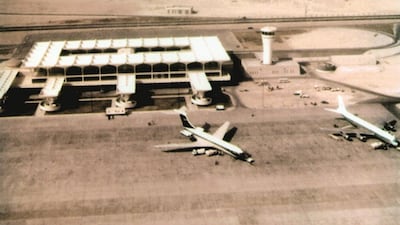
  • An aerial view of the airport in the 1970s
    An aerial view of the airport in the 1970s
  • Dubai International Airport has served more than a billion passengers travelling on almost 7.5 million flights since it opened in 1960
    Dubai International Airport has served more than a billion passengers travelling on almost 7.5 million flights since it opened in 1960
  • Terminal 3, the exclusive terminal for Emirates airline, was opened in 2008. It is the world’s largest single terminal
    Terminal 3, the exclusive terminal for Emirates airline, was opened in 2008. It is the world’s largest single terminal
  • In 2014, Dubai International welcomed 70.4 million passengers, becoming the world’s busiest airport in terms of international passenger traffic
    In 2014, Dubai International welcomed 70.4 million passengers, becoming the world’s busiest airport in terms of international passenger traffic
  • The airport welcomed its one billionth international passenger in 2018
    The airport welcomed its one billionth international passenger in 2018
  • It retained its title of the world’s busiest airport for international passengers for the sixth consecutive year in 2019, with 86.4 million passengers
    It retained its title of the world’s busiest airport for international passengers for the sixth consecutive year in 2019, with 86.4 million passengers
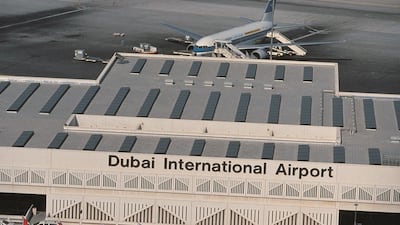
  • Dubai airport in the 1990s. It was the first to introduce e-gates in 2002. Now, millions of passengers use the smart gates, which require residents to scan their passport or Emirates ID to avoid long queues
    Dubai airport in the 1990s. It was the first to introduce e-gates in 2002. Now, millions of passengers use the smart gates, which require residents to scan their passport or Emirates ID to avoid long queues
Tamkeen's offering
  • Option 1: 70% in year 1, 50% in year 2, 30% in year 3
  • Option 2: 50% across three years
  • Option 3: 30% across five years 
Iftar programme at the Sheikh Mohammed Centre for Cultural Understanding

Established in 1998, the Sheikh Mohammed Centre for Cultural Understanding was created with a vision to teach residents about the traditions and customs of the UAE. Its motto is ‘open doors, open minds’. All year-round, visitors can sign up for a traditional Emirati breakfast, lunch or dinner meal, as well as a range of walking tours, including ones to sites such as the Jumeirah Mosque or Al Fahidi Historical Neighbourhood.

Every year during Ramadan, an iftar programme is rolled out. This allows guests to break their fast with the centre’s presenters, visit a nearby mosque and observe their guides while they pray. These events last for about two hours and are open to the public, or can be booked for a private event.

Until the end of Ramadan, the iftar events take place from 7pm until 9pm, from Saturday to Thursday. Advanced booking is required.

For more details, email openminds@cultures.ae or visit www.cultures.ae


High profile Al Shabab attacks
  • 2010: A restaurant attack in Kampala Uganda kills 74 people watching a Fifa World Cup final football match.
  • 2013: The Westgate shopping mall attack, 62 civilians, five Kenyan soldiers and four gunmen are killed.
  • 2014: A series of bombings and shootings across Kenya sees scores of civilians killed.
  • 2015: Four gunmen attack Garissa University College in northeastern Kenya and take over 700 students hostage, killing those who identified as Christian; 148 die and 79 more are injured.
  • 2016: An attack on a Kenyan military base in El Adde Somalia kills 180 soldiers.
  • 2017: A suicide truck bombing outside the Safari Hotel in Mogadishu kills 587 people and destroys several city blocks, making it the deadliest attack by the group and the worst in Somalia’s history.

Mercer, the investment consulting arm of US services company Marsh & McLennan, expects its wealth division to at least double its assets under management (AUM) in the Middle East as wealth in the region continues to grow despite economic headwinds, a company official said.

Mercer Wealth, which globally has $160 billion in AUM, plans to boost its AUM in the region to $2-$3bn in the next 2-3 years from the present $1bn, said Yasir AbuShaban, a Dubai-based principal with Mercer Wealth.

Within the next two to three years, we are looking at reaching $2 to $3 billion as a conservative estimate and we do see an opportunity to do so,” said Mr AbuShaban.

Mercer does not directly make investments, but allocates clients’ money they have discretion to, to professional asset managers. They also provide advice to clients.

“We have buying power. We can negotiate on their (client’s) behalf with asset managers to provide them lower fees than they otherwise would have to get on their own,” he added.

Mercer Wealth’s clients include sovereign wealth funds, family offices, and insurance companies among others.

From its office in Dubai, Mercer also looks after Africa, India and Turkey, where they also see opportunity for growth.

Wealth creation in Middle East and Africa (MEA) grew 8.5 per cent to $8.1 trillion last year from $7.5tn in 2015, higher than last year’s global average of 6 per cent and the second-highest growth in a region after Asia-Pacific which grew 9.9 per cent, according to consultancy Boston Consulting Group (BCG). In the region, where wealth grew just 1.9 per cent in 2015 compared with 2014, a pickup in oil prices has helped in wealth generation.

BCG is forecasting MEA wealth will rise to $12tn by 2021, growing at an annual average of 8 per cent.

Drivers of wealth generation in the region will be split evenly between new wealth creation and growth of performance of existing assets, according to BCG.

Another general trend in the region is clients’ looking for a comprehensive approach to investing, according to Mr AbuShaban.

“Institutional investors or some of the families are seeing a slowdown in the available capital they have to invest and in that sense they are looking at optimizing the way they manage their portfolios and making sure they are not investing haphazardly and different parts of their investment are working together,” said Mr AbuShaban.

Some clients also have a higher appetite for risk, given the low interest-rate environment that does not provide enough yield for some institutional investors. These clients are keen to invest in illiquid assets, such as private equity and infrastructure.

“What we have seen is a desire for higher returns in what has been a low-return environment specifically in various fixed income or bonds,” he said.

“In this environment, we have seen a de facto increase in the risk that clients are taking in things like illiquid investments, private equity investments, infrastructure and private debt, those kind of investments were higher illiquidity results in incrementally higher returns.”

The Abu Dhabi Investment Authority, one of the largest sovereign wealth funds, said in its 2016 report that has gradually increased its exposure in direct private equity and private credit transactions, mainly in Asian markets and especially in China and India. The authority’s private equity department focused on structured equities owing to “their defensive characteristics.”

((Disclaimer))

The Liechtensteinische Landesbank AG (“Bank”) assumes no liability or guarantee for the accuracy, balance, or completeness of the information in this publication. The content may change at any time due to given circumstances, and the Liechtensteinische Landesbank AG is under no obligation to update information once it has been published. This publication is intended for information purposes only and does not constitute an offer, a recommendation or an invitation by, or on behalf of, Liechtensteinische Landesbank (DIFC Branch), Liechtensteinische Landesbank AG, or any of its group affiliates to make any investments or obtain services. This publication has not been reviewed, disapproved or approved by the United Arab Emirates (“UAE”) Central Bank, Dubai Financial Services Authority (“DFSA”) or any other relevant licensing authorities in the UAE. It may not be relied upon by or distributed to retail clients. Liechtensteinische Landesbank (DIFC Branch) is regulated by the DFSA and this advertorial is intended for Professional Clients (as defined by the DFSA) who have sufficient financial experience and understanding of financial markets, products or transactions and any associated risks.

Sweet%20Tooth
%3Cp%3E%3Cstrong%3ECreator%3A%20%3C%2Fstrong%3EJim%20Mickle%3Cbr%3E%3Cstrong%3EStarring%3A%20%3C%2Fstrong%3EChristian%20Convery%2C%20Nonso%20Anozie%2C%20Adeel%20Akhtar%2C%20Stefania%20LaVie%20Owen%3Cbr%3E%3Cstrong%3ERating%3A%20%3C%2Fstrong%3E2.5%2F5%3C%2Fp%3E%0A
How to wear a kandura

Dos

  • Wear the right fabric for the right season and occasion 
  • Always ask for the dress code if you don’t know
  • Wear a white kandura, white ghutra / shemagh (headwear) and black shoes for work 
  • Wear 100 per cent cotton under the kandura as most fabrics are polyester

Don’ts 

  • Wear hamdania for work, always wear a ghutra and agal 
  • Buy a kandura only based on how it feels; ask questions about the fabric and understand what you are buying
The details

Heard It in a Past Life

Maggie Rogers

(Capital Records)

3/5

If you go


  • The nearest international airport to the start of the Chuysky Trakt is in Novosibirsk. Emirates (www.emirates.com) offer codeshare flights with S7 Airlines (www.s7.ru) via Moscow for US$5,300 (Dh19,467) return including taxes. Cheaper flights are available on Flydubai and Air Astana or Aeroflot combination, flying via Astana in Kazakhstan or Moscow. Economy class tickets are available for US$650 (Dh2,400).
  • The Double Tree by Hilton in Novosibirsk ( 7 383 2230100,) has double rooms from US$60 (Dh220). You can rent cabins at camp grounds or rooms in guesthouses in the towns for around US$25 (Dh90).
  • The transport Minibuses run along the Chuysky Trakt but if you want to stop for sightseeing, hire a taxi from Gorno-Altaisk for about US$100 (Dh360) a day. Take a Russian phrasebook or download a translation app. Tour companies such as  Altair-Tour ( 7 383 2125115 ) offer hiking and adventure packages.
The specs

Engine: 2.9-litre, V6 twin-turbo

Transmission: seven-speed PDK dual clutch automatic

Power: 375bhp

Torque: 520Nm

Price: Dh332,800

On sale: now

Coffee: black death or elixir of life?

It is among the greatest health debates of our time; splashed across newspapers with contradicting headlines - is coffee good for you or not?

Depending on what you read, it is either a cancer-causing, sleep-depriving, stomach ulcer-inducing black death or the secret to long life, cutting the chance of stroke, diabetes and cancer.

The latest research - a study of 8,412 people across the UK who each underwent an MRI heart scan - is intended to put to bed (caffeine allowing) conflicting reports of the pros and cons of consumption.

The study, funded by the British Heart Foundation, contradicted previous findings that it stiffens arteries, putting pressure on the heart and increasing the likelihood of a heart attack or stroke, leading to warnings to cut down.

Numerous studies have recognised the benefits of coffee in cutting oral and esophageal cancer, the risk of a stroke and cirrhosis of the liver. 

The benefits are often linked to biologically active compounds including caffeine, flavonoids, lignans, and other polyphenols, which benefit the body. These and othetr coffee compounds regulate genes involved in DNA repair, have anti-inflammatory properties and are associated with lower risk of insulin resistance, which is linked to type-2 diabetes.

But as doctors warn, too much of anything is inadvisable. The British Heart Foundation found the heaviest coffee drinkers in the study were most likely to be men who smoked and drank alcohol regularly.

Excessive amounts of coffee also unsettle the stomach causing or contributing to stomach ulcers. It also stains the teeth over time, hampers absorption of minerals and vitamins like zinc and iron.

It also raises blood pressure, which is largely problematic for people with existing conditions.

So the heaviest drinkers of the black stuff - some in the study had up to 25 cups per day - may want to rein it in.

Rory Reynolds

ABU%20DHABI'S%20KEY%20TOURISM%20GOALS%3A%20BY%20THE%20NUMBERS
%3Cp%3EBy%202030%2C%20Abu%20Dhabi%20aims%20to%20achieve%3A%3C%2Fp%3E%0A%3Cp%3E%3Cstrong%3E%E2%80%A2%2039.3%20million%20visitors%2C%3C%2Fstrong%3E%20nearly%2064%25%20up%20from%202023%3C%2Fp%3E%0A%3Cp%3E%3Cstrong%3E%E2%80%A2%20Dh90%20billion%20contribution%20to%20GDP%2C%3C%2Fstrong%3E%20about%2084%25%20more%20than%20Dh49%20billion%20in%202023%3C%2Fp%3E%0A%3Cp%3E%3Cstrong%3E%E2%80%A2%20178%2C000%20new%20jobs%2C%3C%2Fstrong%3E%20bringing%20the%20total%20to%20about%20366%2C000%3C%2Fp%3E%0A%3Cp%3E%3Cstrong%3E%E2%80%A2%2052%2C000%20hotel%20rooms%2C%3C%2Fstrong%3E%20up%2053%25%20from%2034%2C000%20in%202023%3C%2Fp%3E%0A%3Cp%3E%3Cstrong%3E%E2%80%A2%207.2%20million%20international%20visitors%2C%3C%2Fstrong%3E%20almost%2090%25%20higher%20compared%20to%202023's%203.8%20million%3C%2Fp%3E%0A%3Cp%3E%3Cstrong%3E%E2%80%A2%203.9%20international%20overnight%20hotel%20stays%2C%3C%2Fstrong%3E%2022%25%20more%20from%203.2%20nights%20in%202023%3C%2Fp%3E%0A
Ten tax points to be aware of in 2026

1. Domestic VAT refund amendments: request your refund within five years

If a business does not apply for the refund on time, they lose their credit.

2. E-invoicing in the UAE

Businesses should continue preparing for the implementation of e-invoicing in the UAE, with 2026 a preparation and transition period ahead of phased mandatory adoption. 

3. More tax audits

Tax authorities are increasingly using data already available across multiple filings to identify audit risks. 

4. More beneficial VAT and excise tax penalty regime

Tax disputes are expected to become more frequent and more structured, with clearer administrative objection and appeal processes. The UAE has adopted a new penalty regime for VAT and excise disputes, which now mirrors the penalty regime for corporate tax.

5. Greater emphasis on statutory audit

There is a greater need for the accuracy of financial statements. The International Financial Reporting Standards standards need to be strictly adhered to and, as a result, the quality of the audits will need to increase.

6. Further transfer pricing enforcement

Transfer pricing enforcement, which refers to the practice of establishing prices for internal transactions between related entities, is expected to broaden in scope. The UAE will shortly open the possibility to negotiate advance pricing agreements, or essentially rulings for transfer pricing purposes. 

7. Limited time periods for audits

Recent amendments also introduce a default five-year limitation period for tax audits and assessments, subject to specific statutory exceptions. While the standard audit and assessment period is five years, this may be extended to up to 15 years in cases involving fraud or tax evasion. 

8. Pillar 2 implementation 

Many multinational groups will begin to feel the practical effect of the Domestic Minimum Top-Up Tax (DMTT), the UAE's implementation of the OECD’s global minimum tax under Pillar 2. While the rules apply for financial years starting on or after January 1, 2025, it is 2026 that marks the transition to an operational phase.

9. Reduced compliance obligations for imported goods and services

Businesses that apply the reverse-charge mechanism for VAT purposes in the UAE may benefit from reduced compliance obligations. 

10. Substance and CbC reporting focus

Tax authorities are expected to continue strengthening the enforcement of economic substance and Country-by-Country (CbC) reporting frameworks. In the UAE, these regimes are increasingly being used as risk-assessment tools, providing tax authorities with a comprehensive view of multinational groups’ global footprints and enabling them to assess whether profits are aligned with real economic activity. 

Contributed by Thomas Vanhee and Hend Rashwan, Aurifer

Updated: May 17, 2023, 3:41 PM