

The last time Russia invaded Ukraine, in 2014, world leaders removed it from the Group of Eight industrialised nations, which was rebranded as the Group of Seven.
Eight years later, the G7 is holding at seven — a collection of countries that meet to talk through big issues such as trade, economics and security.
This past week, as leaders gathered in Washington for spring meetings involving the International Monetary Fund, World Bank, G7 and the Group of 20, it became apparent that despite Russia's assault on Ukraine, its membership in the G20 is intact.
While Russia has been ostracised by western states, it remains part of the G20 and associated organisations unless members decide that it should go. That appears less likely, as several countries, including China, Brazil and South Africa, have made plain that they will support Russia's membership in the G20, which represents industrial and emerging-market countries.
Why would Russia stay when its presence in the group is unwelcome?
It has much to gain from sowing discord between countries in the forums. A glimpse of this was seen in the past week when Russia blocked the IMF’s advisory committee from issuing a communique condemning its invasion of Ukraine.
Faced with the questions over what to do about Russia’s membership, finance leaders squirmed, dodged, walked out in protest or stayed put.
IMF managing director Kristalina Georgieva, when asked about the prospect of removing Russia from the G20, avoided calling for such a move.
“There are clearly very, very unsettling facts we have to deal with,’’ she said of Russia's aggression. Then she called for focus on the “need for co-operation” to solve world problems.
“Make a list of questions that no country can solve on its own,” she said, “and it’s obvious that co-operation must continue.’’
Nadia Calvino, Spain’s Economy Minister and chairwoman of the IMF advisory committee, said the meeting had “obviously not been business as usual".
spokesman for South Africa's Department of International Relations and Cooperation
“Russia’s war against Ukraine has made it impossible to come to a consensus on a communique,” she said. The committee “has traditionally worked on the basis of consensus, so when one member breaks away, we cannot reach the agreement that the overwhelming majority of us would have wanted,” she added.
The World Bank said it stopped all of its programmes in Russia and allied Belarus after the invasion in February and has not approved any new investments in Russia since 2014 or in Belarus since the middle of 2020.
The IMF said it has not lent money to Russia in decades and does not support programmes there.
The dispute at the IMF meeting highlighted the problems that government leaders are expected to face in Indonesia in November, when G20 leaders are scheduled to gather in Bali.
US President Joe Biden has called for Russia to be removed from the group, but the US has not said whether Mr Biden would boycott the gathering if Russia participates.
The G20 members are Argentina, Australia, Brazil, Britain, Canada, China, France, Germany, India, Indonesia, Italy, Japan, Mexico, Russia, Saudi Arabia, South Africa, South Korea, Turkey, the US and the EU. Spain is invited as a permanent guest.
The US and Canada have been the biggest critics of Russia's membership.
US Treasury Secretary Janet Yellen and Canadian Finance Minister Chrystia Freeland were among a number of officials who walked out of a G20 meeting on Wednesday when Russia’s representative began talking.
Ms Freeland took to Twitter to explain why.
“This week’s meetings in Washington are about supporting the world economy — and Russia’s illegal invasion of Ukraine is a grave threat to the global economy. Russia should not be participating or included in these meetings,” she said.
But several countries, including China, Brazil and South Africa, have been vocal about rejecting measures to remove Russia. They said that engagement is more important than isolation in troubled times.
“To expel Russia would only isolate it and make it more difficult to achieve constructive engagement,” said Clayson Monyela, a spokesman for South Africa's Department of International Relations and Co-operation. “South Africa believes it is more useful to keep Russia in and to engage with it to find the lasting peace that we are all yearning for.”
-
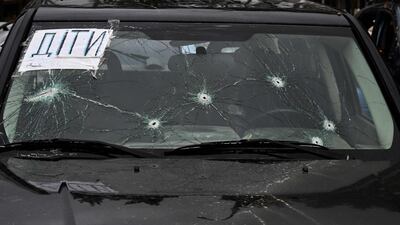
A sign that reads 'Children' is fixed on to a car windscreen riddled with bulletholes in Irpin, Ukraine. AFP -
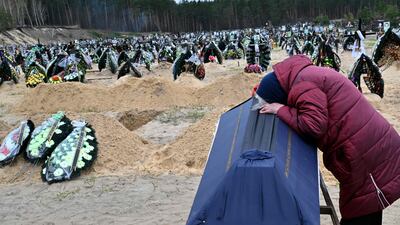
A woman weeps next to her husband's coffin at a cemetery in Irpin. AFP -
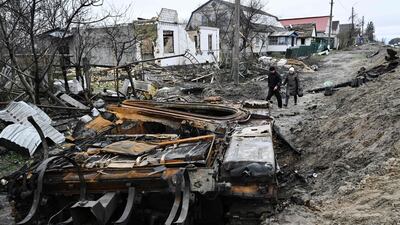
Residents walk amid debris of a charred Russian tank next to destroyed houses in the village of Zalissya. AFP -
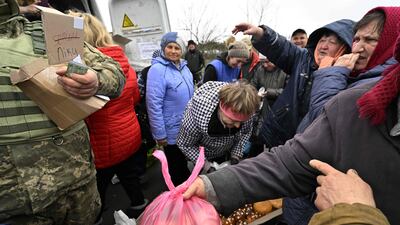
Volunteers distribute food to residents in Zalissya. AFP -
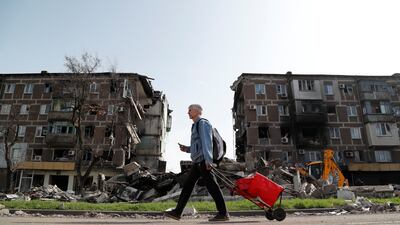
A man walks past a damaged apartment building in the southern port city of Mariupol. Reuters -
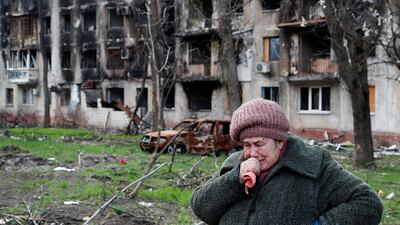
Tamara, 71, cries in front of a destroyed apartment building in Mariupol. Reuters -
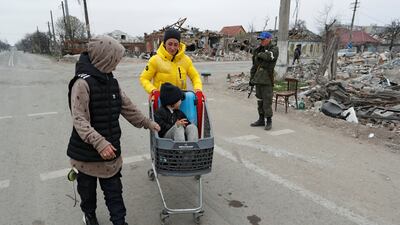
Local residents push a cart with a child past destroyed buildings in Mariupol. Reuters -
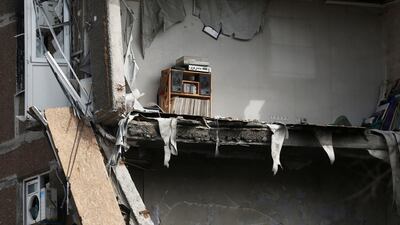
A record player sits among debris inside an apartment in Mariupol. Reuters -
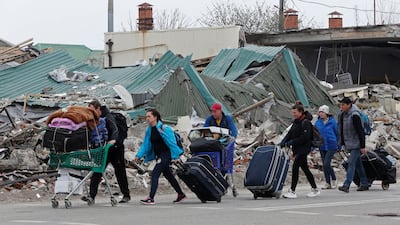
Residents carry belongings past a destroyed building in Mariupol. Reuters -
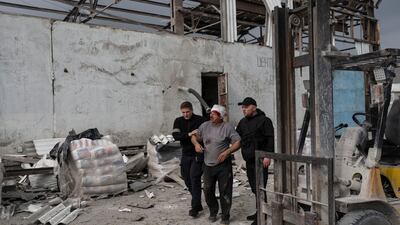
Security guards help an injured man following a Russian bombing of a factory in Kramatorsk. AP -

A man receives first aid treatment. AP -

Soldiers collect explosives after recent battles in the village of Moshchun, close to Kyiv. AP -
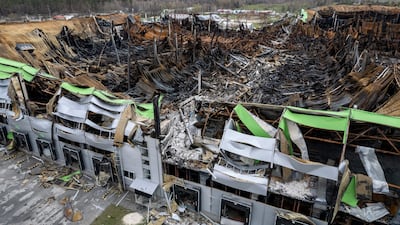
The Komodor logistics park lies in ruins after being bombed and burnt during the Russian invasion near Makarov. Getty Images -
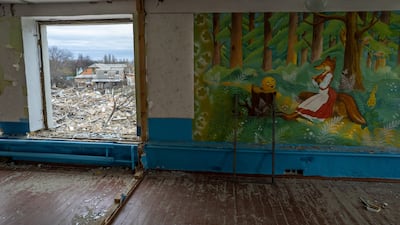
A room in a kindergarten stands windowless in Makarov. Getty Images -
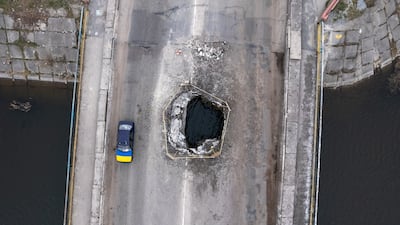
A vehicle draped with a Ukrainian flag passes over a war-damaged bridge in Makarov. Getty Images -
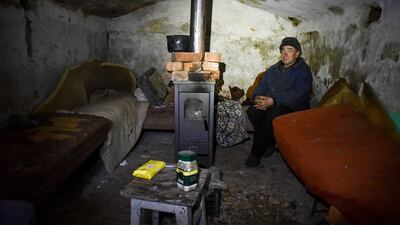
A man sits in a basement that was used as a bomb shelter in the village of Kukhari. EPA -
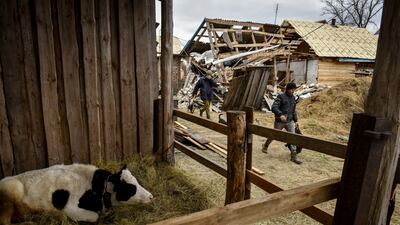
Local residents clean the area around a destroyed farm in Kukhari. EPA -
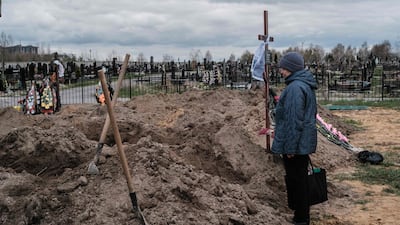
Nadia looks at her husband's coffin at a cemetery in Bucha. He was killed during the war. AFP -
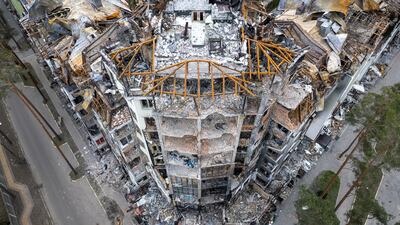
Mangled buildings in Irpin point to the ravages of the ongoing war. Getty Images -
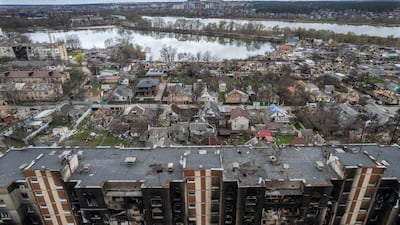
A burnt apartment tower in Irpin. Getty Images -
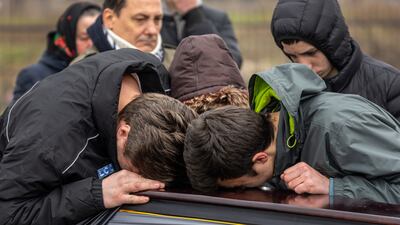
Family members grieve during the funeral of Ruslan Nechyporenko, 47, in Bucha. Getty Images -

An abandoned Russian military position in Borodyanka town near Kyiv. EPA -

Heavily pregnant Dr Marta Kopan, who fled Kyiv with her husband Dr Maxim Motsya and their three-year-old son Makar, narrates their ordeal at a relative's place in Lviv. AP -

A Ukrainian officer searches for unexploded explosives as he passes by an Antonov An-225, the world's biggest cargo aircraft, destroyed during the war on the outskirts of Kyiv. AP -

A woman stands amid the destruction caused when a civilian building was hit by a Russian missile in Lviv, western Ukraine. Getty Images -
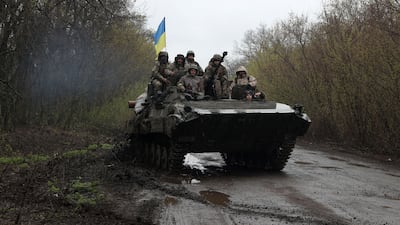
Ukrainian soldiers on an armoured personnel carrier, near the front line with Russian troops, in Izyum district, Kharkiv region, north-eastern Ukraine. AFP -
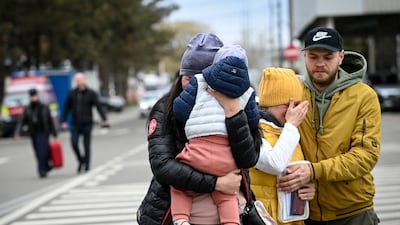
Ukrainian refugees arrive at the Siret border crossing between Romania and Ukraine. AFP -

Ukranian soldiers in a trench look out across the front line near Kharkiv. AFP -
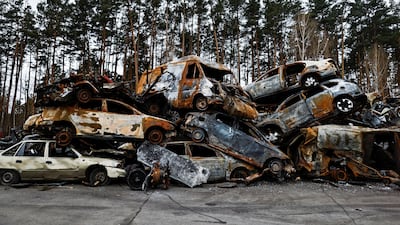
Cars destroyed in Russian attacks, in Irpin, near Kyiv. The scene of fierce fighting, the town was occupied by Russian forces. Reuters -
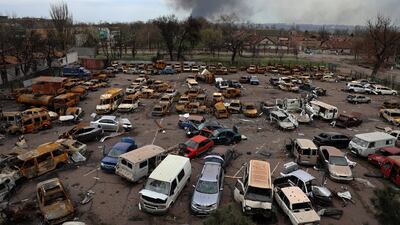
Damaged and destroyed vehicles at Illich Iron and Steel Works Metallurgical Plant, in an area controlled by Russian-backed separatists in besieged south-eastern city Mariupol. AP -
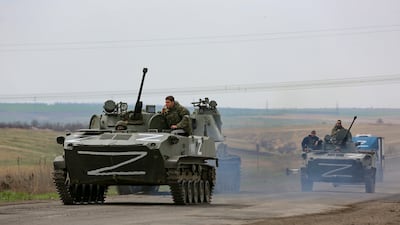
Russian military vehicles in an area controlled by Moscow-backed separatists near Mariupol. AP -
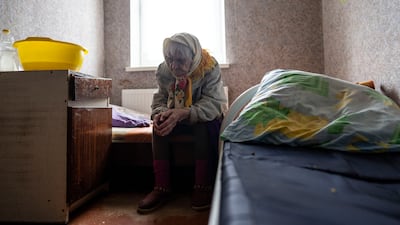
An elderly woman waits do be evacuated from a hospice in Chasiv Yar city, in Donetsk, eastern Ukraine. At least 35 residents have been helped to flee from the region that has been under attack for weeks. AP -
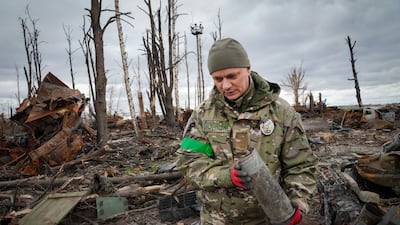
A Ukrainian Interior Ministry serviceman collects unexploded shells, grenades and mines, following fierce fighting in Hostomel. AP


South African President Cyril Ramaphosa blamed Nato for the war in Ukraine.
Brazilian Foreign Minister Carlos Franca told a news conference in Brasilia that excluding Russia “doesn’t help us find a solution to the immediate problem that we have”, which is the need to cease hostilities and have Russia and Ukraine negotiate a lasting peace.
Stewart Patrick, director of the international institutions and global governance programme at the Council on Foreign Relations in Washington, said boycotting the G20 would be a mistake on the part of the US.
Rather, he said, “the US should take every opportunity to hammer the Russians and others should take every opportunity to hammer the Russians,” during the meetings.
“Boycotting is not sustainable,” he said. “There should be efforts to try to shame Russia. It would be a mistake for the US to take its ball and go elsewhere because we would leave a hole in the G20 to be controlled by China.”
Chinese Foreign Ministry spokesman Wang Wenbin last month said Russia remains an “important member” of the G20 and no member has the right to expel another.
The G20 should “practice genuine multilateralism, strengthen solidarity and co-operation, and work together to address outstanding challenges in the areas of economics, finance and sustainable development”, Mr Wang said.
Adam Lipsky, senior director of the Atlantic Council’s GeoEconomics Centre, said Russia has the most to gain from the discord that comes from the US calling for its removal.
“By showing up they're potentially derailing the whole G20,” he said of the Russians. “That’s giving them more control than they should have. If the US boycotts, then the G20 falls apart and that’s to Russia’s benefit.”

