


Live updates: follow the latest news on Russia-Ukraine
Markets tumbled and oil prices soared to above $100 a barrel for the first time since 2014 on Thursday after Russian President Vladimir Putin decided to conduct a special military operation in the Donbas region of Ukraine.
Mr Putin said Russia does not plan to occupy Ukraine and urged Ukrainian forces to stand down and return home, Russian state agency Tass said on Thursday. He said Russia would not let Ukraine secure nuclear arms, the agency reported.
Russia said separatist leaders in the Donetsk and Luhansk enclaves of eastern Ukraine had appealed to Moscow for help in fighting Ukrainian forces.
Brent surged 8.78 per cent to $105.34 at 2.26pm UAE time while West Texas Intermediate, the gauge that tracks US crude, rose 8.72 per cent to $100.13 a barrel.
The turn of events sparked a sell-off across markets, sending stocks across Asia lower on Thursday morning.
Equities across major markets and US futures also declined while Treasuries and the dollar gained. European natural gas futures increased 10 per cent.
Gold, a hedge against inflationary pressures and a safe haven for investors, rallied 3.25 per cent to $1,970.90 an ounce at 3.34pm UAE time on Thursday, its highest since January of last year, following the military escalation. Bullion receded to $1,944.79 by 6.39pm.
Hong Kong's Hang Seng index ended trading more than 3 per cent lower while Singapore's Straits Times Index and Japan's Nikkei 225 closed 3.5 per cent and 2 per cent lower, respectively.
China's SSE Composite Index ended the day 2 per cent lower.
The S&P 500 was 2 per cent lower on Wednesday, the Nasdaq Composite eased about 2.6 per cent while the Dow Jones Industrial Average fell by about 1.4 per cent.
European markets “stand to fare worst out of this situation”, said Jeffrey Halley, a senior market analyst at Oanda.
The FTSE 100 in London fell 3.1 per cent, the DAX in Frankfurt dropped 4.8 per cent and the CAC in Paris lost 4.5 per cent.
The euro came under pressure against the US dollar, falling to $1.114 by 6.28pm UAE time.
Russia' benchmark MOEX Index briefly suspended trading on Thursday morning but plunged more than 45 per cent at 12.35pm UAE time. It pared some of losses and was 36 per cent lower at 6.38pm. The rouble slumped 9 per cent to a record low of 90 against the dollar, prompting the Russian central bank to announce it will intervene to stabilise the financial market.
-
Firefighters arrive at a military building in Kiev that was damaged in an explosion. EPA -

A man looks at the debris of an unidentified object in the aftermath of an explosion in Kiev. EPA -
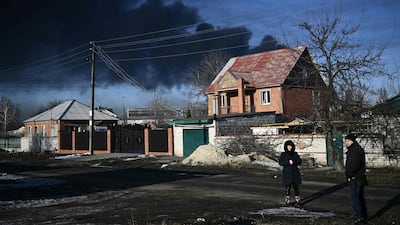
Black smoke rises from a military airport in Chuguyev near Kharkiv. AFP -

People take shelter in a Kiev subway station, after Russian President Vladimir Putin authorised a military operation in eastern Ukraine. Reuters -
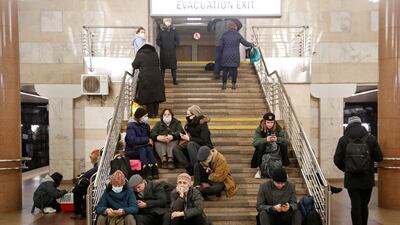
A Kiev underground train station provides some shelter. Reuters -

Clear airspace over Ukraine, shortly after the attack began, as shown on the Flightradar24 website. AP -

Kiev residents leave the city following pre-offensive missile strikes by the Russian armed forces and Belarus. Getty -
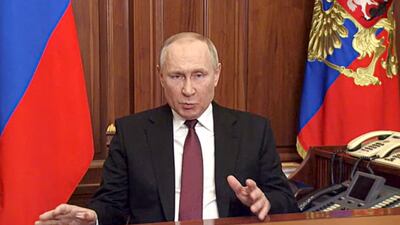
Russian President Vladimir Putin justified the attack in a televised address, saying it was to protect civilians in eastern Ukraine. AP -
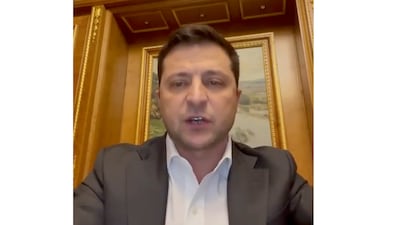
Ukrainian President Volodymyr Zelenskyy addresses the nation in Kiev. He has declared martial law, saying Russia has targeted Ukraine's military infrastructure. AP -
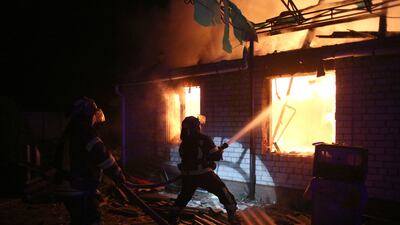
Firefighters extinguish a blaze at a house in Muratovo, in Ukraine's Luhansk enclave. AFP -

The house is said to have been hit during shelling by Russian-backed separatists. AFP -

The coffin of Capt Anton Sidorov is carried by members of the honour guard during a ceremony held at the Ministry of Defence in Kiev, Ukraine. Getty -
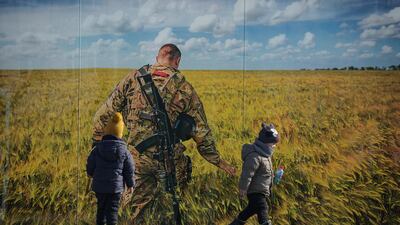
A picture memorial for those killed in the confrontation between Ukraine's military and pro-Russia separatist forces, in the Luhansk region in eastern Ukraine. AP -

UN Secretary General Antonio Guterres and Russia's Ambassador to the UN, Vassily Nebenzia, attend a Security Council meeting in New York to discuss the crisis in Ukraine. Reuters -
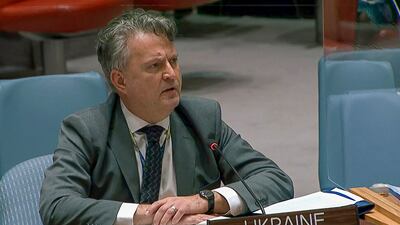
Ukraine's UN ambassador Sergey Kyslytsya speaks during an emergency meeting of the Security Council. AP -
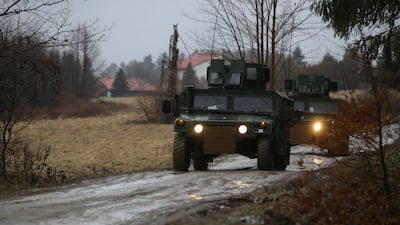
US Army soldiers from the 82nd Airborne Division head towards an air base near Arlamow, Poland. Reuters -

An employee works at the gun counter of a tactical equipment shop in Kiev, Ukraine. Getty -
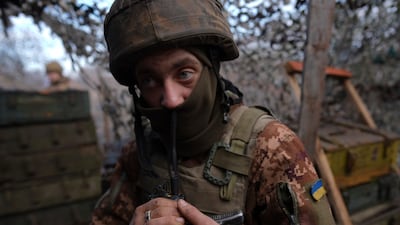
A Ukrainian soldier speaks on a walkie-talkie at his position at the line of separation between Ukraine-held territory and rebel-held territory near Svitlodarsk, eastern Ukraine. AP -
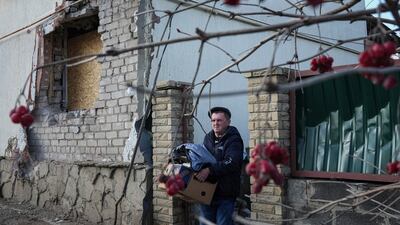
A man removes his belongings from his house after it was struck by artillery shells in Novoluhanske, eastern Ukraine. AP -
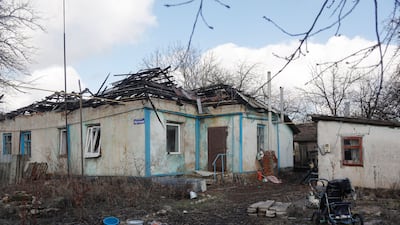
A damaged house in Vibrovka village. EPA -
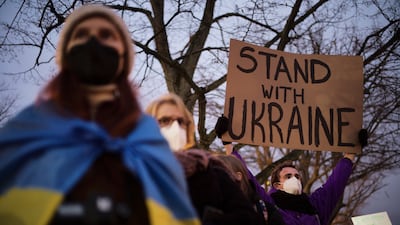
A man shows a poster in support of Ukraine as he protests against the escalation of the tension between Russia and Ukraine, in Berlin. AP -

Soldiers carry the coffin of Capt Anton Sydorov, 35, after he was killed in eastern Ukraine. AP -
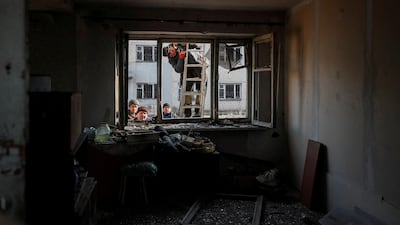
Workers look into a destroyed house after shelling near the city of Novoluhanske in Donetsk. Reuters -

Destroyed buildings in Krasnogorivka, Ukraine. AFP -
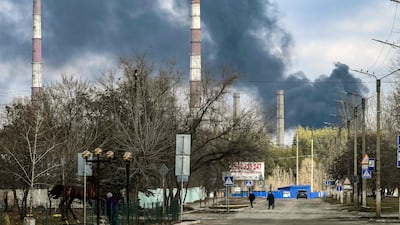
Smoke rises from a power plant after shelling outside the town of Schastia, a day after Moscow recognised two Ukrainian separatist republics and ordered the Russian Army to send in troops as ‘peacekeepers’. AFP -
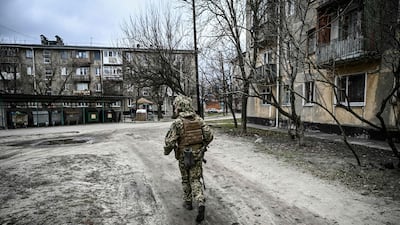
A Ukrainian Army soldier trudges through the wintry streets of Schastia on patrol. AFP -
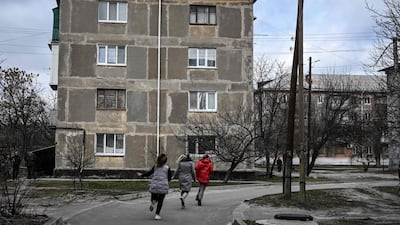
Three women run for cover during shelling in Schastia, eastern Ukraine. AFP -
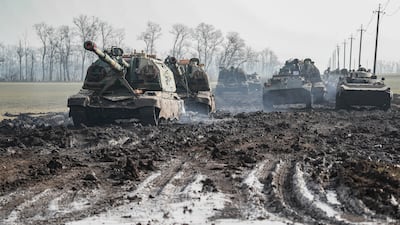
Russian tanks and armoured vehicles on the road in Rostov. EPA -
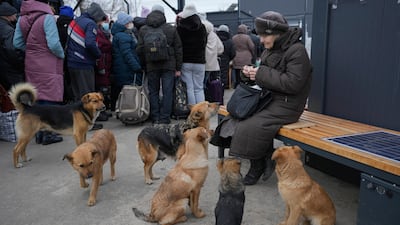
A woman shares food with dogs in Stanytsia Luhanska, a crossing point between Ukrainian government-controlled areas and pro-Russian separatists' territory. AP -
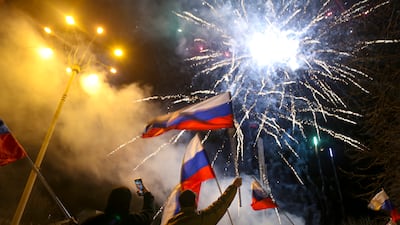
People wave Russian flags in Donetsk, the territory controlled by pro-Russian militants, in eastern Ukraine. AP -
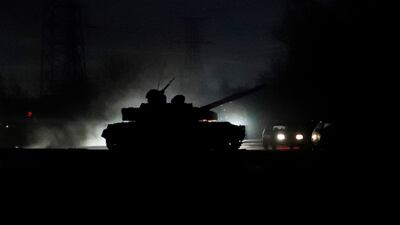
A tank drives along a street in the city of Donetsk. Reuters -
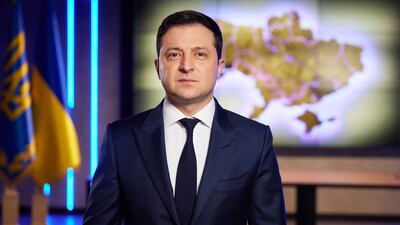
Ukrainian President Volodymyr Zelenskyy addresses the nation on TV and says 'we are not afraid' after Russian President Vladimir Putin ordered troops into Donetsk and Luhansk, two Moscow-backed rebel regions of Ukraine. AFP -
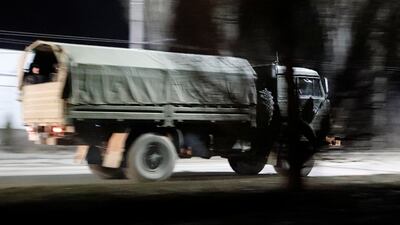
A military truck in Donetsk after Mr Putin ordered the deployment of Russian troops to the city. Reuters -
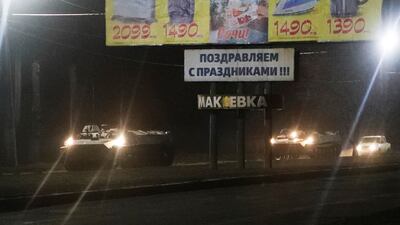
Russian state television showed Mr Putin signing a decree recognising the independence of the two Ukrainian breakaway regions. Reuters -
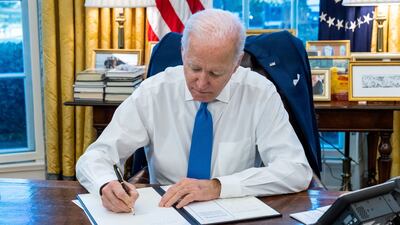
US President Joe Biden signs an executive order at the White House to prohibit trade and investment between US individuals and the two breakaway regions of eastern Ukraine. Reuters -
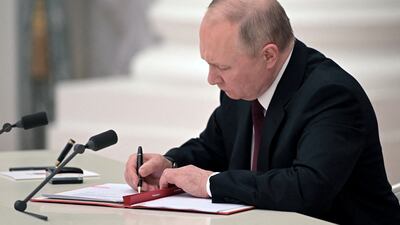
Mr Putin signs documents, including the decree recognising two Russian-backed breakaway regions in eastern Ukraine. Reuters -
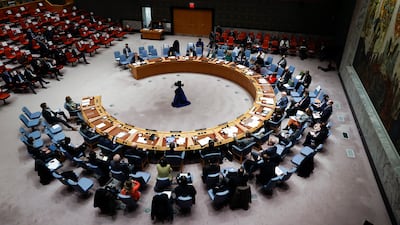
Ukraine ambassador to the United Nations, Sergiy Kyslytsya, addresses an emergency meeting of the UN Security Council on the situation between Ukraine and Russia in New York. EPA


US President Joe Biden called Mr Putin's move into Ukraine an “unprovoked and unjustified attack”, and vowed to hold Russia accountable.
Earlier this week, the US and its Nato allies imposed sanctions on Russia but stopped short of sanctioning its energy industry. Germany and the UK imposed sanctions on Russia, including the suspension of the opening of the Nord Stream 2 gas pipeline.
The sanctions, which were described as part of a first tranche of measures against Moscow, were not as strong as some analysts had expected.
“If the Ukraine situation forces central banks to halt policy normalisation efforts, a stagflationary shock to the world is on the way,” Mr Halley said.
“That won’t be good for equities, high yield credit, emerging market currencies, anything European or risk sentiment currencies such as the New Zealand dollar.”

Russia is Europe's largest gas supplier. While complete suspension of Russian gas imports is unlikely, the escalation of tension is expected lead to a further increase in wholesale gas prices, which have already increased steeply in recent months, according to Moody's Investors Service.
“Energy suppliers would be most at risk from higher gas and electricity prices, unless they are hedged or can quickly pass on higher procurement costs to consumers,” said Knut Slatten, a vice president and senior credit officer at Moody's.
European governments have stepped in over the past few months to cushion the impact of rising gas and electricity prices on customers, with generally limited impact on utilities.
However, “prolonged higher energy prices could raise the risk of government intervention that could hurt the credit profile of European utilities”, Moody's said.
Despite fears that Europe may face a gas crunch following the cancellation of Nord Stream 2, global energy consultancy Wood Mackenzie, said the continent is currently in a better situation than it was at the start of the 2021-2022 winter season.
“Mild weather and increased liquefied natural gas supplies have softened the impact of continuously low Russian flows and resulted in higher volumes of gas in storage,” said Kateryna Filippenko, a principal analyst for Europe gas research at the consultancy.
“From record lows at the start of winter, storage levels have now re-entered their five-year range, albeit on the lower side, and are on track to be in a more comfortable position by the end of March.”
There was more LNG in Europe’s gas system than Russian gas in January and February, according to Wood Mackenzie.
High prices are expected to remain throughout 2022 and this will encourage Norway to continue strong exports to Europe, as well as attract more LNG cargoes to the continent, Ms Filippenko said.
High dam levels in Brazil, which mean a greater potential for electricity generation, will free up additional LNG cargoes for Europe.
“This will reduce the requirement of Russian gas through 2022. Even relatively low flows at current contractual levels — with Poland and Ukraine transit routes running below full capacity — will result in a comfortable storage position ahead of the next winter,” she said.
“Overall, the current supply and storage situation means Europe is in a better position both to navigate 2022 without Nord Stream 2 and to prepare for the next winter.”
On Tuesday, the International Energy Agency said it was monitoring, with “growing concern”, Russia's recent statements and actions, and their potential implications for energy markets.
The agency is consulting with member countries and key partners on “appropriate measures to ensure energy security".
“IEA member countries stand ready to act collectively to ensure that global oil markets are adequately supplied,” the Paris-based agency said in a statement on Wednesday.
Total oil stocks in IEA member countries stood at close to 4.16 billion barrels at the end of last year, of which 1.5 billion barrels were held by governments as emergency reserves.
The US and European countries are expected to unveil another wave of sanctions against Russia on Thursday.
EU Commission President Ursula von der Leyen said EU leaders will be asked to approve “massive and targeted sanctions” on Russia.
“We will target strategic sectors of the Russian economy by blocking their access to key technologies and markets. We will weaken Russia's economic base and its capacity to modernise. In addition, we will freeze Russian assets in the EU and stop the access of Russian banks to the European financial market,” Ms von der Leyen said.

Russia accounted for about 12 per cent of global crude oil exports in 2020 and about 10 per cent of total oil product exports, according to Emirates NBD. It supplies 25 per cent of the world's natural gas exports and is also a major producer of industrial metals.
It is the third-largest source of mined nickel ore and a major supplier of palladium and aluminium to global markets. Aluminium surged 4.8 per cent to $3,449 a tonne on the London Metal Exchange while nickel climbed 3.4 per cent to $25,220 a tonne.
Russia also accounted for 17 per cent of global wheat exports between 2020 and 2021, and more than 10 per cent of feed grains such as barley. Wheat prices increased 5 per cent after the developments on Thursday.


