Air conditioning presents the world with an uncomfortable paradox. The warmer the planet gets, the more air conditioning units we need to keep ourselves cool. And yet those units emit heat, which has to go somewhere – primarily into built-up areas of cities – and they also contribute to global warming through their massive consumption of energy.
While it’s possible to design new buildings that reduce the need for air conditioners, this isn’t necessarily prioritised by developers, and older buildings will continue to be stubbornly warm as temperatures rise. But if a tiny device could lower our personal body temperature, might that lessen the need for us to cool the spaces we live and work in? And could they indirectly help to alleviate the climate crisis?
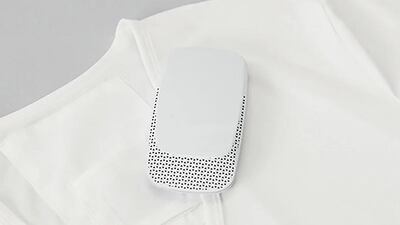
Recent efforts by scientists to combine electronics and clothing to make individual air conditioning units have been yielding results. One of the first to reach the market is the Reon Pocket, launched last week by Sony. While it is currently only available in Japan, there seems to be an intention to roll it out worldwide.
The small, very light device (it weighs only 80 grams) claims to reduce surface body temperature by as much as 13 degrees Celsius, simply by slotting into a pouch in a special V-neck undershirt. Another company, Embr Labs, sells a wrist-worn device called the Wave, which it describes as a “personal thermostat”. Wearing it, the company says, could lower the cost of cooling a building by as much as 35 per cent.
The need for such devices is particularly pressing in the Middle East. In the UAE, 70 per cent of electricity used during the summer months is devoted to cooling in one form or another, according to Powerwise, an Abu Dhabi government office focusing on the awareness of electricity use. The International Energy Agency, meanwhile, predicts that the energy demand from air conditioners will triple by the year 2050, accounting for 13 per cent of worldwide electricity use.

Effective and convenient personal cooling isn’t easy to achieve. The biggest problem is the same one posed by air conditioners: in order to make us cool, physics tells us that something else has to be made warm, and that something would have to be carried around with you.
Fans are impractical, as are devices that need to be continually refilled with water. Twenty years ago, technology developed by the European Space Agency was incorporated into a cooling jacket by Italian fashion firm Corpo Nove, but it was incredibly cumbersome, incorporating 50 metres of 2mm plastic tubing to achieve the desired effect.
The solution now being touted by Sony and Embers Labs, among others, uses an electronic quirk called the Peltier effect. Discovered by French physicist Jean Charles Peltier in 1834, it relies on passing an electric current between two different metals.
Running it one way heats up one of the metals, but run it the other way and it cools down. These tiny devices have been deployed for years in water coolers and laptop computers, so why not clothing?

The new Sony device connects with your smartphone via Bluetooth, and an app allows you to gently adjust the desired temperature up or down, or give yourself a cool blast in boost mode. Sensors regulate that temperature, while movement detectors provide extra cooling when you’re active.
After initially being touted on Sony’s Japanese crowdfunding platform, First Flight, it struck a chord with the public and hit its target last year. Its launch was planned to coincide with the Tokyo Olympics, but it’s now being pitched at commuters travelling in Japan’s notorious humidity. “Reon Pocket solves the summer worries of business people,” says the website.
One early review on technology website The Verge indicates that it does the job: “I did find, generally, that the Reon Pocket improved matters somewhat,” it reads. “The cooling sensation does make a difference while you’re actually out there in the heat.”
And, as experiments continue, we’re likely to see greater efficacy; researchers at the University of California have been working with patches, which, when combined into a garment, promise to use just 26W to cool one person on a hot day. That’s in sharp contrast to the thousands of watts per day it takes to cool down an entire office.
Meanwhile, researchers at the University of Missouri have been working on a different kind of smart cooling, using a material that reflects sunlight from the body but allows body heat to pass through. Again, their ultimate aim is to save electricity.
It remains to be seen how appealing these devices are to the public, particularly as the cost of air conditioning is relatively affordable, and the damage that it may be doing to the planet is largely invisible, day to day.
Persuading us to change habits which affect our comfort isn’t easy. But as these devices get smaller, slimmer and more effective, popping one in our clothing may become second nature – just like putting on a wristwatch.

