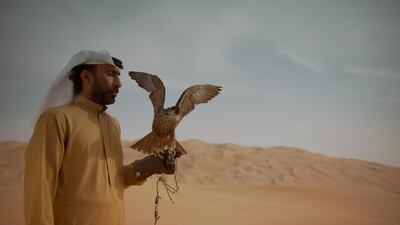
A much-lauded docu-series about the ancient history of the UAE is now available for free online.
History of the Emirates, a five-part series presented by Image Nation Abu Dhabi and produced by Atlantic Productions, screened late last year on networks around the world. It was the culmination of four years of hard work by 75 anthropologists, archaeologists and historians.
Narrated in English by Academy Award-winning actor Jeremy Irons, the three-episode international version of the series is now available to stream on a dedicated website, historyoftheemirates.com.
The five-part local version of the series, available in Arabic, is available to stream on MBC’s Shahid platform, Dubai TV’s Awan and Emarat TV online.
The first episode of the series looks at the earliest human migrations out of Africa to the Arabian Peninsula. It explores how a stone tool found at Jebel Faya in Sharjah has changed the whole theory of human migration. This tool confirms that some of the earliest modern humans left Africa across the Red Sea, rather than over the land bridge in Egypt.
The next four episodes look at how innovation, trade and belief systems have shaped the country, finally arriving in 1971 with the formation of the UAE.
An impressive cast of local and international voices, including Emirati archaeologists Eisa Yousif and Abdullah Al Kaabi, provide clear-headed analysis throughout.
Accompanying the television series, the 7 Mysteries of the UAE app is also now available for free download.
Using virtual reality and gaming techniques, the app helps children learn about the United Arab Emirates’ history. It has been developed with teachers and parents in mind too, as a good tool for long-distance learning.

The specs: 2018 Honda City
Price, base: From Dh57,000
Engine: 1.5L, in-line four-cylinder
Transmission: Continuously variable transmission
Power: 118hp @ 6,600rpm
Torque: 146Nm @ 4,600rpm
Fuel economy, combined: 5.8L / 100km
11 cabbie-recommended restaurants and dishes to try in Abu Dhabi
Iqbal Restaurant behind Wendy’s on Hamdan Street for the chicken karahi (Dh14)
Pathemari in Navy Gate for prawn biryani (from Dh12 to Dh35)
Abu Al Nasar near Abu Dhabi Mall, for biryani (from Dh12 to Dh20)
Bonna Annee at Navy Gate for Ethiopian food (the Bonna Annee special costs Dh42 and comes with a mix of six house stews – key wet, minchet abesh, kekel, meser be sega, tibs fir fir and shiro).
Al Habasha in Tanker Mai for Ethiopian food (tibs, a hearty stew with meat, is a popular dish; here it costs Dh36.75 for lamb and beef versions)
Himalayan Restaurant in Mussaffa for Nepalese (the momos and chowmein noodles are best-selling items, and go for between Dh14 and Dh20)
Makalu in Mussaffa for Nepalese (get the chicken curry or chicken fry for Dh11)
Al Shaheen Cafeteria near Guardian Towers for a quick morning bite, especially the egg sandwich in paratha (Dh3.50)
Pinky Food Restaurant in Tanker Mai for tilapia
Tasty Zone for Nepalese-style noodles (Dh15)
Ibrahimi for Pakistani food (a quarter chicken tikka with roti costs Dh16)
COMPANY PROFILE
The%20Super%20Mario%20Bros%20Movie
Ten tax points to be aware of in 2026
1. Domestic VAT refund amendments: request your refund within five years
If a business does not apply for the refund on time, they lose their credit.
2. E-invoicing in the UAE
Businesses should continue preparing for the implementation of e-invoicing in the UAE, with 2026 a preparation and transition period ahead of phased mandatory adoption.
3. More tax audits
Tax authorities are increasingly using data already available across multiple filings to identify audit risks.
4. More beneficial VAT and excise tax penalty regime
Tax disputes are expected to become more frequent and more structured, with clearer administrative objection and appeal processes. The UAE has adopted a new penalty regime for VAT and excise disputes, which now mirrors the penalty regime for corporate tax.
5. Greater emphasis on statutory audit
There is a greater need for the accuracy of financial statements. The International Financial Reporting Standards standards need to be strictly adhered to and, as a result, the quality of the audits will need to increase.
6. Further transfer pricing enforcement
Transfer pricing enforcement, which refers to the practice of establishing prices for internal transactions between related entities, is expected to broaden in scope. The UAE will shortly open the possibility to negotiate advance pricing agreements, or essentially rulings for transfer pricing purposes.
7. Limited time periods for audits
Recent amendments also introduce a default five-year limitation period for tax audits and assessments, subject to specific statutory exceptions. While the standard audit and assessment period is five years, this may be extended to up to 15 years in cases involving fraud or tax evasion.
8. Pillar 2 implementation
Many multinational groups will begin to feel the practical effect of the Domestic Minimum Top-Up Tax (DMTT), the UAE's implementation of the OECD’s global minimum tax under Pillar 2. While the rules apply for financial years starting on or after January 1, 2025, it is 2026 that marks the transition to an operational phase.
9. Reduced compliance obligations for imported goods and services
Businesses that apply the reverse-charge mechanism for VAT purposes in the UAE may benefit from reduced compliance obligations.
10. Substance and CbC reporting focus
Tax authorities are expected to continue strengthening the enforcement of economic substance and Country-by-Country (CbC) reporting frameworks. In the UAE, these regimes are increasingly being used as risk-assessment tools, providing tax authorities with a comprehensive view of multinational groups’ global footprints and enabling them to assess whether profits are aligned with real economic activity.
Contributed by Thomas Vanhee and Hend Rashwan, Aurifer
COMPANY%20PROFILE%20
More from this package
The burning issue
The internal combustion engine is facing a watershed moment – major manufacturer Volvo is to stop producing petroleum-powered vehicles by 2021 and countries in Europe, including the UK, have vowed to ban their sale before 2040. The National takes a look at the story of one of the most successful technologies of the last 100 years and how it has impacted life in the UAE.
Part three: an affection for classic cars lives on
Read part two: how climate change drove the race for an alternative
Read part one: how cars came to the UAE
Tomorrow 2021
Saudi National Day
Aayan%E2%80%99s%20records
Company%20Profile
RESULT
Manchester United 1 Brighton and Hove Albion 0
Man United: Dunk (66' og)
Man of the Match: Shane Duffy (Brighton)
Whiile you're here
Damien McElroy: Anti-science attitudes in America are proving lethal
Editorial: What makes the UAE such a good place to test vaccines?
Editorial: The fight against Covid-19 should be guided by science
Fight Night
FIGHT NIGHT
Four title fights:
Amir Khan v Billy Dib - WBC International title
Hughie Fury v Samuel Peter - Heavyweight co-main event
Dave Penalosa v Lerato Dlamini - WBC Silver title
Prince Patel v Michell Banquiz - IBO World title
Six undercard bouts:
Michael Hennessy Jr v Abdul Julaidan Fatah
Amandeep Singh v Shakhobidin Zoirov
Zuhayr Al Qahtani v Farhad Hazratzada
Lolito Sonsona v Isack Junior
Rodrigo Caraballo v Sajid Abid
Ali Kiydin v Hemi Ahio
Dubai works towards better air quality by 2021
Dubai is on a mission to record good air quality for 90 per cent of the year – up from 86 per cent annually today – by 2021.
The municipality plans to have seven mobile air-monitoring stations by 2020 to capture more accurate data in hourly and daily trends of pollution.
These will be on the Palm Jumeirah, Al Qusais, Muhaisnah, Rashidiyah, Al Wasl, Al Quoz and Dubai Investment Park.
“It will allow real-time responding for emergency cases,” said Khaldoon Al Daraji, first environment safety officer at the municipality.
“We’re in a good position except for the cases that are out of our hands, such as sandstorms.
“Sandstorms are our main concern because the UAE is just a receiver.
“The hotspots are Iran, Saudi Arabia and southern Iraq, but we’re working hard with the region to reduce the cycle of sandstorm generation.”
Mr Al Daraji said monitoring as it stood covered 47 per cent of Dubai.
There are 12 fixed stations in the emirate, but Dubai also receives information from monitors belonging to other entities.
“There are 25 stations in total,” Mr Al Daraji said.
“We added new technology and equipment used for the first time for the detection of heavy metals.
“A hundred parameters can be detected but we want to expand it to make sure that the data captured can allow a baseline study in some areas to ensure they are well positioned.”

