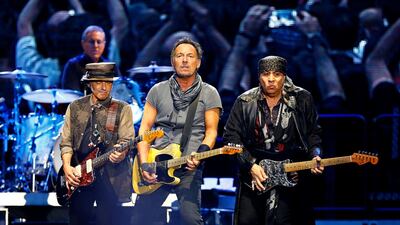
Bruce Springsteen's success partly down to his backing group, The E Street Band. Pictured here are Nils Lofgren (left) and Steven Van Zandt (right). EPA

Prince to Springsteen: six of the greatest backing bands behind the stars


Saeed Saeed
  • English
  • Arabic

On June 9, 1972 opening notes for one of rock music’s most famous bands were strummed.

Almost half a century ago, US singer-songwriter Bruce Springsteen signed with Columbia Records and immediately set to work on his classic 1972 album, Greetings from Asbury Park, NJ.

That meant he needed to assemble a band to match his ambition.

But that’s not as easy as it sounds. Setting up the right group is more than simply looking for the finest musicians available.

It is more about finding that rare alchemy of talent and humility that would, in turn, create a musical shorthand, allowing both leader and group to be in sync on stage and record.

Here are six examples of artists at one with their band:

1. Bruce Springsteen and The E Street Band

Springsteen's band was named after the street in New Jersey where he assembled the original quintet from players in the neighbourhood.

The success of Greetings from Asbury Park, NJ,  and subsequent records Born to Run, Darkness on the Edge of Town and The River are a showcase of the group's influence on The Boss's sound. From the saxophone playing of the late Clarence Clemons, to the sturdy riffs of Steven Van Zandt, the line up provided the fire and drama to Springsteen's chronicles of life in small town America.

The fact that The E Street Band remains synonymous with Springsteen's celebrated body of work is an example of how, in popular music, the whole is better than the sum of its parts.

2. Bob Marley and The Wailers

Originally beginning as a partnership between singer Peter Tosh, percussionist Bunny Wailer and Bob Marley on guitar, the latter took over the group when relationships between the trio soured.

With Aston "Family Man" Barrett (bass) and Carlton Barrett (drums) recruited to form reggae music's greatest ever rhythm section, The Wailers went on to back many of Marley's life-affirming hits, including Get Up, Stand Up, Exodus and Three Little Birds.

3. James Brown and The JB’s

One of the tightest bands in funk music, period. After all, James Brown expected nothing less. As the proclaimed "hardest man in show business," Brown ensured his musicians were on point at all times, largely due to his habit of fining members for every bum note.

But in the end, it seems that tough love approach probably helped the band's members, such as saxophonist Maceo Parker and bassist Bootsy Collins. Both went on to have successful solo careers of their own.

4. Prince and The Revolution

One of the toughest gigs in the business. Such was Prince's restless creative spirit, that he formed and disbanded groups with relative frequency.

But The Revolution will always go down as the Purple One's premier backing group for their work on three essential albums, 1984's Purple Rain, 1985's Around the World and their final outing for 1986's Parade.

5. Joan Jett and The Blackhearts

As a keen rocker, Joan Jett always wanted her own band. Hence, she ignored her label's requests to go solo and placed an advertisement in a Los Angeles paper in the late 1970s requesting "three good men." Not long after The Blackhearts were formed, for the past thirty years they have supported Jett on tour and on classic singles I Love Rock'n'Roll and Crimson and Clover.

6. Nick Cave and The Bad Seeds

Arguably the greatest living backing ensemble working today. Since 1983, this Australian collective of experimental musicians has provided various soundscapes – from the thunderous and the nightmarish to desolate beauty – for singer and poet Nick Cave to impart his personal lyricism. Simply put, there would be no Nick Cave without The Bad Seeds.

______________

Read more:

The 11 best Arab independent musicians you should be listening to right now

______________

Set-jetting on the Emerald Isle

Other shows filmed in Ireland include: Vikings (County Wicklow), The Fall (Belfast), Line of Duty (Belfast), Penny Dreadful (Dublin), Ripper Street (Dublin), Krypton (Belfast)

The%20specs%3A%202024%20Mercedes%20E200
%3Cp%3E%3Cstrong%3EEngine%3A%20%3C%2Fstrong%3E2.0-litre%20four-cyl%20turbo%20%2B%20mild%20hybrid%0D%3Cbr%3E%3Cstrong%3EPower%3A%20%3C%2Fstrong%3E204hp%20at%205%2C800rpm%20%2B23hp%20hybrid%20boost%0D%3Cbr%3E%3Cstrong%3ETorque%3A%20%3C%2Fstrong%3E320Nm%20at%201%2C800rpm%20%2B205Nm%20hybrid%20boost%0D%3Cbr%3E%3Cstrong%3ETransmission%3A%20%3C%2Fstrong%3E9-speed%20auto%0D%3Cbr%3E%3Cstrong%3EFuel%20consumption%3A%20%3C%2Fstrong%3E7.3L%2F100km%0D%3Cbr%3E%3Cstrong%3EOn%20sale%3A%20%3C%2Fstrong%3ENovember%2FDecember%0D%3Cbr%3E%3Cstrong%3EPrice%3A%20%3C%2Fstrong%3EFrom%20Dh205%2C000%20(estimate)%3C%2Fp%3E%0A
COMPANY PROFILE
Name: HyperSpace
 
Started: 2020
 
Founders: Alexander Heller, Rama Allen and Desi Gonzalez
 
Based: Dubai, UAE
 
Sector: Entertainment 
 
Number of staff: 210 
 
Investment raised: $75 million from investors including Galaxy Interactive, Riyadh Season, Sega Ventures and Apis Venture Partners
Infiniti QX80 specs

Engine: twin-turbocharged 3.5-liter V6

Power: 450hp

Torque: 700Nm

Price: From Dh450,000, Autograph model from Dh510,000

Available: Now

Some of Darwish's last words

"They see their tomorrows slipping out of their reach. And though it seems to them that everything outside this reality is heaven, yet they do not want to go to that heaven. They stay, because they are afflicted with hope." - Mahmoud Darwish, to attendees of the Palestine Festival of Literature, 2008

His life in brief: Born in a village near Galilee, he lived in exile for most of his life and started writing poetry after high school. He was arrested several times by Israel for what were deemed to be inciteful poems. Most of his work focused on the love and yearning for his homeland, and he was regarded the Palestinian poet of resistance. Over the course of his life, he published more than 30 poetry collections and books of prose, with his work translated into more than 20 languages. Many of his poems were set to music by Arab composers, most significantly Marcel Khalife. Darwish died on August 9, 2008 after undergoing heart surgery in the United States. He was later buried in Ramallah where a shrine was erected in his honour.

Sinopharm vaccine explained

The Sinopharm vaccine was created using techniques that have been around for decades. 

“This is an inactivated vaccine. Simply what it means is that the virus is taken, cultured and inactivated," said Dr Nawal Al Kaabi, chair of the UAE's National Covid-19 Clinical Management Committee.

"What is left is a skeleton of the virus so it looks like a virus, but it is not live."

This is then injected into the body.

"The body will recognise it and form antibodies but because it is inactive, we will need more than one dose. The body will not develop immunity with one dose," she said.

"You have to be exposed more than one time to what we call the antigen."

The vaccine should offer protection for at least months, but no one knows how long beyond that.

Dr Al Kaabi said early vaccine volunteers in China were given shots last spring and still have antibodies today.

“Since it is inactivated, it will not last forever," she said.

Key figures in the life of the fort

Sheikh Dhiyab bin Isa (ruled 1761-1793) Built Qasr Al Hosn as a watchtower to guard over the only freshwater well on Abu Dhabi island.

Sheikh Shakhbut bin Dhiyab (ruled 1793-1816) Expanded the tower into a small fort and transferred his ruling place of residence from Liwa Oasis to the fort on the island.

Sheikh Tahnoon bin Shakhbut (ruled 1818-1833) Expanded Qasr Al Hosn further as Abu Dhabi grew from a small village of palm huts to a town of more than 5,000 inhabitants.

Sheikh Khalifa bin Shakhbut (ruled 1833-1845) Repaired and fortified the fort.

Sheikh Saeed bin Tahnoon (ruled 1845-1855) Turned Qasr Al Hosn into a strong two-storied structure.

Sheikh Zayed bin Khalifa (ruled 1855-1909) Expanded Qasr Al Hosn further to reflect the emirate's increasing prominence.

Sheikh Shakhbut bin Sultan (ruled 1928-1966) Renovated and enlarged Qasr Al Hosn, adding a decorative arch and two new villas.

Sheikh Zayed bin Sultan (ruled 1966-2004) Moved the royal residence to Al Manhal palace and kept his diwan at Qasr Al Hosn.

Sources: Jayanti Maitra, www.adach.ae

The burning issue

The internal combustion engine is facing a watershed moment – major manufacturer Volvo is to stop producing petroleum-powered vehicles by 2021 and countries in Europe, including the UK, have vowed to ban their sale before 2040. The National takes a look at the story of one of the most successful technologies of the last 100 years and how it has impacted life in the UAE.

Part three: an affection for classic cars lives on

Read part two: how climate change drove the race for an alternative 

Read part one: how cars came to the UAE

Our legal consultant

Name: Dr Hassan Mohsen Elhais

Position: legal consultant with Al Rowaad Advocates and Legal Consultants.
