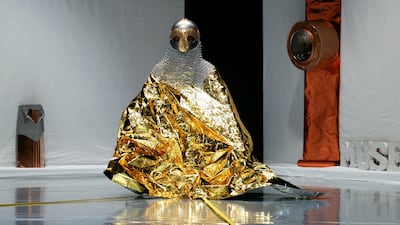

Youness Atbane has spent years through his work as a performer, choreographer and visual artist examining who decides how Arab artists are represented and valued.
Perhaps the clearest expression of that concern is Untitled 14km, which comes to The Arts Centre at NYU Abu Dhabi on Thursday and Friday.
Set inside an imaginary museum, the work scrutinises how museums, curators and cultural institutions influence what Arab art is expected to represent.

Premiering at Mucem in Marseille in 2019, the show went on to Marrakesh, Casablanca, Belfast and Cairo, eliciting the kind of responses Atbane says were usually heard quietly offstage.
"It has been interesting because the work is essentially a piece of satire. I was conscious of not making it feel too aggressive," he recalls. "But I had a lot of people from the industry telling me the show addressed what they were feeling, and what they described as the oppression the show's curator was feeling."
Blending performance, dance and installation, Untitled 14km follows an Arab contemporary artist, a curator, a western museum director and an Arab-Andalusian poet as they attempt to organise an exhibition.
What begins as a curatorial exercise develops into a battle of creative wills over identity and legitimacy, and a broader debate about who gets to decide how Arab culture should be presented.
Those questions remain unresolved and, Atbane says, have become more complicated as museums, universities and cultural institutions have embraced the language of diversity, representation and decolonisation.
Atbane is suspicious of that development, pointing to the gap between institutional language and practice, citing his own experiences having his work commissioned in Europe.
"The vocabulary changed but the question of power is still there. It's just the faces, or maybe the colour of the faces, that change sometimes," he says.
"I'll give you an example. I'm half based in Berlin. Because I live in Berlin, I can be paid differently from a Moroccan artist who lives and works in Morocco for the same exhibition. That's a problem. We're talking about decolonisation, but when I know that a German artist is paid more than a Moroccan artist, that's a question of value."
The nature of those decisions, Atbane says, reflects what he sees as the growing influence of curators, who increasingly act as intermediaries between artists and institutions.
"Now we have this new figure called the star curator and institutions don't talk to artists anymore,” he rues. “They prefer to address these people because they are seen as all-knowing and have knowledge of which artists are good or bad, and in-turn frame how a particular art work or the region it comes from is viewed.”

But curators do not work independently, Atbane says, pointing to the increasingly proactive role museums play, particularly in the Middle East and North Africa. Rather than simply archiving and presenting culture, he says, they can also promote particular ideas about identity.
"This dual role is happening here in the Mena region," he says. "If you look at what is happening in North Africa, museums are now promoting this idea of Africanity more than a shared Arab identity.
“We have seen that over the past 10 years through museums and even sporting events such as the 2025 Africa Cup of Nations in Morocco.
"This is different from the 1960s and 1970s, when Arab identity was discussed much more widely. It shows the context that curators have to navigate and work within. As artists, all we can do is try to find the unknown feelings within all of this and bring them into the open."
There are, however, signs of institutional change. In a recent interview with The National, Anne-Claire Legendre, the new president of the Arab World Institute in Paris, said she wants Arab creatives to have greater autonomy over how their work is curated and presented in Europe.

While welcoming the approach, Atbane says its value will ultimately depend on what artists do with that creative freedom.
"If the institute is going to do it, then the question becomes: which artists are going to take that opportunity to a critical level and really assume it?" he says. "It cannot just become an event where we say we have given artists a voice. The question is what they do with that space.
"The artist also has a responsibility to create change by taking these opportunities."
Abu Dhabi is another example of that change, this time in audience expectations, something Atbane is experiencing first-hand during masterclasses with NYU Abu Dhabi students before the Untitled 14km performances.
"Yesterday, I was eating in the cafeteria when three students came over. They knew my work and its critical aspect, and wanted to tell me where they agreed and where they didn't," he says. "I never had that before. I always felt I had to propose my opinion with the idea of proving something. Here, I'm not proving myself, and that is completely different.
"It made me realise how well this show fits a university context and an audience of students. As an artist, it's not my role to explain things, but to suggest them through forms and then discuss what those forms are suggesting."
Untitled 14km is at The Arts Centre at NYU Abu Dhabi on October 1 and 2 at 7.30pm. Tickets start from Dh52.50

