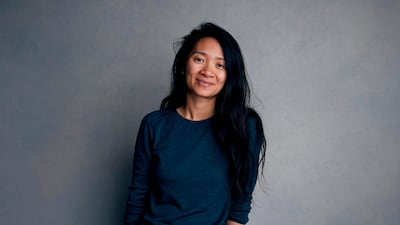
For a film about one woman travelling the Great American Outdoors alone in her campervan, Nomadland has been enjoying an incredible ride.
At the wheel is Chloe Zhao, the Chinese writer-director who was educated in England and has spent much of her adult life living in America, where she developed a fascination for the landscape and people who populate it. Her work may be fictional, but it blends closely with reality. “So far, I haven’t really made films where I didn’t feel like it’s a part of my life,” she says.
Last month, Zhao made history becoming the first Asian woman to win a Golden Globe for Best Director, while the film also claimed Best Motion Picture in the drama category, beating out glitzier productions such as Mank and The Trial of the Chicago 7. This month, she was nominated for four Baftas and four Oscars, and she remains the hot favourite at next month's Academy Awards.
If Zhao wins Best Director, she will be the second woman to do so after Kathryn Bigelow in 2010 for The Hurt Locker.
It's not only awards season where Nomadland has triumphed. When it bowed at the Venice Film Festival last September, it took the prestigious Golden Lion. "I think in China, that's a big deal," says Beijing-born Zhao. "China has a big love affair with Venice." Juries have previously awarded Chinese directors Zhang Yimou and Jia Zhang-ke the festival's top prize. Nomadland also took the Audience Award at Toronto – further evidence that it might rule the Oscars.
Nomadland tells the story of Fern (Frances McDormand), a sixty-something woman who loses her livelihood and home after the 2008 financial crash and takes to the road, travelling across South Dakota, Nebraska and Arizona.
The inspiration was non-fiction book Nomadland: Surviving America in the Twenty-First Century, for which author Jessica Bruder embedded herself with the growing community of nomads in America. Many of them were Fern's age – the so-called baby boomer generation – who were forced to reset their lives when the world was thrown into the Great Recession.
With banks repossessing houses from the newly unemployed, Zhao concedes this instinct to pack up your possessions in a van “definitely was amplified because of the housing crisis”, but it’s always been part of the American mindset.
“Even before the crash, there were a lot of people … once they retire, when they let go of that job title and that responsibility, they don’t just buy a farm somewhere, they hit the road. So I think it’s always been there.”
Zhao, 38, is no stranger to travelling this way. "I spent a lot of time on the road," she says, whether in her Subaru Outback or her campervan, which she named Akira after the character in her favourite manga series, Slam Dunk. Once she decided to adapt Bruder's book, she bonded with the real-life nomads. "I have lived on the periphery of this world. So it was very easy for me to quickly enter."
This immersive way of working is a huge part of her methodology. Her 2015 debut, Songs My Brothers Taught Me, took her to South Dakota's Pine Ridge Indian Reservation, where she told the story of two Native American Lakota Sioux siblings. On the reservation she met real-life Sioux cowboy Brady Jandreau, the star of her second film, 2017's The Rider – the breakout movie that drew McDormand, who had the rights to Bruder's book, to offer Zhao the chance to make Nomadland.
I haven't really made films where I didn't feel like it's a part of my life
Like Zhao, McDormand slipped into the nomad community almost unnoticed – even working the jobs that Fern does, such as packaging in an Amazon warehouse.
“You can imagine what Fran was like. There is no entourage,” says the director. A two-time Oscar-winner, the modest McDormand went unrecognised during the four-month shoot. Much of what she and Zhao heard found its way into the script. “A lot of these folks, they’re on the road alone a lot,” says Zhao. “And then they don’t have a lot of people that really sit down and say, ‘Tell me your story.’”
Much like her earlier work, Zhao was keen to include non-professionals in Nomadland. Several real-life nomads feature in the film, including the irrepressible travellers Charlene Swankie and Linda May and Bob Wells, the founder of the Rubber Tramp Rendezvous, an annual gathering of van-dwellers in Quartzsite, Arizona. What began as a niche event now attracts thousands every year – from artists and writers to scientists and business graduates.
Zhao says despite the diverse array of political and religious beliefs of those she met, there was a shared unity.
“You don’t know who is coming into this gathering … you just don’t know. It doesn’t matter what they believe in, who they vote for. The reason people get on the road is something that people all share: one is losing their homes, their traditional house, and the other is trying to look for something else that they couldn’t find in their homes. And these are very human experiences.”
This might explain why Nomadland has touched a nerve during the pandemic, a time when people are isolated and left to reflect on their lives. Suddenly, it's not only the baby boomers who are taking to the road, but the millennial generation, too – many of whom are unable to afford property in the first place. Environmental concerns have also led to the boom in the tiny-house movement and so-called minimalist living. "That's happening [now] on a much grander scale," says Zhao.
Talking of grand scale, Zhao recently completed work on her fourth movie – an adaptation of Marvel Comics' superhero tale Eternals. Shot just before the pandemic began, she worked with A-list actresses Angelina Jolie and Salma Hayek, with a huge budget far outstripping her work to date. But Zhao has not forgotten the friends she made on Nomadland, and still feels an enormous responsibility for those in the film.
“You have to take care of these people who have shared their very personal thing,” she says. “That’s going to be on screen for ever.”
Nomadland is in UAE cinemas from Thursday, March 25

Living in...
This article is part of a guide on where to live in the UAE. Our reporters will profile some of the country’s most desirable districts, provide an estimate of rental prices and introduce you to some of the residents who call each area home.
COMPANY%20PROFILE
%3Cp%3E%3Cstrong%3ECompany%20name%3A%3C%2Fstrong%3E%203S%20Money%3Cbr%3E%3Cstrong%3EStarted%3A%3C%2Fstrong%3E%202018%3Cbr%3E%3Cstrong%3EBased%3A%3C%2Fstrong%3E%20London%3Cbr%3E%3Cstrong%3EFounders%3A%3C%2Fstrong%3E%20Ivan%20Zhiznevsky%2C%20Eugene%20Dugaev%20and%20Andrei%20Dikouchine%3Cbr%3E%3Cstrong%3ESector%3A%3C%2Fstrong%3E%20FinTech%3Cbr%3E%3Cstrong%3EInvestment%20stage%3A%3C%2Fstrong%3E%20%245.6%20million%20raised%20in%20total%3C%2Fp%3E%0A
Electric scooters: some rules to remember
- Riders must be 14-years-old or over
- Wear a protective helmet
- Park the electric scooter in designated parking lots (if any)
- Do not leave electric scooter in locations that obstruct traffic or pedestrians
- Solo riders only, no passengers allowed
- Do not drive outside designated lanes
Global state-owned investor ranking by size
|
1.
|
United States
|
|
2.
|
China
|
|
3.
|
UAE
|
|
4.
|
Japan
|
|
5
|
Norway
|
|
6.
|
Canada
|
|
7.
|
Singapore
|
|
8.
|
Australia
|
|
9.
|
Saudi Arabia
|
|
10.
|
South Korea
|
THREE
%3Cp%3EDirector%3A%20Nayla%20Al%20Khaja%3C%2Fp%3E%0A%3Cp%3EStarring%3A%20Jefferson%20Hall%2C%20Faten%20Ahmed%2C%20Noura%20Alabed%2C%20Saud%20Alzarooni%3C%2Fp%3E%0A%3Cp%3ERating%3A%203.5%2F5%3C%2Fp%3E%0A
Match statistics
Abu Dhabi Harlequins 36 Bahrain 32
Harlequins
Tries: Penalty 2, Stevenson, Teasdale, Semple
Cons: Stevenson 2
Pens: Stevenson
Bahrain
Tries: Wallace 2, Heath, Evans, Behan
Cons: Radley 2
Pen: Radley
Man of the match: Craig Nutt (Harlequins)
What can victims do?
Always use only regulated platforms
Stop all transactions and communication on suspicion
Save all evidence (screenshots, chat logs, transaction IDs)
Report to local authorities
Warn others to prevent further harm
Courtesy: Crystal Intelligence
Cryopreservation: A timeline
- Keyhole surgery under general anaesthetic
- Ovarian tissue surgically removed
- Tissue processed in a high-tech facility
- Tissue re-implanted at a time of the patient’s choosing
- Full hormone production regained within 4-6 months
INDIA SQUAD
Rohit Sharma (captain), Shikhar Dhawan (vice-captain), KL Rahul, Suresh Raina, Manish Pandey, Dinesh Karthik (wicketkeeper), Deepak Hooda, Washington Sundar, Yuzvendra Chahal, Axar Patel, Vijay Shankar, Shardul Thakur, Jaydev Unadkat, Mohammad Siraj and Rishabh Pant (wicketkeeper)
How it works
Booklava works on a subscription model. On signing up you receive a free book as part of a 30-day-trial period, after which you pay US$9.99 (Dh36.70) per month to gain access to a library of books and discounts of up to 30 per cent on selected titles. You can cancel your subscription at any time. For more details go to www.booklava.com
Why are asylum seekers being housed in hotels?
The number of asylum applications in the UK has reached a new record high, driven by those illegally entering the country in small boats crossing the English Channel.
A total of 111,084 people applied for asylum in the UK in the year to June 2025, the highest number for any 12-month period since current records began in 2001.
Asylum seekers and their families can be housed in temporary accommodation while their claim is assessed.
The Home Office provides the accommodation, meaning asylum seekers cannot choose where they live.
When there is not enough housing, the Home Office can move people to hotels or large sites like former military bases.
Mercer, the investment consulting arm of US services company Marsh & McLennan, expects its wealth division to at least double its assets under management (AUM) in the Middle East as wealth in the region continues to grow despite economic headwinds, a company official said.
Mercer Wealth, which globally has $160 billion in AUM, plans to boost its AUM in the region to $2-$3bn in the next 2-3 years from the present $1bn, said Yasir AbuShaban, a Dubai-based principal with Mercer Wealth.
“Within the next two to three years, we are looking at reaching $2 to $3 billion as a conservative estimate and we do see an opportunity to do so,” said Mr AbuShaban.
Mercer does not directly make investments, but allocates clients’ money they have discretion to, to professional asset managers. They also provide advice to clients.
“We have buying power. We can negotiate on their (client’s) behalf with asset managers to provide them lower fees than they otherwise would have to get on their own,” he added.
Mercer Wealth’s clients include sovereign wealth funds, family offices, and insurance companies among others.
From its office in Dubai, Mercer also looks after Africa, India and Turkey, where they also see opportunity for growth.
Wealth creation in Middle East and Africa (MEA) grew 8.5 per cent to $8.1 trillion last year from $7.5tn in 2015, higher than last year’s global average of 6 per cent and the second-highest growth in a region after Asia-Pacific which grew 9.9 per cent, according to consultancy Boston Consulting Group (BCG). In the region, where wealth grew just 1.9 per cent in 2015 compared with 2014, a pickup in oil prices has helped in wealth generation.
BCG is forecasting MEA wealth will rise to $12tn by 2021, growing at an annual average of 8 per cent.
Drivers of wealth generation in the region will be split evenly between new wealth creation and growth of performance of existing assets, according to BCG.
Another general trend in the region is clients’ looking for a comprehensive approach to investing, according to Mr AbuShaban.
“Institutional investors or some of the families are seeing a slowdown in the available capital they have to invest and in that sense they are looking at optimizing the way they manage their portfolios and making sure they are not investing haphazardly and different parts of their investment are working together,” said Mr AbuShaban.
Some clients also have a higher appetite for risk, given the low interest-rate environment that does not provide enough yield for some institutional investors. These clients are keen to invest in illiquid assets, such as private equity and infrastructure.
“What we have seen is a desire for higher returns in what has been a low-return environment specifically in various fixed income or bonds,” he said.
“In this environment, we have seen a de facto increase in the risk that clients are taking in things like illiquid investments, private equity investments, infrastructure and private debt, those kind of investments were higher illiquidity results in incrementally higher returns.”
The Abu Dhabi Investment Authority, one of the largest sovereign wealth funds, said in its 2016 report that has gradually increased its exposure in direct private equity and private credit transactions, mainly in Asian markets and especially in China and India. The authority’s private equity department focused on structured equities owing to “their defensive characteristics.”
COMPANY PROFILE
Name: Mamo
Year it started: 2019 Founders: Imad Gharazeddine, Asim Janjua
Based: Dubai, UAE
Number of employees: 28
Sector: Financial services
Investment: $9.5m
Funding stage: Pre-Series A Investors: Global Ventures, GFC, 4DX Ventures, AlRajhi Partners, Olive Tree Capital, and prominent Silicon Valley investors.
Killing of Qassem Suleimani
Benefits of first-time home buyers' scheme
- Priority access to new homes from participating developers
- Discounts on sales price of off-plan units
- Flexible payment plans from developers
- Mortgages with better interest rates, faster approval times and reduced fees
- DLD registration fee can be paid through banks or credit cards at zero interest rates
The%20Woman%20King%20
%3Cp%3E%3Cstrong%3EDirector%3A%3C%2Fstrong%3E%20Gina%20Prince-Bythewood%3C%2Fp%3E%0A%3Cp%3E%3Cstrong%3EStars%3A%3C%2Fstrong%3E%20Viola%20Davis%2C%20Thuso%20Mbedu%2C%20Sheila%20Atim%2C%20Lashana%20Lynch%2C%20John%20Boyega%C2%A0%3C%2Fp%3E%0A%3Cp%3E%3Cstrong%3ERating%3A%3C%2Fstrong%3E%203%2F5%3C%2Fp%3E%0A
US households add $601bn of debt in 2019
American households borrowed another $601 billion (Dh2.2bn) in 2019, the largest yearly gain since 2007, just before the global financial crisis, according to February data from the New York Federal Reserve Bank.
Fuelled by rising mortgage debt as homebuyers continued to take advantage of low interest rates, the increase last year brought total household debt to a record high, surpassing the previous peak reached in 2008 just before the market crash, according to the report.
Following the 22nd straight quarter of growth, American household debt swelled to $14.15 trillion by the end of 2019, the New York Fed said in its quarterly report.
In the final three months of the year, new home loans jumped to their highest volume since the fourth quarter of 2005, while credit cards and auto loans also added to the increase.
The bad debt load is taking its toll on some households, and the New York Fed warned that more and more credit card borrowers — particularly young people — were falling behind on their payments.
"Younger borrowers, who are disproportionately likely to have credit cards and student loans as their primary form of debt, struggle more than others with on-time repayment," New York Fed researchers said.
UAE players with central contracts
Rohan Mustafa, Ashfaq Ahmed, Chirag Suri, Rameez Shahzad, Shaiman Anwar, Adnan Mufti, Mohammed Usman, Ghulam Shabbir, Ahmed Raza, Qadeer Ahmed, Amir Hayat, Mohammed Naveed and Imran Haider.
