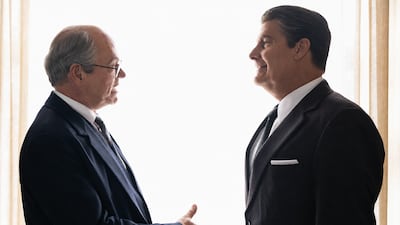

The Brink of War may well be the most relevant historical drama of the year. Its central question – whether two leaders who regard each other as enemies can still sit down together and prevent a war – reaches far beyond the events it recreates.
In the film, Jeff Daniels and Jared Harris respectively play Ronald Reagan and Mikhail Gorbachev in Michael Russell Gunn’s film about the Reykjavik Summit of October 1986. Over two days in Iceland, the American and Soviet leaders came close to agreeing to sweeping reductions to their nuclear arsenals, despite decades of hostility between their countries.
The film arrives as conflict continues to affect the Middle East, with negotiations yet to secure a lasting peace.

Asked what the story might offer at such a moment, Daniels tells The National: “It’s going to take courageous leaders all around the world, everywhere, to acknowledge the fact that we are basically in the same place that Reagan and Gorbachev were in October of 1986, and it’s very dangerous.
“Nuclear weapons are either being developed or sought after, and that’s the opposite direction of what these two guys did back on that weekend in Reykjavik.”
The summit had been proposed by Gorbachev and was initially intended as an informal meeting ahead of a planned visit to Washington. By its final hours, the two leaders were considering proposals that could have eliminated their ballistic missile arsenals.
While significant strides were made, no formal agreement was reached. Reagan would not accept Gorbachev’s demand that research into the Strategic Defence Initiative, the proposed missile defence system known as Star Wars, be restricted to laboratories. Much of the progress made in Reykjavik, however, helped clear a path towards the Intermediate-Range Nuclear Forces Treaty signed in 1987, and the eventual end of the Cold War.
The Brink of War director
But both leaders had arrived in Iceland with advisers who doubted the intentions of the other side and resisted many of the concessions under discussion. Harris draws a direct connection between that circumstance and the ongoing Iran war.
“There’s something that’s apropos to the current situation, as it relates to the movie. There’s a word that comes up constantly in the film, and that’s trust,” Harris says.
“You need to be able to trust the person on the other side of the table, that what you’re agreeing to is going to stick even though you’re ideologically opposed to one another.
“And it’s very difficult to establish trust if the ground keeps shifting.”
-
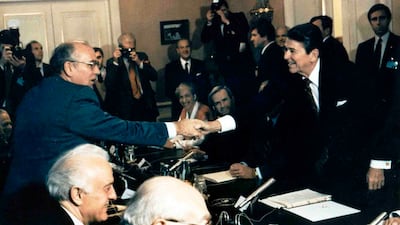
Soviet leader Mikhail Gorbachev, left, shakes hands with Ronald Reagan, the US president at the time, at the Geneva conference in November 1985. AP -
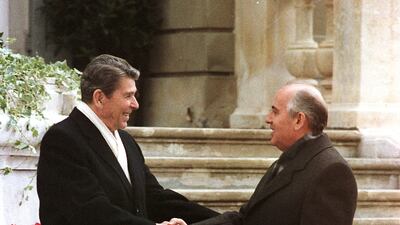
Reagan and Gorbachev meet for the first time before summit talks at the villa Fleur D'Eau at Versoix near Geneva, Switzerland, on November 19, 1985. AP -

Reagan and Gorbachev during their first summit in Geneva. Reuters -
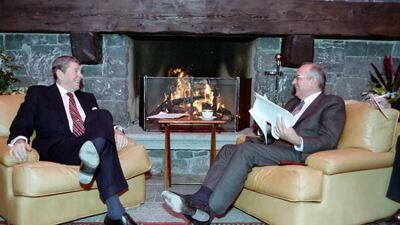
Reagan and Gorbachev at the first summit in Geneva. EPA -
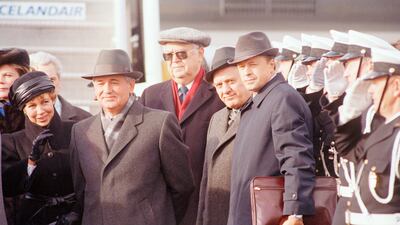
Gorbachev arrives at Keflavik Airport on October 9, 1986, in Reykjavik, Iceland, for several sessions of talks with Reagan. AP -
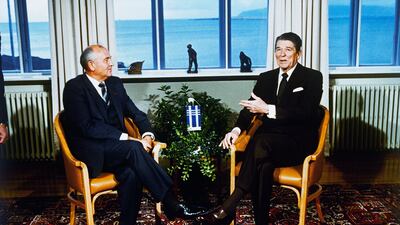
Gorbachev and Reagan talk during their meeting in Reykjavik. AP -

Reagan and Gorbachev during the summit in Reykjavik. Getty Images -

As a supporter of the de-Stalinisation programmes of his predecessor Nikita Khrushchev, Gorbachev initiated numerous reforms during his tenure. EPA -

Reagan and Gorbachev sign the Intermediate-Range Nuclear Forces (INF) treaty at the White House in Washington on December 8, 1987. Reuters -

Gorbachev and Reagan sign the treaty, which eliminated US and Soviet intermediate-range and shorter-range nuclear missiles. AFP -
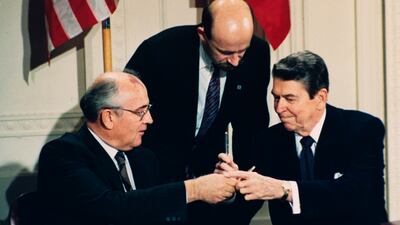
Reagan and Gorbachev exchange pens during the treaty-signing ceremony at the White House. AP -
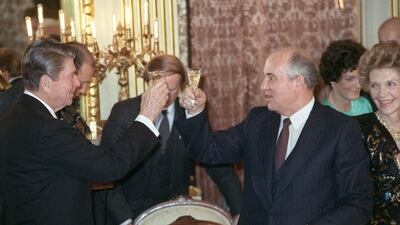
Gorbachev and Reagan share smiles after toasting each other during a dinner hosted at the Soviet embassy in Washington. AFP -
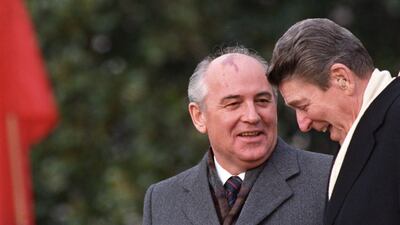
Reagan talks with Gorbachev during arrival ceremonies at the White House during a three-day summit in Washington in 1987. AP -
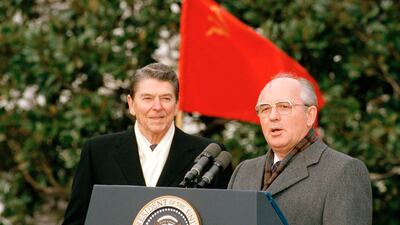
Gorbachev and Reagan speak to the press in Washington on December 8, 1987. AP -
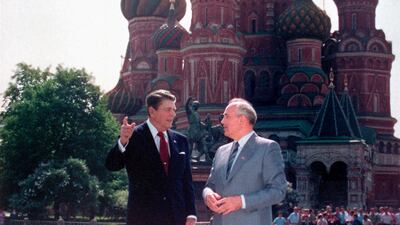
Reagan and Gorbachev talk during a walk in Red Square in Moscow, the former Soviet Union, on May 31, 1988. AP -

Reagan and Gorbachev don cowboy hats while enjoying a moment at Reagan's Rancho del Cielo, near Santa Barbara, California, in May 1992. AP -

Reagan takes Gorbachev for a drive to tour the ranch. Reuters -

Gorbachev and his wife, Raisa, with Reagan and his wife, Nancy, at the ranch in the Santa Ynez Mountains. Reuters -
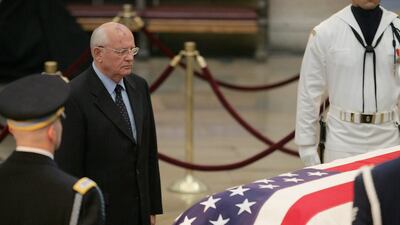
Gorbachev pauses in front of Reagan's casket during his funeral in the Capitol Rotunda in Washington, June 10, 2004. EPA


Ahead of the film, Gunn spent years researching the summit and interviewed former US secretary of state George Shultz before his death in 2021. Much of the movie was shot inside Iceland's Hofdi House, where the original negotiations took place.
“First of all, I’m glad you’re all safe [in the UAE],” Gunn says. “I think that the world is drastically dangerous, as you’re experiencing. It was in 1986, and it is again now.
“The film resonates in this moment because we have such a fraught world and divisions that we aren’t crossing. And if we can find trusted partners to cross those divides with, then I think peace is possible,” adds Gunn.
Daniels has spent much of his later career playing men closely associated with American political and moral life, from news anchor Will McAvoy in The Newsroom to former FBI director James Comey in The Comey Rule. That body of work has also made his own political views part of the way audiences approach his performances – though his own approach keeps a wall between them.
“Who I am as a person and the roles I play are two different things,” he says. “I essay the politics or the beliefs or the internals of the character I’m playing. You can’t play yourself, otherwise you’re just … that’s something else … I don’t know who that is.”
Rather than spanning Reagan’s political career, The Brink of War concentrates on one weekend of his presidency – a distinction that Daniels finds integral to his craft.
“I was privileged to play Reagan,” Daniels says. “What he did that weekend, the courage it took for him to talk with his bitter rival, to try to find something that would make this world a better place for everybody … There are no politics in that room when you’re playing that.”
Part of the challenge for Daniels is that Reagan has been frequently portrayed and impersonated over the four decades since the summit.
“Playing Reagan is a smaller target to hit as an actor because people know what they think they know, and I’ve got to work against that,” Daniels says.

The part continues a career spent moving between genres and confounding expectations, from The Purple Rose of Cairo and Dumb and Dumber to The Squid and the Whale, roles that Daniels often had to fight for because his previous roles had set different expectations.
“I’ve never really cared what people thought, to be honest,” he says. “I do what I want to do. I do things now that challenge me.”
The film also stars JK Simmons as Shultz and Hope Davis as Nancy Reagan, placing Daniels among a cast with decades of experience across film, television and theatre.
“When you surround yourself with great actors like Jared and JK and Hope Davis, you have to up your game. You can’t just cruise, because they aren’t. Everybody on this movie showed up,” Daniels says.
Most important for him, however, was the relevance to the current moment. In his mind, making the film was an act of hope as the quest for peace worldwide continues.
“In this film, you're in the room with two guys who are figuring out how to fix it in 1986, and what good world leaders of today could do to fix it now,” Daniels says. “If this is relevant to you, then you're in the room with us.”

