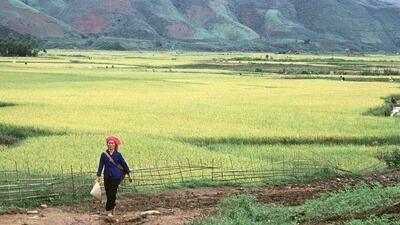
"In Vietnam, the traumatised are considered to be possessed by ghosts." When Vietnamese writer Nguyen Phan Que Mai says this, she is not telling a spooky fairy tale, but describing how her nation continues to be haunted by its harrowing past. "So much of Vietnam's history is trauma," she says. "In my culture, people bury the pain of the past. I have an uncle who refuses to tell me anything. Once people begin to talk about it, they know it is healing."
Que Mai, 47, it is no exaggeration to say, has devoted her life to searching for words to heal anyone possessed by trauma. In collaboration with development agencies and humanitarian organisations, she has worked on projects involving sustainable development and gender. In her current home of Jakarta, she runs creative writing workshops for Afghan refugees.
These political and social concerns are amplified by her journalism, which covers everything from environmental issues to children’s rights, corruption and the abuse of migrant workers. As a poet, Que Mai draws on more personal memories and experiences. She sends me a poem about finding the unmarked grave of her grandmother who died 75 years ago during the Great Vietnamese Famine. “I heard my father call ‘Mum,’ for the first time; the rice field behind his back trembled,” the poem reads.

Now Que Mai has published a highly praised first novel, The Mountains Sing. Its epic scope attempts to narrate Vietnam's century of suffering, division and violence: colonisation, occupation during the Second World War, partition and civil strife, famine, land reforms and war again against France and the US.
But the more Que Mai talks about her life and family, the more I realise how inextricably linked Vietnam's history is with its people. Her own childhood was shaped by aftershocks of the Vietnam War. "I grew up witnessing the fact that my village was emptied of men," she says. Almost as vivid as this absence was the presence of women waiting, day after day, for these men to return. "They would look at the road leading to town. As a child playing kite, I would notice these women, with hair getting white, their backs bending." The few men who did come home were often missing limbs. For many women, the wait never ended.
When Que Mai was 6, her family relocated to then South Vietnam, where the land was more fertile; her parents combined teaching and farming. “On that train ride I saw so many bomb craters,” she says. “The rice had grown around them. Arriving in the South I saw women waiting again. I witnessed the pain of both North and South. I wanted to write a book that placed the Vietnamese people in the centre.”

Implicit here is a pointed reminder of how much of Vietnam's modern history remains untold, distorted or appropriated by others. Some of the most famous examples – Oscar-winning movies such as Oliver Stone's Platoon, lauded documentaries such as Ken Burns's The Vietnam War and novels such as Tim O'Brien's The Things They Carried – narrate the experience of American soldiers at the expense of Vietnam's people.
The Mountains Sing redresses this imbalance in many ways. Que Mai's decision to write in English rather than Vietnamese was precisely intended to "usurp the coloniser," as she puts it. So was her decision to put Vietnamese women in the foreground. "Thousands of books have been written about the war. How many times have Vietnamese women appeared as victims, as powerless, as naive, as opportunistic? As prostitutes?"
All three of Que Mai’s heroines – Grandmother Dieu Lan, her daughter Hoang and granddaughter Huong – display great courage, but it is expressed in patience, intelligence, adaptability, forgiveness and, above all, redemption. This understated heroism serves another of Que Mai’s purposes. “I wanted to represent Vietnam as a country and not just a war,” she says. “Normally it’s the trauma experienced by soldiers which is written about, often by soldiers themselves. I wanted to demonstrate the impact of war on women, on civilians. When a country is at war, citizens are just leaves to be swept away.”
Nevertheless, Que Mai says similar acts of historical misrepresentation have also been perpetrated within Vietnam. She has read countless studies about rehabilitating traumatised American soldiers, but found only one comparable project inside Vietnam. "I have talked to Vietnamese soldiers who told me there were a lot of suicides. They were not allowed to speak about that," she says. "The official belief was that there was no trauma. We won the war. This war was righteous."

One casualty of this denial was Bao Ninh's The Sorrow of War, arguably the classic Vietnamese account of the conflict, which was banned in its own country. It was eventually published, after becoming an international hit in translation. "The title was changed to The Fate of Love instead of The Sorrow of War because there is a love story," Que Mai says. The original title has now been reinstated.
The Mountains Sing dramatises even more unfamiliar episodes: for example, the Great Famine, which killed an estimated million people after the Second World War, and very nearly destroyed Que Mai's entire family. "We lost my grandma, her youngest son and her brother. The village had already lost so many people that there wasn't anyone to bury them."
The only survivors were Que Mai's 6-year-old father and his younger sister; their father was fighting the French with Ho Chi Minh's Viet Minh. Que Mai is certain both children would have died if her grandfather had not made a momentous decision at great personal cost. "When he heard his wife had died, he left the Viet Minh and came home. Because he did this, my father could survive, but my grandfather was blacklisted." Que Mai's father was prohibited from going to high school, a decision that was later reversed after her grandfather begged for forgiveness.
This story, which effectively saved Que Mai's life, casts a long shadow across The Mountains Sing, helping to shape a plot that dramatises Vietnam's history as a series of impossible choices.
The most heartbreaking being Grandmother Dieu Lan’s dilemma to give up her children or watch them starve during the land reforms that began in 1955. This enforced land redistribution was the one event her uncle did not forget after developing Alzheimer’s. “What happened to him and his family – his father was killed – was so horrible it was the only thing he remembered,” she says.
Que Mai is close to finishing a second novel, about “Amerasian” children fathered by American soldiers during the Vietnam War. For her, it is a war that in many ways has never ended. People continue to be killed by unexploded bombs dropped decades before by American B-52s, and die because of Agent Orange – the chemical defoliant sprayed to clear jungles and destroy crops has left an estimated three million Vietnamese with serious health problems. “I wish American companies who produced Agent Orange would take responsibility,” she says.
Does she ever feel anger towards the US? “Absolutely,” she says. “And fear and resentment.” On her first visit to Washington, her husband took her to the Vietnam War Memorial. “I refused to go in. I told him I would not honour the American soldiers who had trampled on my country. There is not a memorial big enough for the names of the Vietnamese, Cambodians and Laotians who perished.” Eventually and reluctantly, Que Mai relented. She read a letter placed on the memorial, written by a (now adult) child of an American soldier killed in the war. “He told him about his granddaughter, and asked why he had to go to Vietnam. For the first time I learnt about the humanity of the other side. I broke down and cried.”
This lesson in empathy underpins some of the most moving encounters in The Mountain Sings: the supposed Japanese sympathiser who saves the Dieu Lan children; the American soldier who refuses to shoot Grandmother Dieu Lan's son, Dat.
For Que Mai herself, the revelation reinforced a lifetime’s hatred of war and fired her desire to find peace.
“Growing up I saw people disabled from the American war, losing their lives in wars against China and Cambodia. I looked at the bomb craters and believed the human race wouldn’t be so stupid as to wage another war on earth. I am still so angry because we refuse to see the other side.”

