'Corruption and negligence': New book uncovers past Beirut port explosions


  • English
  • Arabic

With the fifth anniversary of Beirut’s 2020 port explosion on Monday, one might expect to see memorials and other acts of remembrance across the city, but many in Lebanon are simply trying to move on.

Between the continuing economic crisis, regional conflicts and political inaction, the outrage over the Beirut blast and public demands for justice have grown quieter and quieter. The official investigation remains unfinished, and many remain sceptical that those responsible will ever be held to account.

Complicating matters further is the fact that Lebanon lacks a reliable public record. Archives are poorly maintained, if they are kept at all.
Illuminating and solidifying forgotten heritage has long been a great passion for artist, author and amateur historian Eddy Choueiry, who has brought together his academic background in philosophy and psychology with a quietly patriotic love for the legacy of Lebanon.

In the wake of the August 4 blast, however, his creative practice took on a new meaning, unpicking a disaster years in the making. Half a decade later, he plans to present the findings of his research, first in a public lecture hosted by Assabil Public Library in Beirut, and later in a soon-to-release book.

A brochure commemorates the laying of the first stone of the silos on September 16, 1968, by Lebanese President Charles Helou. Photo: Gestion et Exploitation du Port de Beyrouth

“After the explosion, my target was to make a book to represent what we call in French a travail de deuil, or work of mourning,” Choueiry tells The National. “It's a mourning process and, as is usual with this process, I wanted to do it through art, culture and heritage, so I started the book one week after the blast.”

The history of the Port of Beirut stretches back to the Ottoman Empire, which, in 1887, put control of the port into the hands of the French company Compagnie du Port, des quais et des Entrepots de Beyrouth. The Port of Beirut quickly grew to become a key shipping centre for the region, continuing to expand during the French Mandate thanks to greater funding and trade from France, even after Lebanon became an independent nation in 1943. In 1960, the company was renamed the Gestion et Exploitation du Port de Beyrouth.

President Charles Helou and Emir of Kuwait Sheikh Sabah participate in the foundation stone-laying in 1968. Photo: Gabriel Assioun

Unfortunately, the Port of Beirut also earned a reputation for corruption and smuggling. Abandoned crew and cargo were also common occurrences, as was the case with the MV Rhosus, the Moldovan ship which, in 2013, delivered 2,750 tonnes of ammonium nitrate that caused the 2020 blast.

Many of the records of the port were destroyed by the explosion, but Choueiry managed to uncover a trove of physical documents kept in the Gestion et Exploitation du Port de Beyrouth offices. It took four years just to go through all the files, which include letters, photographs, maps, contracts and even newspaper articles.

“The old archives of the harbour had been saved – although still damaged – because they were in a closet,” says Choueiry. “I discovered a lot of documents, so I limited my research to the Ottoman period, the French Mandate period, and then – after our independence – the construction of the silos.”

Plans for the expansion of the Port of Beirut throughout the 1960s. Photo: Gestion et Exploitation du Port e Beyrouth

Unbeknownst to most in Lebanon, the 2020 explosion at the port of Beirut, although the most devastating, was not the first such blast. In fact, three other explosions had taken place, in 1919, 1928 and 1934. In the case of the first two events, only one fatality was reported from each incident. In the case of the third, 20 people were killed and 14 were injured.

The 1934 case stands out in particular in eerie similarity to the events of 2020. Back then, Warehouse S was used to store hazardous and explosive materials – including gunpowder and TNT – under restricted access but, due to limited space, this holding area had also started to be used for other goods, including flammable textiles and foodstuffs. Questions were also raised regarding the collapse of Warehouse S’s roof and the failure of the sprinkler system to prevent fire from spreading through the building following the explosion. Ultimately, no responsible party was ever identified, and the damaged site was built over.

“The authorities launched an inquiry into the cause of that explosion,” Choueiry explains, “but it led nowhere. Even at the time, it was predicted [in the local press] that it would lead nowhere, as with the two previous port explosions that happened in 1919 and 1928; that the third – 1934 – was going to be the same, without consequences.”

The Amadeo, which was moored next to Warehouse 9, was damaged on the day of the Beirut Port blast in 2020. Photo: Eddy Choueiry

Despite the recurring historical pattern of worsening accidents caused by the improper storage and handling of hazardous materials at the port, no lessons were seemingly learnt. When the new grain silos were completed and put into operation in 1970, the port authorities designated Warehouse 12 – the eventual epicentre of the 2020 explosion – as the holding area for such materials; a building almost directly co-located with the silos.

“This is crazy,” says Choueiry. “The silos stocked grain and wheat for the whole of Lebanon. Who could imagine putting this warehouse in front of the silos? There is no excuse in 2020 that nobody knew about the importance of nitrate, and how it's so dangerous. They are not doing their jobs as they should. It's negligence.”

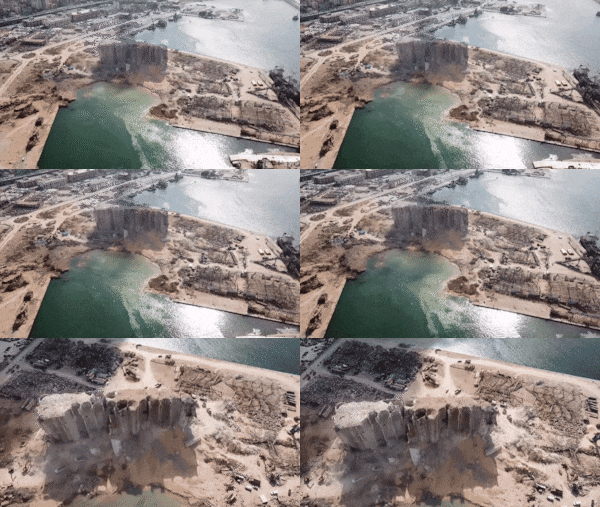
Today, the remains of the damaged silos stand over the Port of Beirut as a scarred reminder of the latest tragedy to befall the harbour, but ensuring that it will be the last requires that Lebanon change its relationship with its complex and often painful past. Through this “mourning work”, Choueiry and those like him are attempting to put Lebanon’s ephemeral history into concrete forms that will persist and provide clarity for future generations, in the hope that this cycle of abuse, impunity and failure can finally be broken for good.

“We shouldn't forget this injustice that happened to Beirut and to Lebanon,” says Choueiry. “We are crossing our fingers with the 2020 explosion that – if we are fortunate – we will have answers. God knows how long it's going to take, to tell the truth about what really happened.”

“If you put yourself face-to-face with catastrophe, it's going to be an eternal trauma,” he continues. “But, if you try to make enough of it into something related to your identity, to your culture, now you are making something fruitful.”


Abu Dhabi GP schedule

Friday: First practice - 1pm; Second practice - 5pm

Saturday: Final practice - 2pm; Qualifying - 5pm

Sunday: Etihad Airways Abu Dhabi Grand Prix (55 laps) - 5.10pm

What%20is%20cystic%20fibrosis%3F
%3Cul%3E%0A%3Cli%3ECystic%20fibrosis%20is%20a%20genetic%20disorder%20that%20affects%20the%20lungs%2C%20pancreas%20and%20other%20organs.%3C%2Fli%3E%0A%3Cli%3EIt%20causes%20the%20production%20of%20thick%2C%20sticky%20mucus%20that%20can%20clog%20the%20airways%20and%20lead%20to%20severe%20respiratory%20and%20digestive%20problems.%3C%2Fli%3E%0A%3Cli%3EPatients%20with%20the%20condition%20are%20prone%20to%20lung%20infections%20and%20often%20suffer%20from%20chronic%20coughing%2C%20wheezing%20and%20shortness%20of%20breath.%3C%2Fli%3E%0A%3Cli%3ELife%20expectancy%20for%20sufferers%20of%20cystic%20fibrosis%20is%20now%20around%2050%20years.%3C%2Fli%3E%0A%3C%2Ful%3E%0A
TEAMS

EUROPE:
Justin Rose, Francesco Molinari, Tyrrell Hatton, Tommy Fleetwood, Jon Rahm, Rory McIlroy, Alex Noren, Thorbjorn Olesen, Paul Casey, Sergio Garcia, Ian Poulter, Henrik Stenson

USA:
Brooks Koepka, Justin Thomas, Dustin Johnson, Patrick Reed, Bubba Watson, Jordan Spieth,​​​​​​​ Rickie Fowler, Webb Simpson, Tiger Woods, Phil Mickelson, Bryson DeChambeau ( 1 TBC)

STAGE 4 RESULTS

1 Sam Bennett (IRL) Deceuninck-QuickStep - 4:51:51

2 David Dekker (NED) Team Jumbo-Visma

3 Caleb Ewan (AUS) Lotto Soudal 

4 Elia Viviani (ITA) Cofidis

5 Matteo Moschetti (ITA) Trek-Segafredo

General Classification

1 Tadej Pogacar (SLO) UAE Team Emirates - 12:50:21

2 Adam Yates (GBR) Teamn Ineos Grenadiers - 0:00:43

3 Joao Almeida (POR) Deceuninck-QuickStep - 0:01:03

4 Chris Harper (AUS) Jumbo-Visma - 0:01:43

5 Neilson Powless (USA) EF Education-Nippo - 0:01:45

THE BIO

Ms Al Ameri likes the variety of her job, and the daily environmental challenges she is presented with.

Regular contact with wildlife is the most appealing part of her role at the Environment Agency Abu Dhabi.

She loves to explore new destinations and lives by her motto of being a voice in the world, and not an echo.

She is the youngest of three children, and has a brother and sister.

Her favourite book, Moby Dick by Herman Melville helped inspire her towards a career exploring  the natural world.

Mercer, the investment consulting arm of US services company Marsh & McLennan, expects its wealth division to at least double its assets under management (AUM) in the Middle East as wealth in the region continues to grow despite economic headwinds, a company official said.

Mercer Wealth, which globally has $160 billion in AUM, plans to boost its AUM in the region to $2-$3bn in the next 2-3 years from the present $1bn, said Yasir AbuShaban, a Dubai-based principal with Mercer Wealth.

Within the next two to three years, we are looking at reaching $2 to $3 billion as a conservative estimate and we do see an opportunity to do so,” said Mr AbuShaban.

Mercer does not directly make investments, but allocates clients’ money they have discretion to, to professional asset managers. They also provide advice to clients.

“We have buying power. We can negotiate on their (client’s) behalf with asset managers to provide them lower fees than they otherwise would have to get on their own,” he added.

Mercer Wealth’s clients include sovereign wealth funds, family offices, and insurance companies among others.

From its office in Dubai, Mercer also looks after Africa, India and Turkey, where they also see opportunity for growth.

Wealth creation in Middle East and Africa (MEA) grew 8.5 per cent to $8.1 trillion last year from $7.5tn in 2015, higher than last year’s global average of 6 per cent and the second-highest growth in a region after Asia-Pacific which grew 9.9 per cent, according to consultancy Boston Consulting Group (BCG). In the region, where wealth grew just 1.9 per cent in 2015 compared with 2014, a pickup in oil prices has helped in wealth generation.

BCG is forecasting MEA wealth will rise to $12tn by 2021, growing at an annual average of 8 per cent.

Drivers of wealth generation in the region will be split evenly between new wealth creation and growth of performance of existing assets, according to BCG.

Another general trend in the region is clients’ looking for a comprehensive approach to investing, according to Mr AbuShaban.

“Institutional investors or some of the families are seeing a slowdown in the available capital they have to invest and in that sense they are looking at optimizing the way they manage their portfolios and making sure they are not investing haphazardly and different parts of their investment are working together,” said Mr AbuShaban.

Some clients also have a higher appetite for risk, given the low interest-rate environment that does not provide enough yield for some institutional investors. These clients are keen to invest in illiquid assets, such as private equity and infrastructure.

“What we have seen is a desire for higher returns in what has been a low-return environment specifically in various fixed income or bonds,” he said.

“In this environment, we have seen a de facto increase in the risk that clients are taking in things like illiquid investments, private equity investments, infrastructure and private debt, those kind of investments were higher illiquidity results in incrementally higher returns.”

The Abu Dhabi Investment Authority, one of the largest sovereign wealth funds, said in its 2016 report that has gradually increased its exposure in direct private equity and private credit transactions, mainly in Asian markets and especially in China and India. The authority’s private equity department focused on structured equities owing to “their defensive characteristics.”

Updated: July 31, 2025, 7:27 AM