Beirut is the setting for Najwa Barakat's new novel 'Mister N'. Piotr Chrobot / Unsplash

'Mister N' review: a complex novel set in Beirut with a jaw-dropping reveal


  • English
  • Arabic

Early into Najwa Barakat’s novel Mister N, the eponymous protagonist, a former author, ponders the origins of a phrase. “Whose line is that?” he asks himself. “I’m pretty sure it’s not mine — I’m not a writer anymore — but where did it come from? There’s a cloud in my head.”

This explains why Mr N’s narrative is made up of cloudy thoughts, nebulous ideas and hazy recollections. What isn’t clear is how his mindset got to be so muddled, and how much of his story is a figment of his feverish imagination.

Barakat, in her latest novel, published by And Other Stories, plays an elaborate guessing game with her reader while simultaneously creating a psychological profile of a man undone by trauma and mapping a bustling city ravaged by violence.

From the outset we learn that Mr N is a man with very specific habits and tastes. He is a stickler for precision. He favours pencils over pens (“Ink behaved like a dictator: ordering, forbidding, controlling, brooking no dissent. Lead, meanwhile was merciful, quick to forgive mistakes”). He hates going out. And he is resistant to change.

'Mister N' by Najwa Barakat is an enthralling novel that skilfully explores identity, insanity and the power of words. Photo: And Other Stories

But lately Mr N has managed to embrace change by leaving his beloved Beirut apartment and checking into a hotel — or what he believes is a hotel. He cannot remember why he moved (or, for that matter, what month it is) but he has adjusted to his new living quarters and is grateful to the attentive “manager” Mr Andrew and to kind Miss Zahra who routinely drops by to examine him.

Mr N hasn’t read or written anything for some time because whenever he has tried to focus, he has found that “letters would separate from each other to make space for squirming, ugly little intruders that robbed the words of their meaning”. There have also been distractions in the form of quarrelling neighbours, unwanted dinner invitations and an unexpected visit from his brother.

Events take a murky turn when Mr N ventures out into the hotel garden one night. He wanders farther afield and spies a ruthless war criminal called Luqman lurking in the doorway of an internet cafe — not one of his old adversaries but rather a character from one of his novels. Does Luqman pose a concrete threat or is Mr N his own worst enemy?

Beirut-born Barakat has written an intricate and enthralling novel that skilfully explores identity, insanity, the power of words and the nature of reality. People and places are vividly rendered. Her native city comes alive when she allows her title character to take leave of his “little circle of light” and lose himself in districts scarred by poverty and brutality.

Lebanese author Najwa Barakat plays an elaborate guessing game with her reader. Getty Images

When Mr N isn’t roaming streets and alleys — “labyrinths of the marginalised, the accursed, and the poor” — and recording their sights and sounds, he is taking trips down memory lane and sifting through agonising episodes from his early years. He tells of his father, a doctor whose demons drove him over the edge, and his mother who, having hoped for a daughter, didn’t hide her disappointment and didn’t show him love.

“Thurayya treated me as though I were an intruder in her life,” he reveals. “And I treated myself as though I were an intruder upon life itself.” Unsurprisingly, he grew up “a child of the corners, the shadows, the silent, shameful hiding places”.

All of which seems focused and clear-cut. And yet we never lose sight of the fact that Mr N is a deeply unreliable narrator given to paranoia, nightmares and delusions. Again and again he wrongfoots us by overlapping past and present and merging reality with fiction. We start to question what we are reading. Is he writing a new novel or recounting his life story? Was he a witness to a suicide or in fact an accomplice in a murder? And is there method in his madness?

Towards the end of the book, Barakat offers answers by way of a horrific act — only to throw us once again on the final page with a jaw-dropping, game-changing reveal.

Her novel is a complex one that at times proves disorientating. However, it pays huge dividends to those who surrender to the chaos, absurdity and confusion that constitute Mr N’s world.

Berlin art show probes Beirut’s fabled Golden Age — in pictures

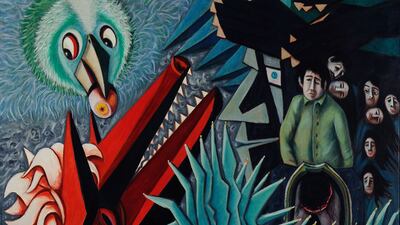
  • This artwork, Aref El Rayess, 'Untitled', 1977 to 1978, is part of Beirut and The Golden Sixties: A Manifesto of Fragility, an exhibition continuing at Berlin’s Gropius Bau. Photo: courtesy Saradar Collection, The Estate of Aref El Rayess
    This artwork, Aref El Rayess, 'Untitled', 1977 to 1978, is part of Beirut and The Golden Sixties: A Manifesto of Fragility, an exhibition continuing at Berlin’s Gropius Bau. Photo: courtesy Saradar Collection, The Estate of Aref El Rayess
  • Juliana Seraphim, 'Untitled', 1979. Oil on Canvas, 80 x 100 cm. Photo: courtesy of Saleh Barakat Collection
    Juliana Seraphim, 'Untitled', 1979. Oil on Canvas, 80 x 100 cm. Photo: courtesy of Saleh Barakat Collection
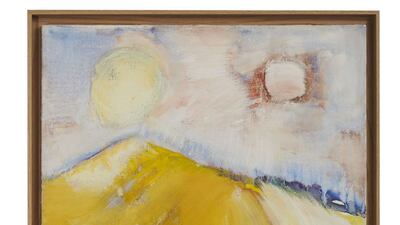
  • Etel Adnan and Simone Fattal, 'La Montagne Liban', 1971. Oil on canvas, 54 x 64 x 2.5cm. Photo: courtesy of Barjeel Art Foundation
    Etel Adnan and Simone Fattal, 'La Montagne Liban', 1971. Oil on canvas, 54 x 64 x 2.5cm. Photo: courtesy of Barjeel Art Foundation
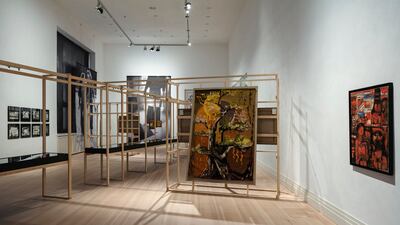
  • Beirut and the Golden Sixties A Manifesto of Fragility, Installation view, Gropius Bau, Berlin. Photo by Luca Girardini
    Beirut and the Golden Sixties A Manifesto of Fragility, Installation view, Gropius Bau, Berlin. Photo by Luca Girardini
  • Nicolas Moufarrege, 'The Blood of the Phoenix', 1975. Thread and pigment on needlepoint canvas. Photo: courtesy of N3M Holdings
    Nicolas Moufarrege, 'The Blood of the Phoenix', 1975. Thread and pigment on needlepoint canvas. Photo: courtesy of N3M Holdings
  • Khalil Zgaib, 'Untitled', 1958. Oil on masonite board, 60 x 100cm. Photo: courtesy Saleh Barkat Collection
    Khalil Zgaib, 'Untitled', 1958. Oil on masonite board, 60 x 100cm. Photo: courtesy Saleh Barkat Collection
  • From the series Civil War Diary 1975-1976 by Jamil Molaeb. Photo: courtesy Saradar Collection
    From the series Civil War Diary 1975-1976 by Jamil Molaeb. Photo: courtesy Saradar Collection
Who was Alfred Nobel?

The Nobel Prize was created by wealthy Swedish chemist and entrepreneur Alfred Nobel.

  • In his will he dictated that the bulk of his estate should be used to fund "prizes to those who, during the preceding year, have conferred the greatest benefit to humankind".
  • Nobel is best known as the inventor of dynamite, but also wrote poetry and drama and could speak Russian, French, English and German by the age of 17. The five original prize categories reflect the interests closest to his heart.
  • Nobel died in 1896 but it took until 1901, following a legal battle over his will, before the first prizes were awarded.
Ten tax points to be aware of in 2026

1. Domestic VAT refund amendments: request your refund within five years

If a business does not apply for the refund on time, they lose their credit.

2. E-invoicing in the UAE

Businesses should continue preparing for the implementation of e-invoicing in the UAE, with 2026 a preparation and transition period ahead of phased mandatory adoption. 

3. More tax audits

Tax authorities are increasingly using data already available across multiple filings to identify audit risks. 

4. More beneficial VAT and excise tax penalty regime

Tax disputes are expected to become more frequent and more structured, with clearer administrative objection and appeal processes. The UAE has adopted a new penalty regime for VAT and excise disputes, which now mirrors the penalty regime for corporate tax.

5. Greater emphasis on statutory audit

There is a greater need for the accuracy of financial statements. The International Financial Reporting Standards standards need to be strictly adhered to and, as a result, the quality of the audits will need to increase.

6. Further transfer pricing enforcement

Transfer pricing enforcement, which refers to the practice of establishing prices for internal transactions between related entities, is expected to broaden in scope. The UAE will shortly open the possibility to negotiate advance pricing agreements, or essentially rulings for transfer pricing purposes. 

7. Limited time periods for audits

Recent amendments also introduce a default five-year limitation period for tax audits and assessments, subject to specific statutory exceptions. While the standard audit and assessment period is five years, this may be extended to up to 15 years in cases involving fraud or tax evasion. 

8. Pillar 2 implementation 

Many multinational groups will begin to feel the practical effect of the Domestic Minimum Top-Up Tax (DMTT), the UAE's implementation of the OECD’s global minimum tax under Pillar 2. While the rules apply for financial years starting on or after January 1, 2025, it is 2026 that marks the transition to an operational phase.

9. Reduced compliance obligations for imported goods and services

Businesses that apply the reverse-charge mechanism for VAT purposes in the UAE may benefit from reduced compliance obligations. 

10. Substance and CbC reporting focus

Tax authorities are expected to continue strengthening the enforcement of economic substance and Country-by-Country (CbC) reporting frameworks. In the UAE, these regimes are increasingly being used as risk-assessment tools, providing tax authorities with a comprehensive view of multinational groups’ global footprints and enabling them to assess whether profits are aligned with real economic activity. 

Contributed by Thomas Vanhee and Hend Rashwan, Aurifer

What can victims do?

Always use only regulated platforms

Stop all transactions and communication on suspicion

Save all evidence (screenshots, chat logs, transaction IDs)

Report to local authorities

Warn others to prevent further harm

Courtesy: Crystal Intelligence

The burning issue

The internal combustion engine is facing a watershed moment – major manufacturer Volvo is to stop producing petroleum-powered vehicles by 2021 and countries in Europe, including the UK, have vowed to ban their sale before 2040. The National takes a look at the story of one of the most successful technologies of the last 100 years and how it has impacted life in the UAE.

Read part three: the age of the electric vehicle begins

Read part two: how climate change drove the race for an alternative 

Read part one: how cars came to the UAE

The Vile

Starring: Bdoor Mohammad, Jasem Alkharraz, Iman Tarik, Sarah Taibah

Director: Majid Al Ansari

Rating: 4/5

UAE currency: the story behind the money in your pockets
Tips to keep your car cool
  • Place a sun reflector in your windshield when not driving
  • Park in shaded or covered areas
  • Add tint to windows
  • Wrap your car to change the exterior colour
  • Pick light interiors - choose colours such as beige and cream for seats and dashboard furniture
  • Avoid leather interiors as these absorb more heat
Updated: June 13, 2022, 11:34 AM